
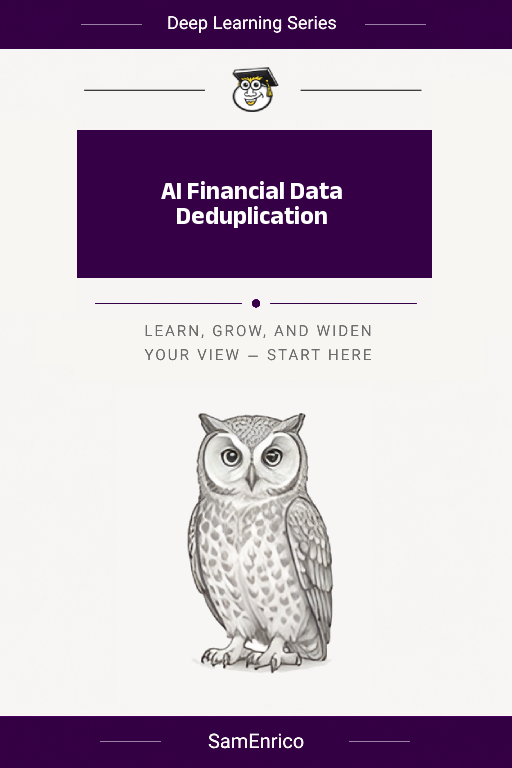
Non-FictionAI OperatorDeduplication
AI Financial Data Deduplication eBook
Identify and merge duplicate transactions, custome
by Bivens Rhoda
Identify and merge duplicate transactions, customers, and vendors using AI that learns matching rules.
Formats
Free sample
Chapter 1: The Million-Dollar Typo--–- The email arrived at 4:47 PM on a Friday, which should have been the first warning sign. Sarah Chen, the finance director of a mid-sized logistics company called Trans Global Freight, had been working late to close the monthly books. The email was from her CFO, subject line: "Question about Wire #40291." She opened it, read the three sentences, and felt her stomach drop.The company had paid 347,000toavendorcalled"Coastal Logistics Group"on Tuesday.Ithadpaidthesamevendoranother347,000 to a vendor called "Coastal Logistics Group" on Tuesday. It had paid the same vendor another 347,000toavendorcalled"Coastal Logistics Group"on Tuesday.Ithadpaidthesamevendoranother347,000 on Thursday. Two separate wires.
Two separate approvals. Two separate entries in the general ledger. The same invoice number. The same due date. The same service description.
The CFO had spotted the discrepancy while reviewing the preliminary cash flow statement, which showed an unexplained $347,000 outflow that did not match any budget line.Sarah pulled up the vendor master file. There it was, plain as day: two records for Coastal Logistics Group. One had been created in 2019 when the company first onboarded the vendor. The second had been created in 2021 by an intern who could not find the existing record because she typed "Coastal Logistics" while the original record said "Coastal Logistics Group." Same tax ID. Same address.
Same banking information. Two records. Two wires. One mistake.The intern had been trying to help. She had been told to set up any missing vendors before processing a new contract.
She searched for "Coastal Logistics," found nothing, and clicked "Create New." The system did not warn her about the near match because the system only flagged exact matches. Two years later, that well-intentioned click had cost the company $347,000.Trans Global Freight eventually recovered the duplicate payment after six weeks of emails, phone calls, and legal threats. The vendor, which had already spent the money on fleet upgrades, agreed to a repayment plan of 50,000permonth.Thecompany′scashflowstatementshoweda50,000 per month. The company's cash flow statement showed a 50,000permonth.Thecompany′scashflowstatementshoweda347,000 receivable for six months. Its credit line was maxed out to cover the gap.
Its relationship with the vendor, once cordial, became adversarial.Sarah Chen did not lose her job, but she came close. The CFO implemented a new policy requiring manual vendor validation before any wire over $100,000. That policy added forty-five minutes to every major payment. The finance team hated it. The vendors hated waiting.
The business hated the friction.All because of a typo. All because of a duplicate.The Hidden Epidemic Sarah's story is not a cautionary tale about an incompetent intern. It is a story about a systemic failure that affects every organization that processes financial data. The specifics change—different company, different dollar amount, different vendor—but the pattern is universal. Duplicate records are created continuously, invisibly, and inevitability.
They accumulate like sediment in a river delta, gradually redirecting the flow of accurate information until the entire financial system is warped.Let me be direct with you: if your organization has been operating for more than three years, you have a duplication problem. It does not matter if you use best-in-class enterprise software. It does not matter if you have a dedicated data governance team. It does not matter if your CFO personally reviews every journal entry. The laws of information entropy guarantee that duplicates will emerge wherever humans enter data, systems integrate, or time passes.The only question is how much this problem is costing you.
And the answer, almost always, is far more than you think.The Three Faces of Duplication Duplication in financial systems manifests in three distinct forms, each with its own causes, consequences, and cures. Understanding these three forms is the foundation of everything that follows in this book.Transaction Duplicates The first and most voluminous form is transaction duplicates. These occur when the same logical financial event is recorded multiple times in your transaction logs. A customer clicks "pay now" twice because the website lagged. A point-of-sale system temporarily goes offline and retransmits the same batch of sales.
A bank feed imports the same transaction on the first and fifteenth of the month because the date field was formatted differently. A high-frequency trading system records the same trade on two different exchanges because of a race condition in the matching engine.Transaction duplicates are characterized by their volume and their subtlety. A single duplicate transaction might be impossible to detect with the naked eye. But a 1 percent duplication rate on a system that processes 10 million transactions per month means 100,000 errors per month. Each error might be small—a 4.95coffee,a4.95 coffee, a 4.95coffee,a29.99 subscription, a $347 wire transfer.
But aggregated across a year, across a business, across an industry, the numbers become staggering.The financial services industry processes approximately 500 billion electronic transactions per year in the United States alone. If even one-tenth of one percent of those transactions are duplicates, that is 500 million errors. If the average duplicate value is 50,thatis50, that is 50,thatis25 billion in misallocated funds annually. Your share of that $25 billion is larger than you think.Customer Duplicates The second form is customer duplicates. These occur when the same individual or organization is represented by multiple records in your customer master data.
A customer named "Robert Johnson" applies for a credit card online and becomes "R. Johnson" in your CRM. He calls support and becomes "Bob Johnson" in your ticketing system. He opens a savings account and becomes "Robert M. Johnson" in your core banking platform.
He updates his address through a mobile app and becomes "Rob Johnson" in your marketing automation system.Four records. Four different names. Four different email formats. Four different phone number conventions. One human being.Customer duplicates create three distinct harms.
First, they fragment your relationship with the customer. You send four different marketing messages, open four different support tickets, and track four different balances. The customer experiences your organization as disjointed and incompetent. Second, they inflate your metrics. You believe you have four customers when you have one.
Your customer count, lifetime value, and churn rate are all wrong. Third, they create compliance risk. If one record is flagged for a sanction screening and another is not, you might transact with a prohibited person without knowing it.Vendor Duplicates The third form is vendor duplicates. These occur when the same supplier is represented by multiple records in your accounts payable system. This is the form that nearly cost Sarah Chen her job.
A vendor named "International Components Supply Corporation" becomes "Intl Components Supply" in one record, "ICS Corp" in another, and "International Components Supply (Legacy)" in a third. A procurement specialist creates a fourth record for "I.C.S. Corporation" because none of the existing names exactly match the new W-9 form.Vendor duplicates are the most expensive form of duplication per incident. While transaction duplicates tend to be small in individual value, vendor duplicates often involve large contract values, recurring payments, and complex billing relationships. A duplicate vendor record can lead to duplicate purchase orders, duplicate invoices, duplicate payments, and duplicate tax reporting.
The cost of a single vendor duplicate can exceed $1 million, as Sarah Chen learned.Vendor duplicates also create the most…
This is the end of the free sample. Get the eBook to keep going. Buy now
About this book
Details
- Author
- Bivens Rhoda
- Publisher
- SamEnrico
- Language
- English
- Genre
- Non-Fiction, AI Operator, Deduplication
- Released
- 2026-05-30
- Pages (approx.)
- 143
- Available as
- eBook, Audiobook

Read better in the ZLOADR app
Your eBooks on your phone or tablet. Sign in with your SamEnrico account and start reading.
More by Bivens Rhoda
 Management Buyout Modeling GuideBivens Rhoda$11.99
 Open World Game Exhaustion CourseBivens Rhoda$11.99
 LBO No Fault Divorce GuideBivens Rhoda$11.99
 Bariatric Surgery Alcohol Risk HandbookBivens Rhoda$11.99
 Gluten Free Athlete Performance GuideBivens Rhoda$11.99
 The Unseen Hand: How a 19th-Century Lawyer Secretly Shaped Modern DemocracyBivens Rhoda$11.99
 The Silk Road to the Stars: Ancient Astronomy in the HimalayasBivens Rhoda$11.99
 Understanding Ccge SyndromeBivens Rhoda$17.99
 Community Engaged ProposalBivens Rhoda$12.99
 Energy AuditingBivens Rhoda$11.99
 How to Become a Inseam TrimmerBivens Rhoda$11.99
You may also like
 Hong Kong Handover 1997Dunn Johnnie$11.99
 Zumba For Postnatal Recovery CourseNeal Christian$11.99
 Zumba for BeginnersLadner Nikia$11.99
 YouTube Comment Mining GuideHumes Pandora$12.99
 Worry Box MeditationCarlin Rudy$11.99
 Workplace Stress MeditationNguyen Lynn$11.99
 Workplace Stress and Sleep RepairHawley Ivory$11.99
 Workplace Perfectionism CureDelaney Jeffry$11.99
 Workplace Injustice Anger GuideWallen Isabelle$11.99
 Work Addiction and Burnout LinkGreenwood Ester$11.99
 Women in Yoga and WellnessBeattie Galina$11.99
 Women in Stand Up ComedyChun Evangeline$11.99