
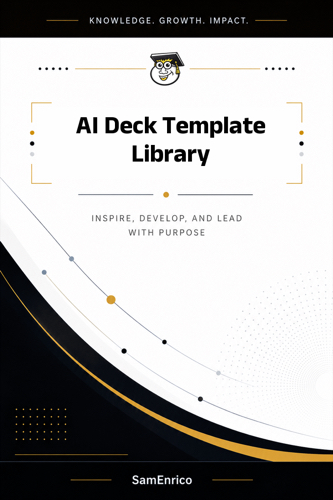
AI Deck Template Library eBook
Build and manage reusable AI prompt templates for
Build and manage reusable AI prompt templates for consistent decks.
Formats
Free sample
Chapter 1: The Midnight Deck...--–- Marcus Chen, a senior strategy consultant at a global firm, stared at his screen for the forty-seventh time that evening. The cursor blinked mockingly on an empty slide—Slide 27 of what was supposed to be a crisp 15-slide board deck for a fintech client. It was 1:47 AM. His third coffee had gone cold two hours ago. The client had moved the deadline up by a week.
The junior associate had used "some AI thing" to generate an initial draft, but the draft was terrible: wrong tone, made-up numbers, a slide that compared the client to a competitor it actually admired, and a bizarre section about "synergistic paradigm shifts" that belonged in a bad MBA essay. Marcus had started over from scratch. Not because the AI was useless, but because nobody had taught anyone how to use it right.He was not alone. Across the city, a marketing director named Sarah was rebuilding a quarterly business review deck after her AI assistant produced 47 slides of generic fluff. In another time zone, a startup founder had just canceled a pitch meeting because the deck she asked Chat GPT to make "looked like everyone else's." And in a corporate headquarters, a finance VP had spent six hours fact-checking an AI-generated earnings slide—only to find two hallucinations buried in the footnotes.This is the hidden cost of the blank slide.
It is not the cost of the tool—Chat GPT, Claude, Gemini, and their competitors are remarkably cheap. It is not even the cost of the time spent typing prompts. It is the cost of prompt chaos: the inconsistent, unrepeatable, and untested way most professionals currently interact with artificial intelligence.What Is Prompt Chaos?Prompt chaos is the silent productivity killer of the AI era. It manifests in four specific ways.First, inconsistency. The same person asks the same AI the same question on two different days and gets two completely different answers—one useful, one useless.
Without a structured template, every interaction is a roll of the dice.Second, unrepeatability. A junior associate discovers a brilliant prompt that generates a perfect competitive analysis slide. She emails it to a colleague. The colleague loses the email. The prompt is never seen again.
The organization learns nothing.Third, untested output. Someone types "Make me a deck about Q3 earnings" into Chat GPT, copies the result directly into Power Point, and sends it to a client. Nobody checks for hallucinations. Nobody validates the tone. Nobody asks, "Does this actually match our brand voice?"Fourth, context blindness.
Generic prompts lack the specific constraints that turn generic AI into specialized AI. The AI doesn't know the audience (board? internal team? potential client?), the data source (which spreadsheet? which quarter?), the length constraint (three slides or thirty?), or the forbidden words ("leverage," "synergy," "disrupt"—all banned by the CMO last year).The result is what Marcus experienced: a draft that looked AI-generated in the worst way—generic, bloated, and untrustworthy.
The AI had not failed. The process had failed.The ROI of a Template Library Let us quantify what prompt chaos costs. Based on surveys of knowledge workers across consulting, marketing, finance, and product management, the average professional spends between six and fourteen hours per deck. Approximately half of that time—three to seven hours—is wasted on what we call "non-differentiating labor": formatting slides, rewriting generic AI output, hunting for consistent data, and second-guessing whether the narrative flow makes sense.Consider a mid-sized organization with fifty knowledge workers who collectively produce twenty decks per person per year. That is one thousand decks annually.
At a conservative estimate of five wasted hours per deck, that is five thousand hours of wasted labor. At an average loaded cost of $75 per hour (salary, benefits, overhead), that is **$375,000 per year** evaporating into prompt chaos.Now consider the alternative: a well-managed prompt template library. A library of fifty templates covering the most common slide types—executive summaries, market analyses, financial projections, team bios, competitive matrices, risk assessments—reduces wasted time by 70-80%. Instead of five wasted hours per deck, the organization spends one hour. The annual waste drops from $375,000 to $75,000.
The net recovered value is $300,000 per year.But the ROI is not purely financial. There is also the cost of what does not happen: the deck that never gets created because it would take too long, the insight that never surfaces because someone was too tired to find it, the meeting that goes poorly because the slides were incoherent, the promotion that does not come because a leader could not communicate clearly.Marcus, the consultant from our opening, eventually built his own template library. It took him three days of focused work. Within a month, he had reduced his deck creation time from fourteen hours to ninety minutes. Within three months, his team adopted his templates.
Within six months, his firm had a company-wide Prompt Registry with version-controlled templates. Within a year, the firm estimated it had saved over two thousand hours of consultant time—time redirected to client thinking, not slide formatting.Two Paths Through This Book Before we proceed, you need to know which path to take. This book serves two distinct audiences.Path One: The Solo Practitioner. You work alone or on a small team. You do not have approval chains, peer review processes, or a dedicated prompt librarian.
You need practical templates, workflow advice, and debugging techniques that work for one person. If this is you, focus on Chapters 1 through 5, read Chapter 8 (Agentic Builders) lightly, study Chapter 10 (Feedback Loop), and live in Appendix A (the 50 templates). Skip the deep governance sections of Chapter 6 unless you are building a library for future scale.Path Two: The Team Lead or Operations Leader. You manage a team of five or more people who produce decks regularly. You care about consistency, brand safety, version control, and onboarding new team members.
If this is you, read every chapter. Prioritize Chapter 6 (Governance), Chapter 7 (Testing), and Chapter 11 (Culture). You will need the permission structures and approval workflows that solo practitioners can ignore.Throughout this book, callout boxes will indicate when content is primarily for one path or the other. When you see the solo practitioner icon (👤), solo readers should pay extra attention. When you see the team icon (👥), team leads should lean in.
When you see both (👤👥), the content is universal.Why Generic AI Prompts Fail To understand why a template library matters, you must first understand why generic prompts produce generic decks. Consider the most common prompt in corporate America: "Make me a deck about X."A generic prompt like this contains no constraints. The AI must guess at everything: the audience, the length, the tone, the structure, the data sources, the visual style, the level of detail, and the desired outcome. The AI will guess—and it will guess conservatively. It will produce a generic corporate deck that looks like a thousand other generic corporate decks.
It will use words like "leverage" and "synergy" because those words appear frequently in its training data. It will create ten slides when you needed five, or five when you needed twenty. It will assume a neutral, professional tone that says…
This is the end of the free sample. Get the eBook to keep going. Buy now
About this book
Details
- Author
- Andrade Sheron
- Publisher
- SamEnrico
- Language
- English
- Genre
- Non-Fiction, AI Operator
- Released
- 2026-06-09
- Pages (approx.)
- 136
- Available as
- eBook, Audiobook

Read better in the ZLOADR app
Your eBooks on your phone or tablet. Sign in with your SamEnrico account and start reading.
More by Andrade Sheron
 The Beginner's Nature MeditationAndrade Sheron$11.99
 Secret Keeping Self Esteem GuideAndrade Sheron$11.99
 Aging Body AcceptanceAndrade Sheron$11.99
 Dietary Supplement Recall LogAndrade Sheron$11.99
 Tuskegee AirmanAndrade Sheron$11.99
 Monsters Under The BedAndrade Sheron$11.99
 Reformation Scandinavian Lutheran Kingdom GuideAndrade Sheron$11.99
 Croatian Tourism Post EU IntegrationAndrade Sheron$11.99
 The Last Flight of the Enola Gay: The Atomic Bomb Mission That Changed the WorldAndrade Sheron$11.99
 Beneath the Skin of the World: The Hungry EarthAndrade Sheron$11.99
 AI for Competitive IntelligenceAndrade Sheron$11.99
 Egypt Factoring GuideAndrade Sheron$12.99
You may also like
 Hong Kong Handover 1997Dunn Johnnie$11.99
 Zumba For Postnatal Recovery CourseNeal Christian$11.99
 Zumba for BeginnersLadner Nikia$11.99
 YouTube Comment Mining GuideHumes Pandora$12.99
 Worry Box MeditationCarlin Rudy$11.99
 Workplace Stress MeditationNguyen Lynn$11.99
 Workplace Stress and Sleep RepairHawley Ivory$11.99
 Workplace Perfectionism CureDelaney Jeffry$11.99
 Workplace Injustice Anger GuideWallen Isabelle$11.99
 Work Addiction and Burnout LinkGreenwood Ester$11.99
 Women in Yoga and WellnessBeattie Galina$11.99
 Women in Stand Up ComedyChun Evangeline$11.99