
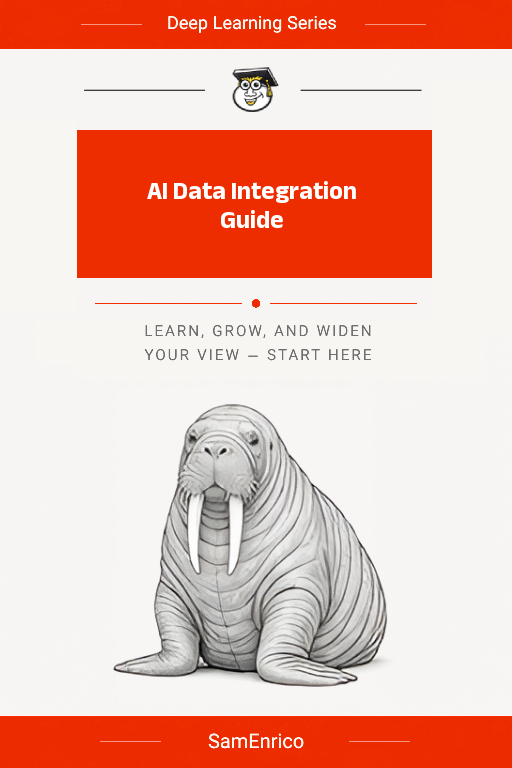
AI Data Integration Guide eBook
Connect ERP, CRM, and bank systems to unified AI a
by Bonds Nakita
Connect ERP, CRM, and bank systems to unified AI analytics for real-time visibility.
Formats
Free sample
Chapter 1: The Trifecta of Blindness...--–- On a Tuesday morning in March, Clara Chen, the newly appointed CFO of a $200 million manufacturing company, walked into the boardroom for what she thought would be a routine quarterly review. She had prepared for three days. She had pulled reports from the ERP system (Oracle, last updated Sunday night), exported dashboards from Salesforce (real-time but only for sales, not cash), and logged into three different bank portals to check balances across twelve accounts. She had even asked her team to manually reconcile invoices against payments for the top twenty customers. She felt ready.The CEO, a sixty-two-year-old founder who had built the company from his garage, didn't ask about revenue growth.
He didn't ask about margins. He looked at Clara and asked a single question: "What is our real cash position right now—not what the ERP says, not what the bank says, but what can we actually spend today?"Clara froze.She knew the ERP would tell her about 8.2millioninaccountsreceivable.Sheknewthebankportalsshowed8.2 million in accounts receivable. She knew the bank portals showed 8.2millioninaccountsreceivable.Sheknewthebankportalsshowed3.1 million in cash across accounts. She knew Salesforce had $12 million in open opportunities. But the question asked for something she had never been able to produce in her entire career: a single, trusted, real-time number that represented what the company could actually spend.
The gap between knowing and not knowing was not a matter of effort. It was a matter of architecture.Silence filled the room for what felt like minutes. Clara gave an answer she immediately regretted: "I think around five million, but I would need to verify."The CEO did not fire her that day. But he did something worse. He smiled, nodded, and said, "Let's circle back next quarter." Clara knew what that meant.
She had ninety days to solve a problem that had defeated every finance team before her. She had ninety days to connect the three systems that refused to talk to each other: the ERP that knew about orders and invoices, the CRM that knew about customers and opportunities, and the bank that knew about cash but knew nothing else.This chapter is for every Clara in every mid-sized company. It is for the CFO who cannot answer a simple question, the CTO who inherited twelve different databases, and the data architect who knows that AI will only amplify existing garbage instead of creating new gold. The problem is not that your data is bad. The problem is that your data is blind—and until you understand the three specific ways it fails, no amount of artificial intelligence will save you.The Goldmine Under Your Feet Most enterprises today sit on a goldmine of transactional data.
Every invoice you send, every payment you receive, every customer interaction your sales team logs, every purchase order your procurement team creates—this is not just operational exhaust. This is the most valuable asset your company owns, because it is the only asset that predicts future behavior.Consider what your transactional data knows about your business. It knows which customers pay on time and which ones pay late. It knows which products have predictable demand and which ones are seasonal anomalies. It knows which vendors consistently deliver early and which ones require three reminder emails.
It knows, if you could connect the dots, exactly where your cash will be in thirty days, not just where it was thirty days ago.Yet the average company uses less than five percent of its transactional data for decision-making. The remaining ninety-five percent sits in silos, locked away by system boundaries that no single person designed but everyone tolerates. This is the "walking over gold" paradox: your most valuable asset is right under your feet, but you cannot see it because the ground is fractured into three separate tectonic plates.Let me be specific. A typical mid-sized company generates approximately fifty thousand transactions per month across its ERP, CRM, and banking systems. Each transaction contains an average of twenty fields: amounts, dates, customer identifiers, product codes, payment terms, and so on.
That is one million data points per month, twelve million per year, sitting in three separate universes that never intersect except through heroic manual effort.The finance team spends seventy percent of its time on reconciliation—matching this invoice to that payment, finding the bank transaction that corresponds to that customer deposit, figuring out why the CRM shows a closed deal that the ERP has never heard of. Only thirty percent of time remains for analysis, strategy, and prediction. When I ask finance leaders what they would do with that seventy percent back, they invariably say the same thing: "We would finally have time to understand what the data is actually telling us."But the problem is not just wasted time. The problem is that you cannot build artificial intelligence on top of fractured data. AI, particularly large language models and generative systems, requires clean, connected, semantically consistent data to produce anything useful.
If you feed an LLM invoices from your ERP but not payment records from your bank, it will hallucinate revenue numbers that do not exist. If you give it customer records from your CRM but not order history from your ERP, it will recommend products to people who already bought them. Garbage in, garbage out is not a cliché. It is a mathematical certainty.The Three Systems That Refuse to Talk Before you can fix the problem, you must understand the three protagonists of our story: the ERP, the CRM, and the banking system. Each was built for a different purpose, by different companies, in different decades, with different assumptions about what "real-time" means and who the primary user should be.The ERP (Enterprise Resource Planning System) is the system of record for operations.
It knows about inventory, purchase orders, invoices, bills of materials, and general ledger accounts. It was designed for accountants and supply chain managers who need to know, with absolute certainty, what happened last quarter. The ERP prioritizes accuracy over speed, consistency over availability, and auditability over usability. Most ERPs run on batch processing because that is how accounting has always worked: you close the books at the end of the month, not continuously throughout the day.The ERP is also the oldest system in your stack. Many companies run on SAP R/3 (released 1992), Oracle E-Business Suite (released 1998), or Microsoft Dynamics GP (originally Great Plains, 1993).
These systems were designed before the internet was commercial, before APIs existed, and before anyone dreamed of real-time AI. They speak dialects of SQL that have not been updated in a decade. They store dates in formats that vary by region and sometimes by module. They treat "customer" as a number in one table and a name in another, with no guarantees that the two stay synchronized.The CRM (Customer Relationship Management System) is the system of record for sales and marketing. It knows about leads, opportunities, contacts, email interactions, and support tickets.
It was designed for salespeople who need to know, in real time, whether a deal is likely to close this week. The CRM prioritizes speed over accuracy, usability over consistency, and recency over auditability. Salespeople…
This is the end of the free sample. Get the eBook to keep going. Buy now
About this book
Details
- Author
- Bonds Nakita
- Publisher
- SamEnrico
- Language
- English
- Genre
- Non-Fiction, Business Brief, Integration AI
- Released
- 2026-06-01
- Pages (approx.)
- 142
- Available as
- eBook, Audiobook

Read better in the ZLOADR app
Your eBooks on your phone or tablet. Sign in with your SamEnrico account and start reading.
More by Bonds Nakita
 EQ In Customer Service GuideBonds Nakita$11.99
 Growth Mindset Failure GuideBonds Nakita$11.99
 Vince Gill Gentle Giant MemoirBonds Nakita$11.99
 Thunberg Autism Pride Activism GuideBonds Nakita$11.99
 Chocolate Flavanols Brain GuideBonds Nakita$11.99
 Excalibur of the Cherry Blossoms: The Samurai’s Quest for the Celestial SwordBonds Nakita$11.99
 The Clockwork Cartographer: Ancient Robots and the Lost Maps of the Australian InteriorBonds Nakita$11.99
 Understanding Fraxa SyndromeBonds Nakita$17.99
 Work Package ManagerBonds Nakita$11.99
 How to Become a Naphthalene-operator HelperBonds Nakita$11.99
 Spotify Engineering Model WorkbookBonds Nakita$12.99