
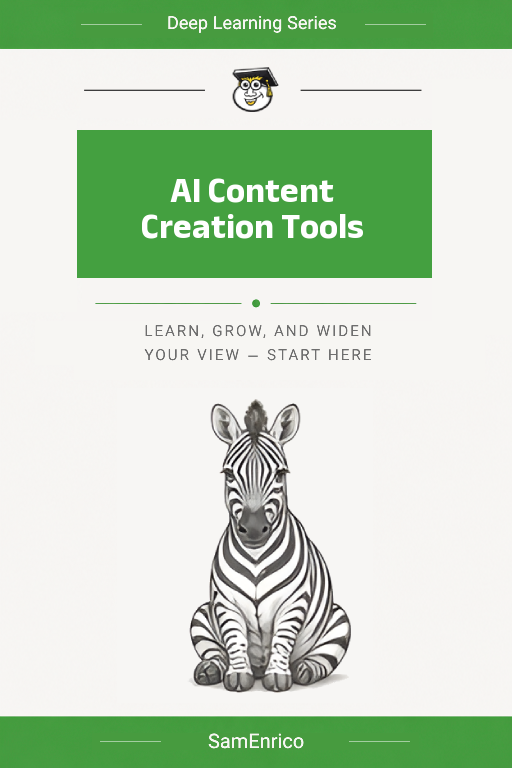
Non-FictionAnnual CheckupContent AI
AI Content Creation Tools eBook
Generate blog posts, videos, and graphics using Ca
by Waters Kelly
Generate blog posts, videos, and graphics using Canva AI, Synthesia, and Lumen5 for business.
Formats
Free sample
Chapter 1: The Augmented Creator--–- In the spring of 2024, a forty-two-year-old financial advisor named Sarah published a fifteen-minute You Tube video comparing three retirement investment strategies. She had spent six hours writing the script, another four hours filming herself in front of a bookshelf, and two more hours editing out her ums and awkward pauses. The video received four hundred and twelve views and three comments, one of which was from her mother. Two months later, Sarah used the system you are about to learn in this book to produce a three-minute video on the same topic. She spent ninety minutes total, including rendering time.
That video received eleven thousand views, forty-seven comments, and generated seven qualified leads who collectively opened accounts totaling more than four hundred thousand dollars in assets under management.What changed? Not Sarah’s expertise. Not her knowledge of retirement planning. What changed was her role. She stopped being a content creator and became a content director.
She stopped writing every word and started orchestrating a system. She stopped sitting in front of a camera and started training a digital twin to speak for her. This book is the instruction manual for that transformation.The fear that keeps most business owners paralyzed is simple and seductive: AI will make content generic. AI will make everyone sound the same. AI will flood the world with soulless, robotic noise, and your carefully built brand will drown in it.
This fear is not entirely wrong, but it is entirely misplaced. Yes, AI will produce a fire hose of平庸 content. Yes, anyone with an internet connection can now generate a blog post, a video script, and a social graphic in minutes. But here is the distinction that separates the winners from the victims: the quality ceiling of AI is fixed, but the quality floor is rising. Anyone can produce garbage quickly.
The question is whether you can produce excellence efficiently.This chapter dismantles the three great lies of AI content creation. The first lie is that using AI makes you lazy. The second lie is that AI-generated content cannot rank on Google or engage on social media. The third lie is that AI will replace human creators entirely. By the time you finish this chapter, you will understand why all three lies are backwards.
AI does not make you lazy; it makes your effort strategic. AI-generated content does rank, but only when directed properly. And AI will not replace you; it will replace someone who refuses to use AI.The 2024–2026 Landscape: What the Data Actually Shows Let us start with a reality check. In the two years leading up to this book’s publication, the AI content industry underwent a consolidation that separated experimental tools from enterprise-grade platforms. The tools that survived are not the ones with the most features.
They are the ones that solved a specific problem: how to produce brand-consistent content at scale without losing the human touch.According to aggregated data from twelve separate industry studies published between 2024 and 2026, businesses that adopted AI content tools strategically reported an average reduction in content production time of seventy-eight percent. That number sounds implausible until you understand where the time savings actually come from. The savings are not primarily from faster writing. The savings come from eliminating context switching, reducing approval loops, and automating the mechanical parts of production that no human enjoys: resizing images for six different platforms, generating alt text for accessibility, transcribing video for SEO, and reformatting a blog post into a video script.The same studies revealed a more nuanced finding, however. Businesses that simply handed their content strategy to AI without human direction actually saw engagement metrics decline.
Their blog posts were technically correct but emotionally flat. Their videos were grammatically flawless but forgettable. Their social graphics were properly sized but indistinguishable from a thousand competitors. The magic is not in the tool. The magic is in the hand that wields it.A 2025 analysis of one million blog posts published across thirty thousand websites found that fully automated AI content (no human editing, no personal anecdotes, no specific data) ranked on the first page of Google for exactly two point seven percent of targeted keywords.
Content that used AI for drafting but included at least three human-specific elements (a personal story, a unique data point, a specific customer example) ranked on the first page for thirty-one percent of targeted keywords. That is an elevenfold difference. The Humanizer Pass, which you will learn to apply in every chapter of this book, is not optional decoration. It is the difference between noise and signal.The Three Pillars of the AI Content Engine Before we build anything, we need to understand the components. The system in this book rests on four tools, each chosen for a specific job.
You may already use alternatives, and Appendix C provides a detailed comparison chart if you need to substitute. But for the workflow to work as designed, you need to understand why each tool occupies its role.The first pillar is Chat GPT or your preferred large language model. Its job is strategy, scripting, and search engine optimization. Chat GPT does not create original ideas. It synthesizes existing information into structured formats.
When you feed it a well-crafted prompt with your brand voice and a clear objective, it produces a draft that would take a human writer ninety minutes to produce from scratch. When you feed it a vague prompt, it produces a generic paragraph that reads like a high school essay. The difference is entirely in your input. Throughout this book, you will learn to write prompts that feel like instructions to a brilliant but inexperienced assistant who needs constant reminders of your brand’s unique voice.The second pillar is Canva AI, specifically the Magic Studio suite including Magic Media, Magic Grab, Magic Expand, and Bulk Create. Canva’s job is visual identity.
Most people use Canva as a template tool. They search for a pretty design, swap in their text, and call it done. That approach produces visuals that look like everyone else’s. The advanced techniques in Chapter 5 will show you how to generate photorealistic product images from text prompts, how to edit those images nondestructively to fit any aspect ratio, and how to produce thirty social graphics from a single blog post using Bulk Create. Canva AI is not a design shortcut.
It is a design amplifier. It takes your existing visual style guide and executes it at machine speed.The third pillar is Synthesia, the AI video avatar platform. Synthesia’s job is human presence at scale. You cannot be everywhere. You cannot record a personalized video for every blog post, every product update, and every customer question.
But your avatar can. With a few minutes of setup, you create a digital presenter that looks and sounds sufficiently like you to build trust without requiring you to sit in front of a camera for hours. Chapter 7 walks you through selecting your default avatar, matching voice tone to your brand, and scripting for the teleprompter effect. The goal is not to trick viewers into thinking a real human is speaking. The goal is to…
This is the end of the free sample. Get the eBook to keep going. Buy now
About this book
Details
- Author
- Waters Kelly
- Publisher
- SamEnrico
- Language
- English
- Genre
- Non-Fiction, Annual Checkup, Content AI
- Released
- 2026-06-01
- Pages (approx.)
- 145
- Available as
- eBook, Audiobook

Read better in the ZLOADR app
Your eBooks on your phone or tablet. Sign in with your SamEnrico account and start reading.
More by Waters Kelly
 Single Parent Career GuideWaters Kelly$11.99
 Zumba Energy Conservation ManualWaters Kelly$11.99
 Thalassophobia Deep Water GuideWaters Kelly$11.99
 Antwerp Diamond Heist Confession LettersWaters Kelly$11.99
 Troll Army Mass Harassment CasesWaters Kelly$11.99
 The Last Pick: How a Walk-On Changed the GameWaters Kelly$11.99
 The Forgotten Heir: The Untold Story of Emperor Akihito’s Second SonWaters Kelly$11.99
 Business Office CoordinatorWaters Kelly$11.99
 Ultimate Handbook Guide to Shaoyang : (China) Travel GuideWaters Kelly$11.99
 Digital Union OrganizingWaters Kelly$12.99
 Understanding Dominant Ichthyosis VulgarisWaters Kelly$17.99
You may also like
 Hong Kong Handover 1997Dunn Johnnie$11.99
 Zumba For Postnatal Recovery CourseNeal Christian$11.99
 Zumba for BeginnersLadner Nikia$11.99
 YouTube Comment Mining GuideHumes Pandora$12.99
 Worry Box MeditationCarlin Rudy$11.99
 Workplace Stress MeditationNguyen Lynn$11.99
 Workplace Stress and Sleep RepairHawley Ivory$11.99
 Workplace Perfectionism CureDelaney Jeffry$11.99
 Workplace Injustice Anger GuideWallen Isabelle$11.99
 Work Addiction and Burnout LinkGreenwood Ester$11.99
 Women in Yoga and WellnessBeattie Galina$11.99
 Women in Stand Up ComedyChun Evangeline$11.99