
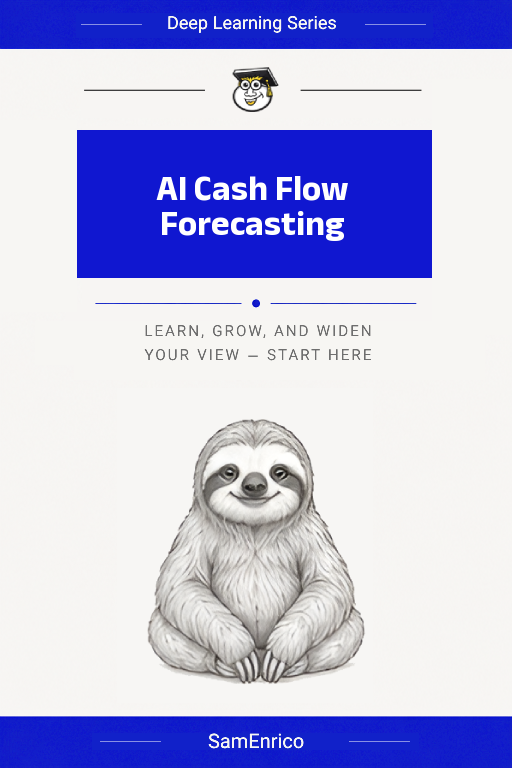
Non-FictionBusiness BriefCash Flow AI
AI Cash Flow Forecasting eBook
Predict cash flow using AI that analyzes historica
by Chong Freddy
Predict cash flow using AI that analyzes historical data and seasonal patterns automatically.
Formats
Free sample
Chapter 1: The Mirror Fallacy--–- On a rainy Tuesday in March, Sarah Chen stared at her laptop screen and watched her company die in slow motion. The spreadsheet open before her showed a healthy 847,000incashreserves.Thebankbalanceonhersecondmonitortoldadifferentstory:847,000 in cash reserves. The bank balance on her second monitor told a different story: 847,000incashreserves.Thebankbalanceonhersecondmonitortoldadifferentstory:62,000. Her largest customer, a retail chain that represented 40 percent of her manufacturing company's revenue, had just filed for bankruptcy protection. The check they had promised for the following Friday would never arrive.
Two weeks later, Sarah laid off thirty-seven people. Her accountant, reviewing the books afterward, said the same thing every failed entrepreneur hears: "But the numbers looked fine."This is the opening scene of a tragedy that plays out thousands of times every year. According to a 2024 study by the U.S. Bank, 82 percent of small business failures are caused not by unprofitability but by poor cash flow management. These companies are profitable on paper.
Their products sell. Their margins are acceptable. Their balance sheets show assets exceeding liabilities. And yet they run out of money because the timing of their cash inflows and outflows does not align. The problem is not a lack of profit.
The problem is a failure of foresight.Sarah's story illustrates a fundamental truth that most finance professionals have learned the hard way: profit is an opinion, but cash is a fact. A profit and loss statement represents a series of accounting conventions, accruals, and estimates. It tells you whether your business model works in theory. A cash flow statement tells you whether you can make payroll on Friday. These two truths often diverge dramatically, and the divergence is where businesses die.The Illusion of Precision Spreadsheets are magnificent inventions.
They have enabled trillions of dollars in commerce, empowered financial analysts to build complex models, and democratized access to quantitative analysis. But spreadsheets have a fatal flaw when applied to cash flow forecasting: they create an illusion of precision that is actively dangerous.Consider what happens when a typical finance team builds a thirteen-week cash flow forecast in Excel. They begin with the current bank balance, a number that is precise to the penny. They add expected inflows from accounts receivable, typically based on invoice due dates. They subtract expected outflows from accounts payable, based on bill due dates.
The result is a single number at the bottom of each column: projected cash balance.This number looks exact. It is formatted with two decimal places and a dollar sign. It carries the weight of mathematical certainty. But it is built on a foundation of assumptions that are almost certainly wrong.The first assumption is that customers pay on their due dates. In reality, payment timing follows behavioral patterns that vary dramatically by customer, invoice size, day of the week, season, and economic conditions.
A Net 30 invoice might be paid in fifteen days by one customer and sixty days by another. The same customer might pay on time for eleven months and then delay payment for forty-five days in the twelfth month with no warning. The spreadsheet's single date assumption ignores this entire universe of variation.The second assumption is that all expenses are fixed and predictable. In reality, approval delays, variable costs, early payment discounts, and unexpected expenses create constant variation. An invoice that requires three levels of approval might sit in a manager's inbox for a week before being processed.
A supplier might offer a two percent discount for payment within ten days, creating an optimization problem that spreadsheets rarely model. A utility bill might spike during an unexpected heat wave.The third and most dangerous assumption is that the future will resemble the recent past. Spreadsheet forecasts are almost always built on historical averages or simple linear extrapolations. When a major customer goes bankrupt, when a supply chain shock doubles raw material costs, when interest rates rise unexpectedly, these static models offer no warning. They project the past forward and call it a prediction.The Rearview Mirror Fallacy Accounting is fundamentally backward-looking.
A balance sheet reports the financial position at a specific moment in the past. An income statement reports the results of operations over a period that has already ended. A cash flow statement reconciles the difference between net income and actual cash movement, but it does so after the fact.This is not a criticism of accounting. Accounting serves a vital purpose: providing a standardized, auditable, comparable record of what has already happened. Investors, lenders, and regulators rely on historical financial statements for good reason.
But using historical accounting to predict future cash flow is like driving a car while looking exclusively in the rearview mirror. You know where you have been with perfect clarity. You have no idea what is coming.Consider the distinction between accrual accounting and cash accounting. Under accrual accounting, revenue is recognized when earned, not when cash is received. A company can book a million dollars in revenue, show a healthy profit margin, and still have zero cash if customers have not yet paid.
Conversely, a company can receive a large cash prepayment from a customer, show a strong cash balance, and still be unprofitable when the cost of fulfilling that order is recognized.The gap between accrual profit and cash flow is called the cash conversion cycle, and it varies dramatically by industry. A software-as-a-service company might collect annual subscriptions upfront, creating a negative cash conversion cycle where cash arrives before expenses are incurred. A manufacturing company might have to pay for raw materials sixty days before receiving payment from customers, creating a positive cash conversion cycle where cash is tied up in working capital for months.Spreadsheet forecasts that start from accrual-based financial statements inherit all the timing distortions of accrual accounting. They project revenue based on sales made, not cash collected. They project expenses based on obligations incurred, not payments made.
The result is a forecast that predicts profitability accurately but cash flow poorly.Why Most AI Forecasts Fail If spreadsheets are so flawed, why not simply replace them with artificial intelligence? This question leads to the single most important lesson in this book: the number one reason AI cash flow forecasts fail is not bad math, not insufficient computing power, and not the wrong model architecture. The number one reason AI forecasts fail is bad data.Artificial intelligence models are, at their core, pattern recognition engines. They ingest historical data, identify statistical relationships, and project those relationships forward. If the historical data is incomplete, inconsistent, or corrupted, the patterns the AI learns will be equally corrupted.
The computer science aphorism applies perfectly to cash flow forecasting: garbage in, gospel out.What does bad data look like in practice? Consider the typical small business accounting system. Transactions are imported from bank feeds, but many are uncategorized. The owner categorizes some expenses as "office supplies," others as "administrative expenses," and still others are left as "uncategorized income." Duplicate transactions appear when a customer pays via credit card and the bank feed imports both the authorization and the settlement. Missing transactions occur when a check has been written but not yet cleared.
Date formats vary between American and international standards. Customer names are entered inconsistently: "Amazon.com" appears sometimes as "AMZN," sometimes as…
This is the end of the free sample. Get the eBook to keep going. Buy now
About this book
Details
- Author
- Chong Freddy
- Publisher
- SamEnrico
- Language
- English
- Genre
- Non-Fiction, Business Brief, Cash Flow AI
- Released
- 2026-05-29
- Pages (approx.)
- 115
- Available as
- eBook, Audiobook

Read better in the ZLOADR app
Your eBooks on your phone or tablet. Sign in with your SamEnrico account and start reading.
More by Chong Freddy
 Emotional Intelligence Self CareChong Freddy$11.99
 The Caregiver Lung Disease GuideChong Freddy$11.99
 Legal Career Failure FearChong Freddy$11.99
 Carson Editor Relationship Memoir GuideChong Freddy$11.99
 Anticholinergic Medications Cognitive RiskChong Freddy$11.99
 Frostbound: The Troll Queen’s GambitChong Freddy$11.99
 Frozen Secrets: The Forgotten Antarctic Explorers of the Age of DiscoveryChong Freddy$11.99
 Understanding Follicular LymphoreticulomaChong Freddy$17.99
 Founder Storytelling ManualChong Freddy$12.99
 Unit CoordinatorChong Freddy$11.99
You may also like
 Hong Kong Handover 1997Dunn Johnnie$11.99
 Zumba For Postnatal Recovery CourseNeal Christian$11.99
 Zumba for BeginnersLadner Nikia$11.99
 YouTube Comment Mining GuideHumes Pandora$12.99
 Worry Box MeditationCarlin Rudy$11.99
 Workplace Stress MeditationNguyen Lynn$11.99
 Workplace Stress and Sleep RepairHawley Ivory$11.99
 Workplace Perfectionism CureDelaney Jeffry$11.99
 Workplace Injustice Anger GuideWallen Isabelle$11.99
 Work Addiction and Burnout LinkGreenwood Ester$11.99
 Women in Yoga and WellnessBeattie Galina$11.99
 Women in Stand Up ComedyChun Evangeline$11.99