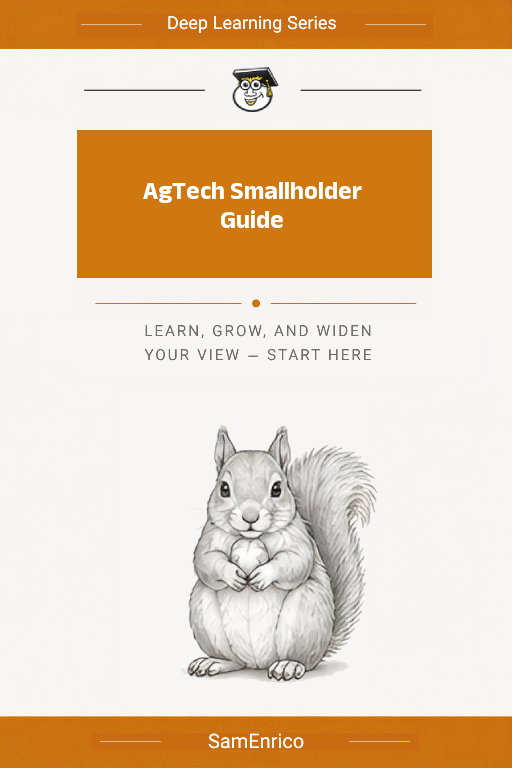
AgTech Smallholder Guide eBook
Project farm management apps, drone crop monitorin
Project farm management apps, drone crop monitoring, and supply chain platform adoption across rice and palm oil.
Formats
Free sample
Chapter 1: The Two Harvests...-- Every morning, before the sun burns through the haze, Siti walks her palm oil plantation in Riau, Sumatra. She checks the fallen fruit beneath each tree, kicks the loose soil, and listens—really listens—to what her land is telling her. Thirty kilometers away, in a flooded rice paddy in West Java, Raj does the same. He kneels, plunges his hand into the muddy water up to his wrist, and feels for the moisture level. Two farmers.
Two crops. One identical problem: they have no idea what their harvest is worth until a buyer tells them.This book is not about drones, blockchain, or artificial intelligence. Those are tools. This book is about the 500 million smallholder farmers who feed one-third of humanity while living on less than two dollars a day. And it is about the single most valuable commodity they do not yet know they possess: their data.The thesis of "Ag Tech Smallholder Guide" is simple but radical.
The technology industry has spent the past decade building solutions for problems farmers never said they had. They built apps for farmers who cannot read. They built drones for farmers who cannot afford fertilizer. They built traceability systems for supply chains where the first transaction is still recorded on a cigarette carton with a ballpoint pen. The result is a graveyard of failed Ag Tech startups and millions of dollars in donor-funded pilot projects that never scaled.What works?
The answer, hidden in plain sight across Indonesia, Vietnam, Ghana, and Brazil, is not a technology. It is a psychology. Successful digitization starts not with a feature list but with a single question that every farmer asks silently every day: "How does this put money in my pocket today?"This chapter establishes the ground truth. It explains why rice and palm oil—two crops that dominate smallholder agriculture across Southeast Asia and beyond—demand fundamentally different digital strategies. It dissects the economic realities of farm gate pricing, land titling, and aggregation points.
And it introduces the single most important forcing function in global agriculture today: the European Union Deforestation Regulation, or EUDR, which goes into full effect in December 2026 and will permanently change how rice and palm oil move from farm to fork.If you are a project manager, a cooperative leader, an NGO program officer, or an Ag Tech founder, this chapter is your diagnostic. Before you build anything, before you write a line of code or purchase a single drone, you must understand the terrain. Because the difference between rice and palm oil is the difference between a weekly intervention and a monthly one. And that difference determines whether your project succeeds or fails.The Biological Divide: Annuals vs. Perennials Rice is an annual crop.
From seed to harvest, it takes approximately 100 to 150 days, depending on the variety and growing conditions. During that narrow window, a rice farmer must make dozens of high-stakes decisions: when to flood the field, when to drain it, when to apply nitrogen, when to watch for blast fungus, when to scare away the birds, when to cut. Miss a decision by a week, and yield drops by twenty percent. Miss it by two weeks, and the crop is gone.Palm oil is a perennial tree crop. A single oil palm tree lives for twenty-five to thirty years and begins producing fruit eighteen to thirty months after planting.
Once mature, it produces fruit year-round, with harvest cycles every ten to fourteen days. The decisions are fewer but the stakes are higher: when to prune, when to fertilize, when to detect the early signs of bud rot that can destroy an entire plantation, when to cut the fresh fruit bunches at exactly the right ripeness to maximize oil extraction rate.These biological differences are not academic. They determine the entire rhythm of digital intervention. A rice farmer needs weekly, sometimes daily, alerts about water levels, pest pressure, and weather. A palm oil farmer needs monthly summaries of tree health, harvest predictions, and deforestation alerts.
Build a weekly alert system for palm oil, and farmers will ignore it. Build a monthly summary for rice, and fields will flood or dry at the wrong time.The failed Ag Tech projects of the past decade almost all share the same mistake: they assumed that one platform could serve both crops equally. They built generic farm management software with dropdown menus for "crop type" and considered the job done. But a rice paddy and a palm oil plantation are as different as a bakery and a steel mill. The inputs are different, the labor patterns are different, the post-harvest urgency is different, and the buyer requirements are different.Consider post-harvest biology.
Palm oil fresh fruit bunches begin to degrade within twenty-four hours of cutting. The free fatty acid content rises, and the oil extraction rate falls. A delay of forty-eight hours can reduce the value of a harvest by thirty percent. This is why palm oil mills are located within a few hours' drive of plantations, and why every hour of transport time is measured in lost revenue.Rice, by contrast, can be stored for weeks or months after harvest, provided it is dried properly. The post-harvest urgency is not biological but logistical and financial.
The longer a farmer stores rice, the more vulnerable it is to theft, spoilage from moisture, and price fluctuations. But the crop itself does not rot in hours. This means that digital solutions for palm oil must prioritize speed—real-time weighbridge integration, instant grading reports, immediate payment settlement—while digital solutions for rice can prioritize aggregation and market access.The Land Question: Titles, Boundaries, and Power To digitize a farm, you must first know where it is. This seemingly simple requirement becomes a nightmare when applied to the land tenure systems of Southeast Asia.Rice paddies in countries like Vietnam, Thailand, and Cambodia are typically small, fragmented, and often untitled. A single farmer may work three or four non-contiguous plots spread across a village, none of which have formal legal boundaries.
The farmer knows where the plots are, his neighbors know, but there is no cadastral map, no GPS coordinate, no legal document that proves ownership or even tenancy. This is not because farmers are disorganized. It is because formal land titling is expensive, bureaucratic, and often politically contested.Palm oil concessions, by contrast, are massive. A single plantation may cover thousands of hectares. But those hectares are frequently contested—by indigenous communities, by environmental regulators, by neighboring concessions, and by the farmers themselves who work as sharecroppers on land owned by a mill or a landlord.
The boundaries exist on paper, but on the ground, they are fluid.This land question is not a side issue. It is the central obstacle to drone monitoring, traceability, and carbon credit verification. A drone can fly over a palm oil concession and produce beautiful maps. But if the farmer cannot prove that she owns or has legal rights to that land, no buyer will accept the traceability data. A satellite can estimate the yield of a rice paddy.
But if the paddy has no formal boundary, the estimate cannot be attributed to a specific farmer for payment or…
This is the end of the free sample. Get the eBook to keep going. Buy now
About this book
Details
- Author
- Pfeifer Toney
- Publisher
- SamEnrico
- Language
- English
- Genre
- Non-Fiction, Forecast & Outlook, Agriculture
- Released
- 2026-05-29
- Pages (approx.)
- 133
- Available as
- eBook, Audiobook

Read better in the ZLOADR app
Your eBooks on your phone or tablet. Sign in with your SamEnrico account and start reading.
More by Pfeifer Toney
 Global Talent Migration and Visa BacklogsPfeifer Toney$11.99
 Suicide Loss WorkbookPfeifer Toney$11.99
 Elon Musk Twitter TakeoverPfeifer Toney$11.99
 Central Sensitization Explained GuidePfeifer Toney$11.99
 The Amanda Knox Case Timeline GuidePfeifer Toney$11.99
 Whispers in the Dark: The Lost Library of Alexandria’s Final NightPfeifer Toney$11.99
 East African Exporter Payment WorkbookPfeifer Toney$12.99
 Understanding Lichen Planus FollicularisPfeifer Toney$17.99
 Dialect CoachPfeifer Toney$11.99
 How to Start a Charcoal (wholesale) Business (Beginners Guide)Pfeifer Toney$11.99