
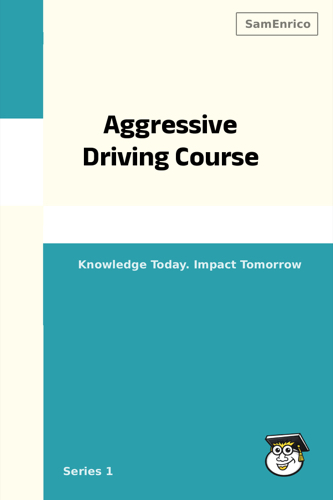
Aggressive Driving Course eBook
An 8-week program to transform reactive driving in
An 8-week program to transform reactive driving into calm commuting.
Formats
Free sample
Chapter 1: The Windshield Mask--Let me tell you about the time I almost became a criminal.It was a Tuesday. Not even a bad Tuesday. Just a Tuesday. I was driving home from work, the kind of exhausted where you are not even tired anymore, just hollow. The freeway was crowded but moving.
I was in the left lane, doing maybe seventy, when a minivan – and is it not always a minivan? – drifted into my lane without a signal. No blinker. No shoulder check. Just a slow, oblivious drift, like the driver had forgotten that other people exist.I slammed on the brakes.
The car behind me honked. The minivan completed its drift and then, as if to add insult to injury, slowed down. Ten miles per hour slower than traffic. In the left lane.And something inside me just... broke.Not broke like a glass shattering.
Broke like a dam breaking. All the exhaustion, all the frustration, all the small humiliations of the day – the missed deadline, the curt email from my boss, the fight with my partner about whose turn it was to make dinner – it all came rushing through that crack in the dam, and the target was a gold Chrysler Town & Country with a faded "Baby on Board" sticker in the rear window.I tailgated. Close enough to count the dust on their bumper. I flashed my high beams. I honked – not a polite tap, but a long, angry blare that went on for several seconds.
I pulled into the right lane, sped up, pulled back into the left lane in front of them, and then brake-checked them. Hard. I wanted them to feel what I had felt. I wanted them to be scared. I wanted them to know that they had wronged me, and I was not the kind of person you wrong without consequences.And then, as I sped away, my heart pounding, my knuckles white on the steering wheel, I caught a glimpse of the minivan in my rearview mirror.
It had pulled over to the shoulder. The hazard lights were flashing. Through the rear window, I could see the driver – a woman, maybe sixty years old – leaning over to the passenger seat, reaching toward something.Toward someone.A child. A small child, maybe three or four years old, who had apparently unbuckled their seatbelt and climbed into the front seat. The woman was not drifting because she was oblivious.
She was drifting because she was trying to reach into the back seat to grab a wandering toddler without taking her eyes entirely off the road. She was doing her best. She was failing at her best, but she was trying.And I had just terrorized her for it.I pulled over too. About a quarter mile ahead, at the next exit. I sat in my car for a long time, not moving, not crying, just sitting.
My hands were still shaking. My jaw ached from clenching. And I could not stop seeing that child in the rear window. If my brake-check had caused an accident – if she had swerved, if the car behind her had hit her – that child could have been hurt. Or worse.All because someone did not use a turn signal.That was the day I realized that I was not a calm person who occasionally got angry in traffic.
I was an angry person who had built an entire identity around being calm, and the car was the only place where the mask slipped. The Windshield Mask, I call it now. The invisible screen that drops between you and the rest of humanity the moment you close your car door. Behind that mask, you are not you. You are someone else.
Someone who does things you would never do face to face.This chapter is about that mask. Where it comes from. How it works. And why understanding it is the first step to taking it off.The Psychology of the Unseen Face There is a reason why you would never scream at a stranger on the sidewalk but you will scream at a stranger on the freeway. It is not because you are a hypocrite.
It is not because you lack self-control. It is because your brain literally processes a person in a car differently than a person on foot.Let me explain the neuroscience.Your brain has a specialized region called the fusiform face area, or FFA. It is located in the temporal lobe, roughly behind your right ear. The FFA is responsible for recognizing and responding to human faces. When you look at another person, your FFA activates within milliseconds.
It assesses familiarity, emotion, intent, threat level. It is one of the oldest and most sophisticated social processing systems in the human brain.But here is the catch. The FFA is triggered by faces. Not by cars. Not by silhouettes.
Not by shapes. The FFA requires certain visual cues – two eyes, a nose, a mouth, arranged in a roughly oval configuration – to activate. When those cues are absent, the FFA does not fire.Now consider what you see when you look at another driver. You do not see eyes. You see a windshield.
You do not see a mouth. You see a grille. You do not see expressions. You see painted metal. The human being inside the car is reduced to a set of abstract visual features – color, shape, movement, position.
Your brain, which evolved to respond to faces, has nothing to respond to. So it falls back on an older, cruder system: threat detection.This is the Windshield Mask. It is not a metaphor. It is a neurological reality. When you cannot see a face, your brain cannot fully register the presence of another person.
And when your brain cannot register a person, it cannot activate the social brakes that normally prevent you from screaming, threatening, or attacking.The research on this is startling. In a study conducted at the University of Groningen in the Netherlands, researchers placed cameras inside test vehicles to record the faces of other drivers. Then they had subjects watch footage of traffic incidents – someone cutting them off, someone braking suddenly, someone merging unsafely. Half the subjects saw the footage with the other drivers' faces visible through the windshield. Half saw the same footage with the faces blurred out.The results?
The subjects who saw the blurred faces – the ones who could not see the other drivers as people – rated the incidents as significantly more intentional, more personal, and more anger-inducing than the subjects who could see the faces. The only difference was whether they could see a human being behind the wheel.Let that sink in. The exact same behavior – a cut-off, a brake check, a slow merge – was perceived as more aggressive and more offensive simply because the driver's face was not visible. The Windshield Mask did not just hide the other driver. It changed how the observer experienced the event.This is not a bug in your brain.
It is a feature of your brain, but it is a feature that was designed for a world that no longer exists. Your brain evolved in a world where the…
This is the end of the free sample. Get the eBook to keep going. Buy now
About this book
Details
- Author
- Goodwin Natasha
- Publisher
- SamEnrico
- Language
- English
- Genre
- Non-Fiction, Self-Help / Course
- Released
- 2026-06-08
- Pages (approx.)
- 128
- Available as
- eBook, Audiobook

Read better in the ZLOADR app
Your eBooks on your phone or tablet. Sign in with your SamEnrico account and start reading.
More by Goodwin Natasha
 Francis and the Perfection of JoyGoodwin Natasha$11.99
 Resentment in FamiliesGoodwin Natasha$11.99
 Catherine Succession Plan FailureGoodwin Natasha$11.99
 NVC for ESL LearnersGoodwin Natasha$11.99
 IBS Acupuncture Relief GuideGoodwin Natasha$11.99
 Responding to Personal AttacksGoodwin Natasha$11.99
 Prebiotic Fiber GuideGoodwin Natasha$11.99
 The Ransom of Madrid: Cyberwar in the Shadows of the Spanish Civil WarGoodwin Natasha$11.99
 Love at First Serve: The Unlikely Tennis Romance That Defied the 18th CenturyGoodwin Natasha$11.99
 How to Produce Interior LaTeX Flat PaintGoodwin Natasha$11.99
 A Collector's Handbook to the Humber SnipeGoodwin Natasha$11.99
 Service Providers Guide to Primary CareGoodwin Natasha$11.99
You may also like
 Hong Kong Handover 1997Dunn Johnnie$11.99
 Zumba For Postnatal Recovery CourseNeal Christian$11.99
 Zumba for BeginnersLadner Nikia$11.99
 YouTube Comment Mining GuideHumes Pandora$12.99
 Worry Box MeditationCarlin Rudy$11.99
 Workplace Stress MeditationNguyen Lynn$11.99
 Workplace Stress and Sleep RepairHawley Ivory$11.99
 Workplace Perfectionism CureDelaney Jeffry$11.99
 Workplace Injustice Anger GuideWallen Isabelle$11.99
 Work Addiction and Burnout LinkGreenwood Ester$11.99
 Women in Yoga and WellnessBeattie Galina$11.99
 Women in Stand Up ComedyChun Evangeline$11.99