
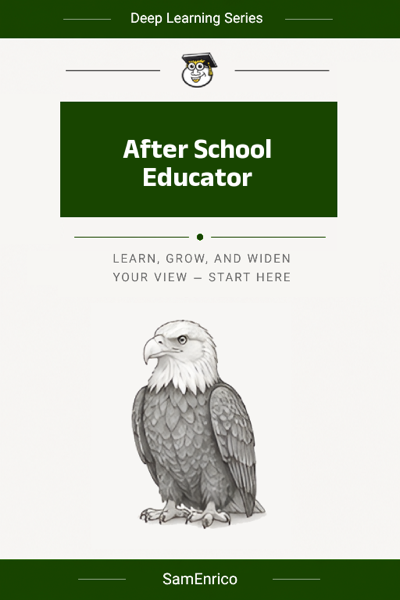
After School Educator eBook
A Coursebook on After School Educator
A Coursebook on After School Educator
Formats
Free sample
Chapter 1: The 3-to-6 Danger Zone--–- At 3:15 on a Tuesday afternoon, a sixth-grader named Marcus walked out of school and into a parking lot where no one was waiting. His mother, a single parent working the second shift at a nursing home, had texted him: Busy tonight. Go to the center. But the community center had closed its after-school program due to budget cuts three months earlier. So Marcus did what thousands of children do every day.
He walked two miles home alone, let himself in with a key under a fake rock, microwaved a burrito, and spent the next three hours scrolling a phone in a silent apartment. When a truancy officer called his mother six weeks later to report that Marcus had missed fourteen days of school, she was bewildered. “He goes to the center,” she said. “I drop him every morning.” She didn’t know the center’s after-school program no longer existed. No one had told her.
And no one had been watching.This is not an isolated story. It is not an outlier. It is the quiet crisis of American childhood, unfolding between the final school bell and the moment a parent walks through the door. The hours of 3:00 PM to 6:00 PM have been called many things by researchers: the “after-school gap,” the “danger zone,” the “unstructured window.” But for the nearly eleven million children who return home to no adult supervision every week, these hours are not a statistic. They are a three-hundred-minute test of survival, boredom, temptation, and luck.This book exists because those hours can be transformed.
They can become the most productive, relationship-rich, skill-building hours of a child’s day. But that transformation does not happen by accident. It requires trained, intentional, supported educators who understand exactly what is at stake. You are reading this book because you are one of those educators, or you want to become one. Before we talk about schedules, brain science, behavior plans, or project-based learning, we must first answer a single question with absolute clarity: Why do the hours between 3:00 and 6:00 matter so much?The answer, it turns out, is terrifying and hopeful in equal measure.The Unsupervised Gap: What the Data Actually Says Let us begin with the numbers, because the numbers are what convinced policymakers, philanthropists, and school districts to care about after-school at all.
According to the most comprehensive data from the Afterschool Alliance’s America After 3PM study, which surveys tens of thousands of families every several years, approximately one in five school-age children in the United States—roughly 11.3 million children—is alone and unsupervised between the hours of 3:00 PM and 6:00 PM on a typical weekday. That number spikes to nearly one in three for middle school students, the precise age group most vulnerable to risk-taking behavior and least capable of mature judgment.Now let us attach consequences to those numbers. The federally funded study known as the National Institute on Out-of-School Time (NIOST) has tracked juvenile crime statistics for decades, and the pattern is so consistent that criminologists call it the “after-school arrest peak.” For children ages twelve to seventeen, the peak hours for violent juvenile crime are not midnight or after dark. They are 3:00 PM to 4:00 PM, the first hour after dismissal. The peak for property crime—theft, vandalism, burglary—extends from 2:00 PM to 6:00 PM.
In other words, the moment school ends, the risk of a child committing a crime or becoming a victim of a crime more than doubles compared to the school hours.Why? Because supervision is the single most powerful crime deterrent for adolescents. Not police. Not alarms. Not curfews.
Presence. A trusted adult who knows a child’s name and expects something from them. When that adult is absent, the combination of boredom, peer pressure, low impulse control, and free time becomes a recipe for decisions that can alter a life trajectory in thirty seconds.But crime is only the most visible danger. The quieter harm is academic. Researchers have long documented the phenomenon of “summer learning loss,” where students lose one to three months of reading and math skills over vacation.
What is less widely known is that a similar but more insidious “after-school learning loss” occurs daily for unsupervised children. A study published in the Journal of Educational Psychology followed two groups of elementary students from the same school with comparable morning academic performance. One group attended a structured after-school program. The other went home unsupervised. After a single academic year, the unsupervised group had fallen nearly half a grade level behind in reading and mathematics.
The mechanism was simple: the unsupervised children did not practice skills, had no one to answer their questions, and often never opened a book between 3:00 and bedtime. The structured program children, by contrast, had ninety minutes of supported academic time daily. Over 180 school days, that difference compounded into a chasm.And then there is the unseen harm: loneliness. In a national survey of middle school students conducted by the Robert Wood Johnson Foundation, unsupervised children were three times more likely to report feeling “sad or hopeless almost every day” compared to peers in after-school programs. They were also significantly more likely to report having no adult they could talk to about a serious problem.
The hours of isolation are not empty. They fill with self-doubt, anxiety, and the quiet belief that no one is paying attention because no one cares.Distinguishing After-School from Daycare and Extended School Before we go any further, we must clear up a confusion that has harmed the after-school field for decades. Ask a random stranger on the street what “after-school” means, and they will likely say something like “daycare for older kids” or “babysitting until parents get home.” This misunderstanding is not merely semantic. It has practical consequences: lower pay for staff, lower expectations for programs, lower respect for the profession, and ultimately lower quality for children.After-school is not daycare. Daycare serves infants, toddlers, and preschoolers.
Its primary functions are safety, basic care (feeding, changing, napping), and early socialization. The adults in daycare are caregivers first and educators second. The ratio of adults to children in daycare is high—often one to four for infants—because the physical needs are intense.After-school is not an extension of the school day. Extended school day programs, sometimes called “expanded learning time,” simply add more of the same: more math worksheets, more reading passages, more seat work. They are designed to raise test scores and close achievement gaps through additional instructional minutes.
There is nothing wrong with extended learning time in theory, but it fails after 3:00 PM because children’s brains are exhausted. A child who has sat through six hours of direct instruction cannot productively sit through two more. They will comply, but they will not learn. Or they will not comply, and they will be labeled “behavior problems” when in fact they are simply human.After-school is a third space. It is neither school nor home.
It is something else entirely, with its own rules, rhythms, and purposes. The purpose of after-school is threefold, and these three pillars will structure this entire book.Pillar One: Academic Support, Not Academic Repetition. The goal is…
This is the end of the free sample. Get the eBook to keep going. Buy now
About this book
Details
- Author
- Eastman Leandra
- Publisher
- SamEnrico
- Language
- English
- Genre
- Non-Fiction, Informative, Educational
- Released
- 2026-05-07
- Pages (approx.)
- 154
- Available as
- eBook, Audiobook

Read better in the ZLOADR app
Your eBooks on your phone or tablet. Sign in with your SamEnrico account and start reading.
More by Eastman Leandra
 Mindful Breathing For Panic GuideEastman Leandra$11.99
 Digital Detox Recovery GuideEastman Leandra$11.99
 Isaiah Visionary ProphetEastman Leandra$11.99
 Workplace Stress for Tech WorkersEastman Leandra$11.99
 Self Esteem After Cancer Treatment GuideEastman Leandra$11.99
 Divine Dissolution: The Fall of Cleopatra and Mark AntonyEastman Leandra$11.99
 SaaS in Financial Services GuideEastman Leandra$12.99
 Sentiment Override ManualEastman Leandra$12.99
 Understanding Kniest DysplasiaEastman Leandra$17.99
 How to Start a On-line Mailing List Publishing Business (Beginners Guide)Eastman Leandra$11.99