
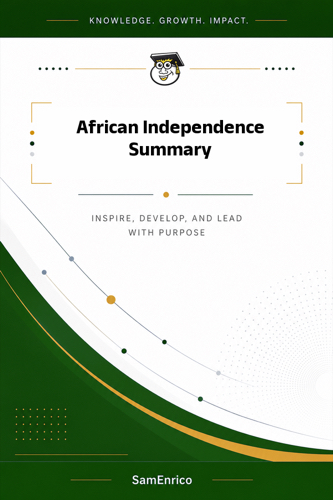
African Independence Summary
Overview of how 32 nations gained freedom in two d
Overview of how 32 nations gained freedom in two decades.
Formats
About this book
Free sample
Chapter 1: The Paper Partition...--The men who drew the map of Africa had never seen it. Not the rivers, not the mountains, not the dust that turns to mud when the rains finally come after eleven months of waiting. They sat in Berlin, in a building on Wilhelmstraße, with rulers and compasses and a cheap atlas purchased from a bookstore down the street. Fourteen nations, no Africans. The year was 1884, and the continent they carved up over the course of three months would, within a single generation, lose ninety percent of its sovereignty to European powers.
The lines they drew with such casual precision still exist today. They are the borders of thirty-two nations that would later fight for freedom—and the starting point of this story.The Invitation That Never Came On November 15, 1884, Otto von Bismarck, the Iron Chancellor of a newly unified Germany, welcomed representatives from Austria-Hungary, Belgium, Denmark, France, Great Britain, Italy, the Netherlands, Portugal, Russia, Spain, Sweden-Norway, the Ottoman Empire, and the United States. They had gathered to solve what European diplomats called the "African problem"—the chaotic scramble among European powers for territory, resources, and prestige on a continent most of them had never explored. Bismarck's official agenda was trade and navigation, specifically the Congo and Niger rivers. His unofficial agenda was to establish rules for colonization that would favor German interests while preventing war among European powers.No African leader received an invitation.
Not King Leopold II of Belgium—he attended as a private citizen, representing his own interests, not those of the Congo. Not the Asantehene of the Ashanti Confederation, which had been trading with Europeans for centuries and maintained a sophisticated bureaucracy and military. Not the Sultan of Sokoto, whose caliphate was one of the largest states in nineteenth-century Africa. Not the King of Kongo, whose kingdom had sent ambassadors to Europe two hundred years earlier. Not the Emperor of Ethiopia, whose civilization predated most European nations.The absence of African voices was not an oversight.
It was the point. The Berlin Conference was designed to declare, in the language of international law, that Africa was…
This is the end of the free sample. Get the eBook to keep going. Buy now
Contents
- Chapter 1
- Chapter 2
- Chapter 3
- Chapter 4
- Chapter 5
- Chapter 6
- Chapter 7
- Chapter 8
- Chapter 9
- Chapter 10
- Chapter 11
- Chapter 12
Details
- Author
- Troutman Celine
- Publisher
- SamEnrico
- Language
- English
- Genre
- Non-Fiction, History, Survey
- Released
- 2026-06-08
- Pages (approx.)
- 135
- Available as
- eBook, Audiobook

Read better in the ZLOADR app
Your eBooks on your phone or tablet. Sign in with your SamEnrico account and start reading.
More by Troutman Celine
 Metta For All Beings GuideTroutman Celine$11.99
 Immigrant Beauty Brand Founder StoriesTroutman Celine$11.99
 Storm Before the CalmTroutman Celine$11.99
 Empathy for Postpartum DepressionTroutman Celine$11.99
 Double Close Wholesaling MethodTroutman Celine$11.99
 Height Insecurity Self-EsteemTroutman Celine$11.99
 British Casualty FiguresTroutman Celine$11.99
 Conditional Love Fallout GuideTroutman Celine$11.99
 The Iron Kings of Meroë: Forging the Golden Age of KushTroutman Celine$11.99
 The Last Verdict: The Judge Who Ruled the Internet AgeTroutman Celine$11.99
 Into the Abyss: The Kayak Explorers of Europe’s Hidden UnderworldTroutman Celine$11.99
 The Mineral Guide to PyromorphiteTroutman Celine$11.99
You may also like
 Hong Kong Handover 1997Dunn Johnnie$11.99
 Zumba For Postnatal Recovery CourseNeal Christian$11.99
 Zumba for BeginnersLadner Nikia$11.99
 YouTube Comment Mining GuideHumes Pandora$12.99
 Worry Box MeditationCarlin Rudy$11.99
 Workplace Stress MeditationNguyen Lynn$11.99
 Workplace Stress and Sleep RepairHawley Ivory$11.99
 Workplace Perfectionism CureDelaney Jeffry$11.99
 Workplace Injustice Anger GuideWallen Isabelle$11.99
 Work Addiction and Burnout LinkGreenwood Ester$11.99
 Women in Yoga and WellnessBeattie Galina$11.99
 Women in Stand Up ComedyChun Evangeline$11.99