
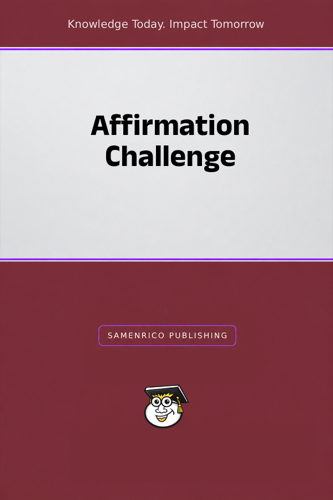
Affirmation Challenge eBook
Thirty days of daily self talk practice.
Thirty days of daily self talk practice.
Formats
Free sample
Chapter 1: The Diagnosis Trap...--The first time I tried an affirmation, I was twenty-three years old, broke, and crying on my bathroom floor because I had just been rejected from a job I didn't even want. The rejection wasn't the problem. The problem was what I said to myself afterward: Of course they said no. You're not qualified for anything. You've never been qualified for anything.A friend had given me a self-help book that promised to change my life with three simple phrases.
I opened it there on the bathroom tiles and read the first affirmation: "I am worthy of success and happiness."I said it out loud. "I am worthy of success and happiness."My brain answered immediately: That's a lie. You just spent three months unemployed. You can't even keep a plant alive. Worthy of what, exactly?I said it again, louder this time, trying to force belief through volume.
"I AM WORTHY OF SUCCESS AND HAPPINESS."The voice in my head didn't shut up. It got meaner. Now you're lying AND shouting. This is pathetic.I closed the book and didn't open it again for two years. Not because affirmations don't work, but because I had been given the wrong kind of affirmation at the wrong time in the wrong way.
I was trying to install a new roof on a house with a crumbling foundation, and no amount of positive chanting was going to fix the structural damage underneath.If you are reading this book, there is a good chance you have had a similar experience. You have tried affirmations before. Maybe you wrote them on sticky notes. Maybe you recorded yourself saying them and listened to the recording while you slept. Maybe you stood in front of a mirror and repeated "I am confident" until your throat was sore.
And maybe, like me, you found that the affirmations didn't stick, or worse, they made you feel like a fraud.This chapter is not about affirmations. Not yet. This chapter is about something much more important, much more uncomfortable, and much more useful than positive thinking. This chapter is about the voice that talks back when you try to say something positive about yourself. That voice is not your enemy.
It is a failed protection program, a outdated operating system that learned the wrong lessons at the wrong time. And before you can rewire it, you have to map it.The Lie of the Generic Affirmation Let me be direct with you: most affirmations you have encountered in books, on social media, or from well-meaning friends are not designed for your brain. They are designed to sound nice on a coffee mug.Consider the classic "I am enough." On its surface, this seems harmless, even helpful. But what happens when a person with a long history of self-criticism, perfectionism, or childhood emotional neglect says "I am enough" for the first time? The brain does a rapid reality check.
It scans your memory for evidence that you are not enough. And because your brain is a pattern-recognition machine that has spent years collecting evidence of your inadequacy, it finds that evidence instantly. The gap between the affirmation and your actual self-belief is not a small gap. It is a canyon. And standing at the edge of that canyon, looking across at the words "I am enough," you feel not hope but despair.
The affirmation hasn't lifted you. It has highlighted how far you have to fall.This is not your fault. This is a failure of the affirmation industry, which has sold you the idea that words alone can rewire your brain without accounting for the existing architecture of your beliefs.The technical term for this is the discrepancy principle. In psychological research, affirmations that are too far from your current self-concept do not produce positive change. They produce cognitive dissonance, and cognitive dissonance produces anxiety.
A 2009 study at the University of Waterloo found that participants with low self-esteem who repeated the phrase "I am lovable" actually felt worse afterward than participants who did not repeat any affirmation. The researchers concluded that for people who need affirmations the most, standard positive affirmations can backfire spectacularly.Think of your brain as a muscle that has been trained in a specific pattern of movement. If you have spent twenty years learning to curl your hand into a fist of self-criticism, you cannot simply say "open hand" and expect your fingers to uncurl. The muscle memory is too strong. The neural pathway is too deep.
You need to train the opening gradually, with small movements, with achievable repetitions, with a level of challenge that is difficult but not impossible.The same is true of your self-talk. You cannot jump from "I am a failure" to "I am a success" in one step. That gap is too wide. Your brain will reject the leap and snap back to the familiar ground of self-criticism. What you need is not a bigger affirmation.
What you need is a better map of the terrain you are actually standing on.The Inner Critic Is Not the Enemy Before we go any further, I need you to understand something that might sound strange: your inner critic is not trying to hurt you. It is trying to protect you.This was a difficult truth for me to accept. My inner critic had called me stupid, unlovable, lazy, awkward, and a hundred other things I would never say to another human being. It felt like an enemy living inside my head, a saboteur who had broken into my consciousness and taken up permanent residence.But here is what I learned in my years of studying self-talk and working with clients: the inner critic is actually a protection program that was installed at a time when you needed it. For most people, this installation happened in childhood.
If you grew up in an environment where mistakes were punished harshly, your brain learned that the safest way to survive was to criticize yourself before anyone else could. If you were told you were not good enough, your brain learned to repeat that message preemptively, as a way of lowering expectations and avoiding the pain of disappointment. If you were neglected or ignored, your brain learned that self-criticism was a way to stay alert, to keep scanning for threats, to never rest.The inner critic is not your enemy. It is a failed protection program. It worked once, when you needed it.
It kept you safe in an environment that was not safe. But now it is running in the background of your operating system, applying old rules to a new reality, and the protection it offers has become a prison.This reframing is essential because most affirmation work fails at this exact point. If you see your inner critic as an enemy, you will try to fight it, silence it, or drown it out with louder positive statements. And fighting your own mind is exhausting. It creates an internal civil war that drains your energy and leaves you feeling split in half.
But if you see your inner critic as a well-intentioned but outdated protection program, you can approach it differently. You…
This is the end of the free sample. Get the eBook to keep going. Buy now
About this book
Details
- Author
- Melvin Dorris
- Publisher
- SamEnrico
- Language
- English
- Genre
- Non-Fiction, Self-Help, 30 Day
- Released
- 2026-06-08
- Pages (approx.)
- 144
- Available as
- eBook, Audiobook

Read better in the ZLOADR app
Your eBooks on your phone or tablet. Sign in with your SamEnrico account and start reading.
More by Melvin Dorris
 Philanthropic Legacy Planning GuideMelvin Dorris$11.99
 CrossFit WOD MasteryMelvin Dorris$11.99
 Zumba Choreography BuilderMelvin Dorris$11.99
 The Video Ad Disclosure GuideMelvin Dorris$11.99
 The Maestro of Mechanical Wonders: Christiaan Huygens and the Birth of the Pendulum ClockMelvin Dorris$11.99
 Certification for Coffee ExportersMelvin Dorris$12.99
 BOP Urban Poor GuideMelvin Dorris$12.99
 Understanding Usher Syndrome, Type 1cMelvin Dorris$17.99
 Henequen HarvestingMelvin Dorris$11.99
 How to Become a Plastic-design ApplierMelvin Dorris$11.99
You may also like
 Workplace Esteem ChallengeRife Lolita$11.99
 Jealousy ChallengeMcdougal Caprice$11.99
 Sleep Meditation ChallengeGarrison Florinda$11.99
 Purpose Challenge GuideWhittaker Luis$11.99
 Personal Ing For Success ChallengeCulver Larisa$11.99
 Flow ChallengeOuellette Harriette$11.99
 Creative Block ChallengeAnaya Caroyln$11.99
 Loneliness ChallengeDick Kasie$11.99
 Post Hypnotic ChallengeMcreynolds Rhiannon$11.99
 Divorce ChallengeRoby Mia$11.99
 Sleep Memory Improvement PlanHillman Zetta$11.99
 Improv ChallengeSchell Dusty$11.99