
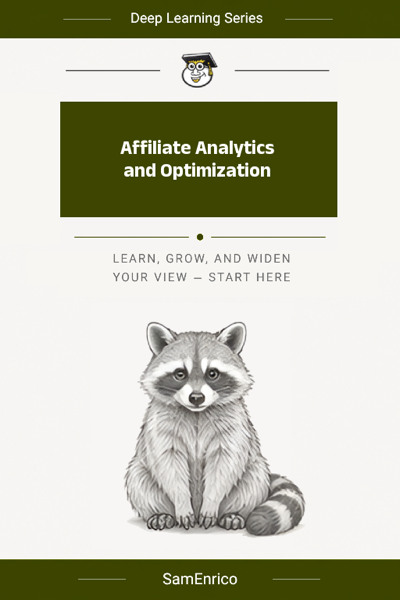
Affiliate Analytics and Optimization eBook
A Coursebook on Affiliate Analytics and Optimizati
A Coursebook on Affiliate Analytics and Optimization
Formats
Free sample
Chapter 1: The Click Delusion--–- The first time I watched an affiliate marketer celebrate 10,000 clicks in a single day, I felt confused. He was practically giddy, high-fiving his laptop screen, already calculating imaginary future earnings. But when I asked him how much money those 10,000 clicks had actually made, his face went blank. He didn't know. He had never bothered to check.
Three weeks later, he quit affiliate marketing entirely, convinced that "the system was rigged" and that "affiliate marketing doesn't work."The truth was far simpler and far more brutal: he had been optimizing for the wrong thing. He had fallen into the Click Delusion – the belief that more clicks automatically mean more money. It is the most expensive mistake in affiliate marketing, and it is also the most common.This book exists to ensure you never make that mistake again.The Case of the Two Affiliates Let me tell you a story about two people who started promoting the exact same product on the exact same day. Both had the same commission rate, the same promotional tools, and the same 30-day cookie window. On paper, they were identical.Affiliate A was a volume machine.
She ran Facebook ads, posted in massive Telegram groups, blasted links through email newsletters, and even experimented with Tik Tok. By the end of her first month, she had generated 10,000 clicks. Her dashboard looked impressive. The click counter kept climbing. She felt productive.Affiliate B was a sniper.
Instead of spraying links everywhere, he focused on one thing: a detailed, 4,000-word review of the product on his niche blog. He sent that review to his small but engaged email list of 500 subscribers. By the end of his first month, he had generated just 500 clicks.Now, pause here. If you were a merchant running an affiliate program, which affiliate would you bet on? If you said Affiliate A because 10,000 is bigger than 500, you have just failed the first test of this book.Here is what actually happened.Affiliate A's 10,000 clicks produced 50 sales.
That is a conversion rate of 0.5%. At a $20 commission per sale, she earned $1,000. Her Earnings Per Click – which we will call EPC from now on, and which you will learn to love – was exactly $0.10.Affiliate B's 500 clicks produced 150 sales. That is a conversion rate of 30%. At the same $20 commission per sale, he earned $3,000.
His EPC was $6.00.Affiliate B made three times more money from twenty times less traffic.Let those numbers sink in.Ten thousand clicks. Five hundred clicks. The affiliate with less traffic won by a landslide because his traffic was better. Not luckier. Not richer.
Better.The Myth That Keeps Affiliates Poor The Click Delusion is not accidental. It is deliberately reinforced by almost every platform in the affiliate marketing ecosystem.Ad networks want you to believe that more clicks are always better because they sell you those clicks. Affiliate networks display click counts prominently because high click volume makes their platforms look active. Dashboard designers put click counters front and center because they are easy to measure. Easy does not mean useful.Here is the hard truth that most affiliate marketers never learn: you can not spend clicks.
You can not retire on clicks. You can not pay your mortgage with clicks.You can only spend commissions. And commissions come from conversions, not from clicks.The Click Delusion is a specific form of what psychologists call activity bias – the human tendency to feel productive when we are busy, regardless of whether that busyness produces results. Sending 10,000 links into the world feels productive. Tweaking ad campaigns for hours feels productive.
Watching your click counter tick upward is genuinely satisfying on a neurological level. Your brain releases small amounts of dopamine with each new click, training you to chase volume like a lab rat chasing a pellet.But activity bias is not your friend. It is the enemy of profit.The solution is to replace activity bias with what I call profit bias – the relentless focus on outcomes rather than outputs. Activity bias asks, "How many clicks did I get?" Profit bias asks, "How much money did I keep?" These are completely different questions, and they lead to completely different behaviors.Introducing the Optimization Loop Throughout this book, you will return again and again to a single framework. I call it the Optimization Loop, and it has four steps:Test → Measure → Analyze → Adjust Let me explain each step briefly before we spend the rest of the book applying them.Test.
You cannot optimize what you never change. Testing means deliberately trying something new – a different headline, a new traffic source, a redesigned landing page, a changed email subject line – with the explicit intention of comparing it to what you were doing before. Without testing, you are guessing. And guessing is not a strategy.Measure. You cannot learn from a test if you do not track the results.
Measurement means collecting data about what actually happened. How many clicks? How many conversions? What was the EPC? But here is the critical insight: measurement only works if you measure the right things.
Measuring clicks while ignoring conversion rate is like measuring how many times you swung a baseball bat while ignoring how many times you hit the ball. It is activity bias disguised as analytics.Analyze. Data alone is noise. Analysis is the process of turning data into insight. Why did Version A outperform Version B?
Was the difference statistically significant, or was it random chance? Which segments responded differently? Analysis answers the "so what" question that measurement alone cannot touch.Adjust. Insight without action is worthless. Adjustment means taking what you learned and applying it to your next test.
If email subject line A beat subject line B by 40%, you send subject line A to your whole list and then test something else. If Facebook traffic converts at 0.5% while organic search converts at 5%, you shift your budget away from Facebook and double down on SEO. Adjustment is how improvement becomes actual profit.Here is what makes the Optimization Loop powerful: it never ends. You test, measure, analyze, adjust, and then test again. The moment you stop looping is the moment you stop improving.
And in affiliate marketing, standing still is the same as falling behind.Every technique, every metric, and every strategy in this book lives inside this loop. Chapter 10 will teach you the scientific method for running A/B tests – that is the "Test" step in action. Chapter 12 will give you a dashboard cadence for daily, weekly, and monthly measurement – that is "Measure" and "Analyze" on a schedule. But the loop itself starts here, in Chapter 1, because it is the foundation upon which everything else is built.Vanity Metrics vs. Sanity Metrics Now that you understand the Optimization Loop, we need to talk about what you should actually measure inside that loop.Most affiliate dashboards are overflowing with numbers.
Clicks. Impressions. Click-through rate. Average order value. Conversion rate.
Revenue. Commissions. EPC. ROAS. LTV.
CTR. CPA. The list goes on. If you try to track all of them, you will drown.The solution is to separate metrics into two categories: vanity metrics and sanity metrics.Vanity metrics are numbers that make you feel good but do…
This is the end of the free sample. Get the eBook to keep going. Buy now
About this book
Details
- Author
- Singleton Ada
- Publisher
- SamEnrico
- Language
- English
- Genre
- Non-Fiction, Informative, Educational
- Released
- 2026-06-03
- Pages (approx.)
- 138
- Available as
- eBook, Audiobook

Read better in the ZLOADR app
Your eBooks on your phone or tablet. Sign in with your SamEnrico account and start reading.
More by Singleton Ada
 PTSD Therapy For Conflict Zones ManualSingleton Ada$11.99
 Evidence Log for Self DoubtSingleton Ada$11.99
 Chunking Apps GuideSingleton Ada$11.99
 Time Pressure Driving GuideSingleton Ada$11.99
 The Sobriety Sleep HygieneSingleton Ada$11.99
 Empowerment HandbookSingleton Ada$11.99
 FCPA Successor Liability CasesSingleton Ada$11.99
 TM For AsthmaSingleton Ada$11.99
 Self Talk For Layoff SurvivorsSingleton Ada$11.99
 The Phantom Heist of the Century: The Great Train Robbery of 1963Singleton Ada$11.99
 The Lion of Karkemish: Sennacherib's Defeat at the Euphrates (691 BC)Singleton Ada$11.99
 The World Carved from Bone: The Inuit Cosmic ForgeSingleton Ada$11.99