
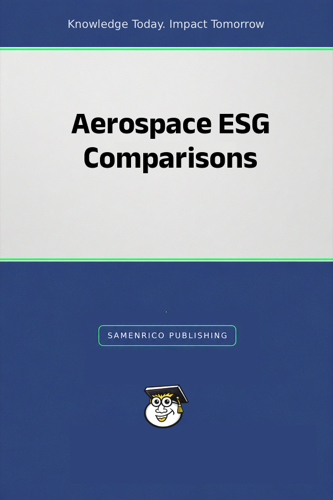
Non-FictionStrategic AtlasAviation ESG
Aerospace ESG Comparisons
Compare carbon neutrality pledges and supply chain
Compare carbon neutrality pledges and supply chain sustainability among aviation firms.
Formats
About this book
Free sample
Chapter 1: Beyond the Press Release--At first glance, the press release looked like a victory. In March 2020, Delta Air Lines declared itself "the first and only U.S. airline to cap global carbon emissions from that day forward," pledging carbon neutrality across its entire global operation. The language was bold, the commitments ambitious, and the headlines flattering. Investors applauded.
Environmental groups issued cautious praise. Competitors scrambled to issue similar statements.But beneath the glossy marketing language lay a complex reality that few analysts took the time to decode. Delta's neutrality was achieved almost entirely through carbon offsets—purchased credits from forestry and land-use projects—not through reductions in jet fuel burn. The airline continued to burn fossil kerosene at essentially the same rate. And the offsets themselves?
Many came from projects that independent auditors would later question for additionality, the critical test of whether the emissions reduction would have happened anyway without the offset purchase.This gap between announcement and actuality is not unique to Delta. Across the aerospace sector, from full-service carriers to low-cost operators, from original equipment manufacturers to maintenance providers, companies are making increasingly ambitious environmental claims. The vocabulary has expanded: carbon neutral, net-zero, science-based targets, CORSIA compliance, Scope 1, 2, and 3, Sustainable Aviation Fuel certificates, book-and-claim, insetting, offsetting, removal, avoidance, reduction. Each term carries specific technical meaning, yet in the hands of marketing departments, these distinctions often blur into a uniform haze of environmental virtue signaling.The problem is not that airlines are lying—most are not. The problem is that without a standardized framework for comparison, stakeholders cannot distinguish between genuine transformation and strategic communication.
An investor evaluating two airlines, both claiming "net-zero by 2050," has no way to know that one plans to achieve 80 percent of its reductions through direct fuel switching and fleet renewal, while the other plans to achieve 80 percent through purchasing the cheapest available carbon credits on the voluntary market. A corporate travel manager selecting a carrier for a sustainability mandate cannot tell which airline's SAF pledge represents physical fuel uplift versus certificates purchased from a broker. A lessor deciding which aircraft…
This is the end of the free sample. Get the eBook to keep going. Buy now
Contents
- Chapter 1
- Chapter 2
- Chapter 3
- Chapter 4
- Chapter 5
- Chapter 6
- Chapter 7
- Chapter 8
- Chapter 9
- Chapter 10
- Chapter 11
- Chapter 12
Details
- Author
- Loper Pandora
- Publisher
- SamEnrico
- Language
- English
- Genre
- Non-Fiction, Strategic Atlas, Aviation ESG
- Released
- 2026-06-06
- Pages (approx.)
- 148
- Available as
- eBook, Audiobook

Read better in the ZLOADR app
Your eBooks on your phone or tablet. Sign in with your SamEnrico account and start reading.
More by Loper Pandora
 The Forgiveness Metta GuideLoper Pandora$11.99
 The Stress Recovery ParadoxLoper Pandora$11.99
 Chemical Pregnancy Support HandbookLoper Pandora$11.99
 The Letting Go of Resentment LogLoper Pandora$11.99
 The Tunguska Enigma: When the Sky Blew UpLoper Pandora$11.99
 Pet First Aid InstructorLoper Pandora$11.99
 Understanding Sarcoma, GranulocyticLoper Pandora$17.99
 Foreign LLC Qualification GuideLoper Pandora$12.99
 SA Business Credit Score GuideLoper Pandora$12.99
 10 Ways to Use Dextrose (Recipe Book)Loper Pandora$11.99
You may also like
 Hong Kong Handover 1997Dunn Johnnie$11.99
 Zumba For Postnatal Recovery CourseNeal Christian$11.99
 Zumba for BeginnersLadner Nikia$11.99
 YouTube Comment Mining GuideHumes Pandora$12.99
 Worry Box MeditationCarlin Rudy$11.99
 Workplace Stress MeditationNguyen Lynn$11.99
 Workplace Stress and Sleep RepairHawley Ivory$11.99
 Workplace Perfectionism CureDelaney Jeffry$11.99
 Workplace Injustice Anger GuideWallen Isabelle$11.99
 Work Addiction and Burnout LinkGreenwood Ester$11.99
 Women in Yoga and WellnessBeattie Galina$11.99
 Women in Stand Up ComedyChun Evangeline$11.99