
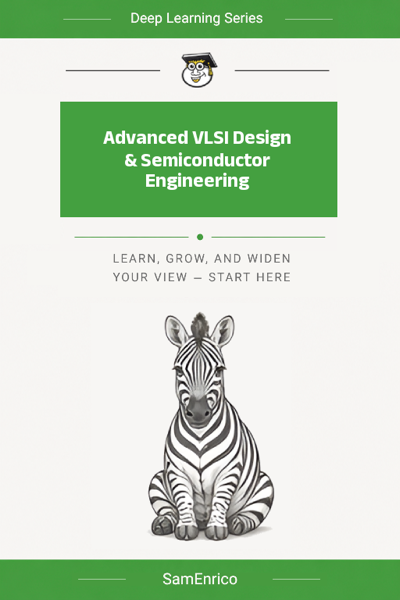
Non-FictionInformativeEducational
Advanced VLSI Design & Semiconductor Engineering eBook
A Coursebook on Advanced VLSI Design & Semiconduct
A Coursebook on Advanced VLSI Design & Semiconductor Engineering
Formats
Free sample
Chapter 1: The Dennard Funeral--The year is 2005. A senior design team at Intel is huddled around a simulation report that should not exist.They are working on the next-generation Pentium 4, codenamed "Presler," targeted for a 65nm process. For thirty years, they have ridden a beautiful, predictable wave: shrink the transistor, and everything gets better. Frequency goes up. Power per transistor goes down.
Cost per function plummets. This is the magic of Dennard scaling, named after IBM physicist Robert Dennard, who observed in 1974 that as transistors get smaller, their power density stays constant. In practice, this meant each new process node delivered a free lunch: faster chips that did not run hotter.But the Presler simulations are telling a different story. The 65nm transistors are faster, yes. But they are not cooler.
In fact, the power density is climbing. The chip is running so hot that the thermal simulation shows hotspots exceeding 130°C—past the point where silicon starts leaking current uncontrollably, past the point where reliability becomes a coin flip.The engineers check their models. They check again. The math is correct.Dennard scaling is dead. No one sent a memo.This chapter is about what happened next.
It is about the four forces—Cost, Power, Performance, and Variability—that now constrain every chip you will ever design. It is about the strange new world of Dark Silicon, where most of your chip must remain powered off most of the time. And it is about a new metric, Energy-Delay Product, that has replaced raw frequency as the true measure of a great design.If you take only one thing from this book, take this: the old rules are gone. The sooner you accept that, the sooner you start building chips that actually work.The Great Freeze: When Dennard Scaling Died Let us go back to the golden age, because you need to understand what was lost.From 1974 to roughly 2004, semiconductor engineers lived in a linear world. Every two years, Moore's Law doubled the number of transistors on a chip.
But Moore's Law alone was not enough—those transistors needed to get faster and more efficient. That was Dennard's contribution.Dennard scaling said: if you shrink all transistor dimensions (length, width, oxide thickness) and voltages by the same factor (say, 0.7x), then three beautiful things happen. First, the transistor switches faster because the channels are shorter. Second, the power per transistor drops because the capacitance and voltage both shrink. Third, power density—power per unit area—stays constant, because you are packing more transistors into less space, but each one uses less power.This was the engine of the digital revolution.
It meant that Intel could take a 386, shrink it to 486, and get a chip that was faster, cooler, and cheaper to manufacture. It meant that your Pentium II ran at 233MHz while consuming roughly the same power as a 166MHz Pentium. It meant that Dennard scaling was the invisible subsidy behind every performance gain for three decades.Then, around 2005, the subsidy ran out.The problem was voltage. Dennard scaling required that supply voltage (VDD) shrink in proportion to transistor dimensions. For years, it did: from 5V in the 1980s to 3.3V, to 2.5V, to 1.8V, to 1.2V.
But below 1V, things get difficult. Transistors need a minimum voltage to switch reliably—about 0.6V to 0.7V for conventional CMOS. Further reduction requires exotic materials (like III-V compounds) or radically different device structures (like tunnel FETs). Neither was ready for high-volume manufacturing.So voltage stopped scaling. At 90nm, VDD was around 1.2V.
At 65nm, it was still 1.1V. At 45nm, 1.0V. The voltage was not dropping fast enough to keep pace with the transistor density increase.The result was catastrophic: power density started rising exponentially. By 2007, high-performance processors were approaching 100W per square centimeter—roughly the power density of a hot plate. By 2010, some server chips exceeded 150W/cm² at peak load.
Air cooling was no longer sufficient. Liquid cooling, expensive and bulky, became necessary for high-end parts.The industry responded the only way it could: it stopped trying to run all the transistors at once.The Birth of Dark Silicon Dark Silicon is a simple but profound concept. It means that at any given moment, a significant fraction of your chip must be powered off.Not idle in a low-power state. Actually off. No voltage, no current, no switching.
Dark.Why? Because if you turned on every transistor at once, the chip would exceed its thermal budget within microseconds. The heat would spread, hotspots would form, and the silicon would degrade or fail. The cooling solution—whether a fan, a heat sink, or liquid cold plate—can only remove so many watts per square centimeter. That thermal limit, not the transistor count, now determines how much computation you can actually use.Consider a modern high-end GPU.
It might have 80 billion transistors. But at full load, it can only sustain about 300-400W of power dissipation. At 5nm, a billion switching transistors consuming 1W is optimistic—the real number is closer to 2-3W per billion transistors at high frequency. Simple math: 80 billion transistors would consume 160-240W if all switched at once. That is within the thermal envelope, barely.
But the problem is not just total power; it is power density. The compute cores occupy a fraction of the die area, creating hotspots that exceed the average by 2-3x.The result is that a GPU cannot run all its cores at maximum frequency simultaneously. It must "power gate" (completely shut off) some cores while others run. The dark area of the chip changes over time—this core is dark while that one lights up—but at any instant, a substantial percentage of the silicon is doing nothing.Industry data suggests that at 7nm, a typical high-performance processor can only actively use 15-25% of its transistors at any given moment without exceeding thermal limits. At 5nm, that fraction drops to 10-15%.
At 3nm, it may fall below 10%. The rest is Dark Silicon.This is not a bug. It is a feature of modern design. Dark Silicon is the new reality. Your job as a designer is not to turn on everything; it is to decide what to turn on, when, and for how long.The Tetrad: Cost, Power, Performance, Variability Every chip design is a negotiation between four competing forces.
Think of them as the four legs of a table. If you push too hard on one leg, the table tips.Cost Cost is the constraint that non-engineers understand best and engineers understand worst. It is not just about the bill of materials. It is about the entire economic stack: wafer cost, mask cost, packaging cost, test cost, yield, and time-to-market.Let us start with masks. A mask set for a modern process node is one of the most expensive tools in manufacturing.
At 28nm, a full mask set cost about $3 million. At 16nm, $5 million. At 7nm, $12-15 million. At 5nm, $20-25 million. At 3nm, rumors place it above $40 million.These are not numbers from a textbook.
They are real costs that real companies pay. If you are a startup, a $20 million mask set is a bet-the-company expense. If you are…
This is the end of the free sample. Get the eBook to keep going. Buy now
About this book
Details
- Author
- Turpin Lucienne
- Publisher
- SamEnrico
- Language
- English
- Genre
- Non-Fiction, Informative, Educational
- Released
- 2026-06-02
- Pages (approx.)
- 153
- Available as
- eBook, Audiobook

Read better in the ZLOADR app
Your eBooks on your phone or tablet. Sign in with your SamEnrico account and start reading.
More by Turpin Lucienne
 Einstein's Nobel LegacyTurpin Lucienne$11.99
 Drug Dependency Nutrition RecoveryTurpin Lucienne$11.99
 Metta for Sleep DisturbancesTurpin Lucienne$11.99
 Anapanasati for DrivingTurpin Lucienne$11.99
 Food Dream MeaningTurpin Lucienne$11.99
 Parent Home Safety GuideTurpin Lucienne$11.99
 Hypochondria Body ScanTurpin Lucienne$11.99
 Financial Stress For AddictsTurpin Lucienne$11.99
 Billy Crystal 700Turpin Lucienne$11.99
 The Lioness of Meroë: Amanishakheto's Golden CampaignTurpin Lucienne$11.99
 The Celestial Calculators: How Ancient Egypt’s Astronomers Charted the CosmosTurpin Lucienne$11.99
 The Line in the Sand: The Israel-Gaza Conflict ExplainedTurpin Lucienne$11.99
You may also like
 Hong Kong Handover 1997Dunn Johnnie$11.99
 Zumba For Postnatal Recovery CourseNeal Christian$11.99
 Zumba for BeginnersLadner Nikia$11.99
 YouTube Comment Mining GuideHumes Pandora$12.99
 Worry Box MeditationCarlin Rudy$11.99
 Workplace Stress MeditationNguyen Lynn$11.99
 Workplace Stress and Sleep RepairHawley Ivory$11.99
 Workplace Perfectionism CureDelaney Jeffry$11.99
 Workplace Injustice Anger GuideWallen Isabelle$11.99
 Work Addiction and Burnout LinkGreenwood Ester$11.99
 Women in Yoga and WellnessBeattie Galina$11.99
 Women in Stand Up ComedyChun Evangeline$11.99