
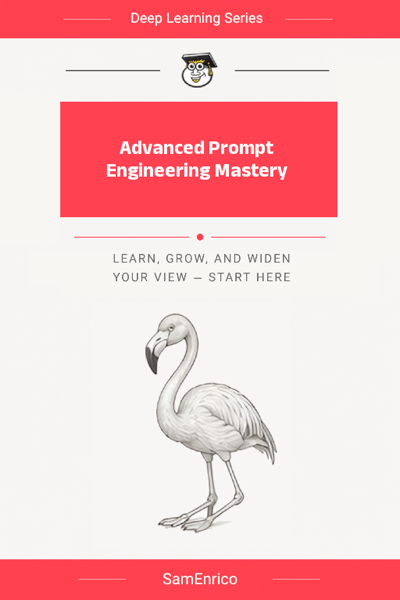
Non-FictionInformativeEducational
Advanced Prompt Engineering Mastery eBook
A Coursebook on Advanced Prompt Engineering Master
A Coursebook on Advanced Prompt Engineering Mastery
Formats
Free sample
Chapter 1: The Prediction Machine--–- In the winter of 2022, a software developer named Ethan asked an artificial intelligence to help him debug a piece of code that had been failing for three days. He pasted the error message, explained the expected behavior, and waited. The AI responded with a detailed analysis, identified a race condition in his threading logic, and provided corrected code. Ethan deployed the fix. It worked perfectly.
He sat back in his chair, stunned, and thought: That thing is smarter than I am.Three hours later, the same developer asked the same AI a simple factual question: "Who wrote the novel The Great Gatsby?" The AI responded with a confident, beautifully written paragraph explaining that the novel was written by Ernest Hemingway in 1924 while he was living in Paris. Ethan laughed out loud. Then he frowned. Then he realized he had no idea how to reconcile these two experiences. How could the same system that flawlessly debugged concurrent code not know who wrote one of the most famous novels in American literature?This moment of confusion—when brilliance meets baffling stupidity—is where every serious prompt engineer begins their journey.
It is also where most people stop. They conclude that AI is unreliable, unpredictable, or simply magic. They memorize a few prompt templates, celebrate the wins, curse the losses, and never develop the mental framework that would make both successes and failures predictable.This book exists to ensure you are not one of those people.Before you can master the art of prompting, before you can chain thoughts, inject personas, or optimize for enterprise scale, you must answer a single foundational question: What is actually happening inside that black box? The answer transforms everything. It transforms frustration into debugging.
It transforms guesswork into engineering. It transforms a magical oracle into a predictable, usable tool.This chapter builds that foundation. We will strip away the metaphors and marketing language. We will look under the hood at the actual mechanics of large language models. We will not write a single line of code, but by the end, you will understand these systems more deeply than ninety percent of the people using them every day.
You will never look at a prompt the same way again.The Great Misconception: Intelligence Versus Statistics Let us start by naming the elephant in the room. Most people, including many who use LLMs professionally, implicitly believe that these models possess something like human intelligence. They use words like "think," "understand," "know," and "reason" to describe what the AI does. When the AI produces a correct answer, they credit its knowledge. When it produces an incorrect answer, they call it a hallucination—a word that implies the model was trying to be accurate but made a mistake.Both interpretations are wrong.The AI does not think.
It does not understand. It does not know anything. It does not reason. It does not have beliefs it can be mistaken about. It has one job, and one job only: given a sequence of words, predict the next word.
That is it. Everything else—the fluent conversations, the code debugging, the poetry, the mathematical proofs, the apparent reasoning, the confident falsehoods—all of it emerges from this single, surprisingly powerful operation.Consider what happens when you type "The capital of France is" into a chat interface. The model does not consult a mental map. It does not recall a fact it learned in training. It performs a massive statistical calculation across its billions of parameters to determine which token is most likely to follow that sequence.
Given how many times the phrase "The capital of France is Paris" appears in its training data, the probability that "Paris" comes next approaches certainty. The output looks like knowledge. It feels like recall. But it is pure pattern matching.This distinction is not academic pedantry. It is the difference between being a passive user and an active engineer.
When you understand that the model is a prediction engine, not a knowledge engine, every behavior becomes legible. You stop being surprised by failures. You start anticipating them. You learn to structure your prompts to guide the prediction machine toward useful outputs and away from confident falsehoods.Tokens: The Alphabet of Prediction Every prediction the model makes begins with a transformation that most users never see. Your words are not processed as words.
They are broken into smaller pieces called tokens.Here is how it works. Take the sentence "Prompt engineering is fascinating." A tokenizer might break this into ["Prompt", " engineering", " is", " fascinating", "."]. Notice that some tokens include spaces. Others do not. The word "engineering" starts with a space token because it appeared after a space.
This seemingly minor detail matters enormously for how models understand boundaries between words.Now take a more complex word: "unhappiness." This becomes ["un", "happi", "ness"]. The word "tokenization" becomes ["token", "ization"]. Rare words, technical terms, and proper names split into even more pieces. Every token has a numerical ID, and the model operates exclusively on these IDs. It does not see letters or words.
It sees a sequence of numbers representing subword fragments.Why should you care about tokens? Three reasons that will directly impact your prompting effectiveness.First, tokens determine your context window. Every LLM has a maximum number of tokens it can process in a single interaction. When this book was written, typical limits ranged from 4,000 tokens for smaller models to 128,000 or even 1 million for cutting-edge models. If your prompt plus the model's response exceeds this limit, the model simply drops the earliest tokens from its attention.
No warning. No summary. Just erasure. Understanding this constraint shapes everything from how long your prompts can be to how you structure multi-turn conversations.Second, tokens explain otherwise mysterious model behaviors. Why does the model sometimes misspell "Washington" as "Washing ton"?
Because the tokenizer splits it that way. Why does it struggle with rare names? Because those names may tokenize into unusual fragments that appeared infrequently in training. Why does code generation sometimes insert spaces in odd places? Token boundary issues.
These are not random errors. They are predictable consequences of the tokenization process.Third, tokens have direct economic consequences. Every API call charges by the token. A prompt using 10,000 tokens costs roughly ten times more than a 1,000-token prompt. The most elegant prompt in the world is useless if it costs too much to run at scale.
Optimizing token usage is not just about performance—it is about economics.Here is a practical exercise you can do right now. Take any sentence you care about and run it through a tokenizer visualization tool. Most model providers offer these publicly. Watch how your words fragment. Notice that common words like "the" and "and" often remain whole while uncommon words split.
Notice that capitalization matters. This simple act of seeing the world through the model's eyes will change how you write prompts forever.Attention: Why Order and Context Matter If tokenization is how the model reads, attention is how it thinks—or rather, how it performs the computation that looks like thinking. The attention mechanism is the innovation that made modern LLMs possible, and understanding it at a conceptual level will…
This is the end of the free sample. Get the eBook to keep going. Buy now
About this book
Details
- Author
- Proctor Donita
- Publisher
- SamEnrico
- Language
- English
- Genre
- Non-Fiction, Informative, Educational
- Released
- 2026-06-02
- Pages (approx.)
- 121
- Available as
- eBook, Audiobook

Read better in the ZLOADR app
Your eBooks on your phone or tablet. Sign in with your SamEnrico account and start reading.
More by Proctor Donita
 Nobel Prize mRNA Vaccine BreakthroughProctor Donita$11.99
 Estate Planning HandbookProctor Donita$11.99
 Drug Dependency and Meaning MakingProctor Donita$11.99Drug Dependency and Meaning MakingProctor Donita$11.99
 Territory Marking BehaviorsProctor Donita$11.99
 The Medicine Nobel Circadian RhythmProctor Donita$11.99
 Mindful Commute MeditationProctor Donita$11.99
 Bankruptcy Proof Contract ClausesProctor Donita$11.99
 Kenai Fjords DisappearancesProctor Donita$11.99
 The Golden Voices of the Nile: The Opera Divas of Ancient KemetProctor Donita$11.99
 The Quantum Tides: Portugal’s Navigators and the Birth of Modern ScienceProctor Donita$11.99
 How to Become a Administrative ClerkProctor Donita$11.99
You may also like
 Hong Kong Handover 1997Dunn Johnnie$11.99
 Zumba For Postnatal Recovery CourseNeal Christian$11.99
 Zumba for BeginnersLadner Nikia$11.99
 YouTube Comment Mining GuideHumes Pandora$12.99
 Worry Box MeditationCarlin Rudy$11.99
 Workplace Stress MeditationNguyen Lynn$11.99
 Workplace Stress and Sleep RepairHawley Ivory$11.99
 Workplace Perfectionism CureDelaney Jeffry$11.99
 Workplace Injustice Anger GuideWallen Isabelle$11.99
 Work Addiction and Burnout LinkGreenwood Ester$11.99
 Women in Yoga and WellnessBeattie Galina$11.99
 Women in Stand Up ComedyChun Evangeline$11.99