
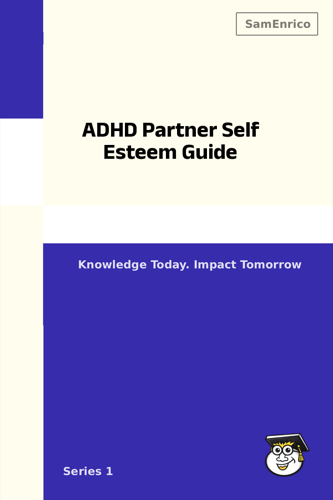
ADHD Partner Self Esteem Guide eBook
Manage rejection sensitivity dysphoria in relation
Manage rejection sensitivity dysphoria in relationships.
Formats
Free sample
Chapter 1: The 20,000 Cuts...--–- The milk. It was just milk. A half-gallon of two percent, the same brand you have bought every Tuesday for four years. You opened the refrigerator, noticed the empty shelf, and said the words without thinking: "Hey, don't forget the milk."That was all.Three words. Seven syllables.
A neutral observation delivered in a tired voice after a long day of work. You were not accusing. You were not criticizing. You were not hinting at a deeper character flaw or cataloging a lifetime of forgotten errands. You were simply reminding someone you love about milk.And yet, twenty minutes later, you are sitting alone in the dark living room while your partner has locked themselves in the bedroom.
Or they are standing in the kitchen doorway with tear-streaked cheeks, asking you why you hate them. Or they have left the house entirely, slamming the door hard enough to rattle the picture frames, and your phone is silent because they have turned it off.You rewind the conversation for the fortieth time. Did your tone sound sharp? Did you roll your eyes without noticing? Did you say "don't forget" instead of "please remember"?
You dissect each syllable like a forensic linguist, searching for the hidden cruelty you must have committed to cause this reaction. Because the alternative—that three ordinary words could trigger this much pain—is too terrifying to accept. If milk can do this, anything can. You are living in a world where the ground might open beneath your feet at any moment, and you have no idea where the fault lines are.This chapter is where the ground stops moving. Not because the RSD will disappear—it will not—but because you will finally understand what is actually happening.
You will learn why a neutral comment about milk can feel like a knife to your partner. You will learn that the shame they carry did not begin with you, and it will not end with you. And most importantly, you will learn that you are not the cause of this chaos. You are not crazy. You are not abusive.
You are the partner of someone with Rejection Sensitive Dysphoria, and no one has ever explained to you what that actually means.Until now.The Scene You Know Too Well Let us stay with the milk for a moment, because the specifics matter. You said, "Don't forget the milk." Your partner heard something entirely different. What they heard was not three words about dairy products. What they heard was a lifetime of accumulated evidence that they are not enough.Here is what actually happens inside their brain during those twenty seconds between your words and their reaction.First, their brain registers your comment as a potential rejection. The content of the comment is irrelevant.
You could have said "I love the way you folded the laundry" and if your tone carried even a microgram of fatigue or distraction, their RSD brain would still register it as a threat. The brain does not wait to analyze context or intention. It reacts first, asks questions never.Second, the emotional pain hits. This is not a metaphor. Neuroimaging studies of RSD show that the same brain regions activated by physical pain—the anterior cingulate cortex and the insula—light up during perceived social rejection.
Your partner is not being dramatic when they say something hurts. Their brain is processing your words the same way it would process a broken bone.Third, the shame reservoir overflows. By the time your partner reached adulthood, they had already accumulated a lifetime of negative messages. Dr. William Dodson, a leading ADHD specialist, calculated that by age twelve, a child with ADHD receives approximately twenty thousand more negative messages than their neurotypical peers.
Twenty thousand. That is not an exaggeration or a rounding error. That is twenty thousand moments when a teacher said "Why can't you sit still?" A parent said "You're not trying hard enough." A classmate said "You're so annoying." A coach said "You're letting the team down." A sibling said "Why do you always ruin everything?" Each message lands like a small cut. Most heal. But twenty thousand cuts leave scars, and those scars become a reservoir of shame that never fully empties.Fourth, the defensive action triggers.
The brain, flooded with pain and shame, demands immediate relief. For some partners, relief looks like lashing out: "You never appreciate me! You think I'm useless! Everyone thinks I'm useless!" For others, relief looks like withdrawal: silence, stonewalling, leaving the room, shutting down entirely. Neither response is a choice.
Both are survival reflexes, as involuntary as jerking your hand away from a hot stove.You are not fighting your partner. You are fighting a neurological fire alarm that has been malfunctioning since childhood, and you are losing because you did not even know there was a fire alarm.The Statistic That Changes Everything Let us look more closely at those twenty thousand negative messages, because this number is the single most important piece of information you will carry from this book.By age twelve. Twenty thousand. More negative messages than positive ones by a ratio of approximately six to one. This is not because the parents of children with ADHD are cruel or incompetent.
It is because children with ADHD require, on average, twenty-six more prompts per day to complete basic tasks than neurotypical children. Each prompt—"Please sit down," "Focus on your worksheet," "Stop tapping your pencil," "Did you write down your homework?"—lands as a correction. Each correction, over time, becomes internalized as evidence of defect.The teacher who says "Try harder" is not trying to wound. The parent who sighs "Why can't you ever remember anything?" is exhausted, not malicious. The peer who rolls their eyes and turns away is immature, not evil.
But the child with RSD does not have the neurological capacity to distinguish between "This behavior was annoying" and "I am inherently annoying." Their brain collapses the specific into the global, the momentary into the permanent, the correction into the condemnation.By the time your partner met you, the reservoir was already full. You did not fill it. You cannot drain it. But you are now living downstream from it, and every neutral comment you make lands on top of twenty thousand previous cuts.This is not your fault. It is also not theirs.
It is the inheritance of a neurodevelopmental condition that no one diagnosed early enough to protect them.The Difference Between RSD and ADHDA brief but essential clarification before we go further. Throughout this book, we will primarily discuss RSD in the context of ADHD, because approximately ninety-nine percent of adolescents and adults with ADHD experience RSD. The two conditions are deeply intertwined. The executive function deficits of ADHD—difficulty with working memory, emotional regulation, and impulse control—create the perfect environment for RSD to flourish.However, RSD can also exist independently. Some people without ADHD experience the same extreme sensitivity to perceived rejection, often in the context of atypical depression, borderline personality disorder, or complex trauma.
If your partner does not have an ADHD diagnosis but does have RSD symptoms, the tools in this book still…
This is the end of the free sample. Get the eBook to keep going. Buy now
About this book
Details
- Author
- Schilling Lanita
- Publisher
- SamEnrico
- Language
- English
- Genre
- Non-Fiction, Self-Help, ADHD
- Released
- 2026-06-08
- Pages (approx.)
- 128
- Available as
- eBook, Audiobook

Read better in the ZLOADR app
Your eBooks on your phone or tablet. Sign in with your SamEnrico account and start reading.
More by Schilling Lanita
 OKRs for Parent Child BondingSchilling Lanita$11.99
 Acceptance Sleep MeditationSchilling Lanita$11.99
 Deepshot Dialogue Replacement GuideSchilling Lanita$11.99
 The Recovery Gift A Gratitude PracticeSchilling Lanita$11.99
 The Silk Road's Forgotten Envoys: Spies, Merchants, and the Birth of Global DiplomacySchilling Lanita$11.99
 Aquaponics Systems GuideSchilling Lanita$12.99
 CEO Apology That WorksSchilling Lanita$12.99
 Understanding Immunodeficiency, Microcephaly With Normal IntelligenceSchilling Lanita$17.99
 Unique Train TripsSchilling Lanita$11.99
 How to Start a Bridges Made In Dental Labs Business (Beginners Guide)Schilling Lanita$11.99
You may also like
 Hong Kong Handover 1997Dunn Johnnie$11.99
 Zumba For Postnatal Recovery CourseNeal Christian$11.99
 Zumba for BeginnersLadner Nikia$11.99
 YouTube Comment Mining GuideHumes Pandora$12.99
 Worry Box MeditationCarlin Rudy$11.99
 Workplace Stress MeditationNguyen Lynn$11.99
 Workplace Stress and Sleep RepairHawley Ivory$11.99
 Workplace Perfectionism CureDelaney Jeffry$11.99
 Workplace Injustice Anger GuideWallen Isabelle$11.99
 Work Addiction and Burnout LinkGreenwood Ester$11.99
 Women in Yoga and WellnessBeattie Galina$11.99
 Women in Stand Up ComedyChun Evangeline$11.99