
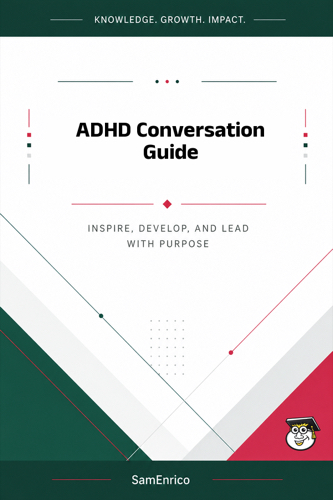
ADHD Conversation Guide eBook
Manages interrupting and topic jumping in small ta
Manages interrupting and topic jumping in small talk.
Formats
Free sample
Chapter 1: The Enthusiasm Loop...--–- The first time I realized I had a problem with interrupting, I was standing in my own kitchen, holding a sponge, watching my sister’s face collapse.She had been telling me about her miscarriage. Three minutes into her story, I launched into a tangent about a podcast I had heard on pregnancy loss statistics. I thought I was connecting. I thought I was showing her I understood. She later told me she felt like I had taken her pain, turned it into a lecture, and handed it back to her like a homework assignment.I did not interrupt her because I was selfish.
I interrupted her because my brain made a frantic, millisecond calculation: She is hurting. I have information that might help. If I do not say it now, I will forget it forever. I chose speed over presence. And I hurt someone I loved.That night, I Googled something I had never dared to type before: “Why do I keep interrupting people?”The search results were brutal.
Most articles assumed I was arrogant, socially clueless, or simply rude. But one forum thread stopped me cold. A woman with ADHD wrote: “I interrupt because when I have a thought, it feels like a live wire. If I don’t say it immediately, the wire touches my skin and burns until I let it out.”That was the moment everything shifted. I was not broken.
I was not cruel. I was running a different operating system.This book is the manual I wish I had that night.The Shame Spiral: Why Most Advice Fails ADHD Brains If you have picked up this book, you have likely been told—repeatedly—that you need to “just listen more” or “wait your turn.” You have probably tried. You have probably failed. And each failure has added another layer of shame to an already heavy stack.Here is what most communication advice gets wrong about the ADHD brain: it assumes you are starting from a place of neurotypical impulse control. It assumes you can hold a thought in your working memory for thirty seconds while someone else finishes speaking.
It assumes your brain has a natural “pause button” installed at the factory.For the ADHD brain, none of these assumptions are true.Shame is not a motivator for the ADHD brain. It is a paralyzer. When you feel shame about interrupting, your nervous system activates the same fight-or-flight response as physical danger. Your heart rate increases. Your muscles tense.
Your working memory—already compromised—collapses further. And then, because your brain is now in threat mode, you interrupt again. Not because you want to. Because your brain is trying to survive the conversation.This is the shame spiral: interrupt, feel ashamed, try harder, fail, feel more ashamed, interrupt more.The only way out is not to try harder. The way out is to understand why your brain interrupts in the first place.The Neuroscience of the Enthusiasm Loop Let me introduce you to a concept that will appear throughout this book: the Enthusiasm Loop.The ADHD brain is chronically under-stimulated in resting states.
Your baseline dopamine level is lower than that of a neurotypical brain. When you are sitting quietly, listening to someone speak at a normal pace, your brain is not calmly waiting. It is searching. It is scanning for something—anything—that will provide a dopamine hit.Then the other person says something interesting. A word, a story, a question that sparks a connection.
Suddenly, your brain lights up. Dopamine floods your system. You feel excited, engaged, alive.Here is the cruel twist: the act of listening produces a small dopamine increase. But the act of speaking—especially speaking about something you are passionate about—produces a much larger one. Your brain learns, very quickly, that interrupting with a related thought or story delivers a rewarding chemical hit instantly.
The longer you wait, the more that dopamine fades.This is the Enthusiasm Loop in action:You hear something interesting.Your brain releases a burst of dopamine (excitement).You feel an urgent need to respond now.You interrupt or blurt out your thought.Your brain receives another dopamine hit (reward).The cycle strengthens for next time.Your brain is not punishing you for interrupting. It is rewarding you. Every interruption is a tiny chemical celebration. You are literally addicted—at a neurochemical level—to the act of jumping in.Understanding this loop is the first step to breaking it. You cannot shame yourself out of a reward cycle.
You can only replace it with a different cycle.Aggressive Interrupting vs. Enthusiastic Blurting: A Critical Distinction Before we go any further, we need to make a distinction that will save you years of unnecessary guilt.Aggressive interrupting is when you cut someone off to dominate the conversation, dismiss their point, or assert superiority. It is intentional. It is strategic. It sounds like: “Actually, that’s wrong.
Here’s the real answer.” Aggressive interrupting is a behavioral choice, not a neurological symptom. If this is your pattern, this book may help, but you likely need additional support around emotional regulation and interpersonal communication.Enthusiastic blurting is what most ADHD adults experience. You are not trying to dominate. You are trying to connect. You are excited.
You are afraid of forgetting your thought. You are jumping in because the conversation has sparked something alive in you. Enthusiastic blurting sounds like: “Oh! That reminds me of—” or “Yes! And also—” or “That happened to me too, except—”The difference is intent.
Aggressive interrupting says: “What I have to say is more important than what you are saying.” Enthusiastic blurting says: “What you said is so important that my brain immediately generated a connection, and I am terrified of losing it.”One is about power. The other is about fear and excitement.Most ADHD adults have been told their entire lives that their enthusiastic blurting is aggressive interrupting. They have internalized a lie. And that lie has cost them friendships, jobs, and self-worth.The Enthusiasm Signature: How Your Body Warns You Before You Blurt Here is a question most ADHD communication books never ask: What does your body feel like right before you interrupt?Not the moment after—the moment before. The half-second when the thought is forming but has not yet left your mouth.For most ADHD adults, there is a physical signature that precedes every blurt.
I call this your Enthusiasm Signature.For some people, it is a tightness in the chest—like a spring being compressed. For others, it is a leaning forward, a lifting of the shoulders, a sudden stillness in the hands. Some people feel a rush of heat in their face. Others feel their tongue press against their teeth, as if the words are already trying to escape.Your Enthusiasm Signature is unique to you. And once you learn to recognize it, you have something incredibly valuable: a warning system.The next time you are in a conversation, pay attention.
Do not try to change anything yet. Just notice. When you feel that familiar urge to speak—that pressure building—what does your body do? Where do…
This is the end of the free sample. Get the eBook to keep going. Buy now
About this book
Details
- Author
- Prather Candy
- Publisher
- SamEnrico
- Language
- English
- Genre
- Non-Fiction, Self-Help, ADHD
- Released
- 2026-06-08
- Pages (approx.)
- 148
- Available as
- eBook, Audiobook

Read better in the ZLOADR app
Your eBooks on your phone or tablet. Sign in with your SamEnrico account and start reading.
More by Prather Candy
 LGBTQ Inclusive BenefitsPrather Candy$11.99
 Critical Listening for Debates and ArgumentsPrather Candy$11.99
 Remote Workspace OrganizationPrather Candy$11.99
 Chunking For ParentsPrather Candy$11.99
 Public Speaking Anxiety GuidePrather Candy$11.99
 The Minivan GenerationPrather Candy$11.99
 Carb Loading GuidePrather Candy$11.99
 The Hound of Whitechapel: Sherlock Holmes' Forgotten PartnerPrather Candy$11.99
 The Opium Wars: Britain's Bloody Trade in the East (1839-1842)Prather Candy$11.99
 How to Produce Wallpaper PrimerPrather Candy$11.99
 Service Providers Guide to Horse ExercisersPrather Candy$11.99
 How to Start a Nightwear for Men and Boys Business (Beginners Guide)Prather Candy$11.99
You may also like
 Hong Kong Handover 1997Dunn Johnnie$11.99
 Zumba For Postnatal Recovery CourseNeal Christian$11.99
 Zumba for BeginnersLadner Nikia$11.99
 YouTube Comment Mining GuideHumes Pandora$12.99
 Worry Box MeditationCarlin Rudy$11.99
 Workplace Stress MeditationNguyen Lynn$11.99
 Workplace Stress and Sleep RepairHawley Ivory$11.99
 Workplace Perfectionism CureDelaney Jeffry$11.99
 Workplace Injustice Anger GuideWallen Isabelle$11.99
 Work Addiction and Burnout LinkGreenwood Ester$11.99
 Women in Yoga and WellnessBeattie Galina$11.99
 Women in Stand Up ComedyChun Evangeline$11.99