
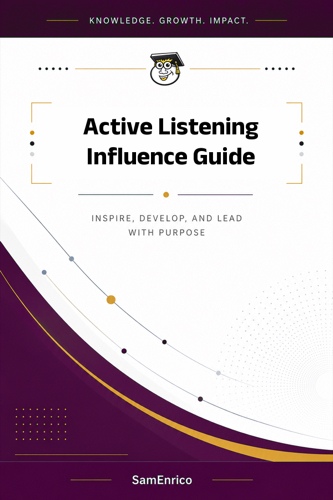
Non-FictionSelf-HelpActive ListeningUnderstanding
Active Listening Influence Guide eBook
Listen fully to understand then guide conversation
Listen fully to understand then guide conversation toward desired outcome.
Formats
Free sample
Chapter 1: The Listening Paradox--–- Most people believe that influence is about speaking well. They think the person with the sharpest arguments, the most confident voice, or the most persuasive words wins the day. This is wrong. It is not only wrong—it is backwards. The person who talks the most reveals the most.
The person who argues the loudest loses the most leverage. And the person who believes they can "talk their way" to a desired outcome is playing a game they have already lost.The hard truth, learned from decades of hostage negotiations, high-stakes sales, and marital counseling, is this: listening is not a passive act of reception. It is the most aggressive form of persuasion available to any human being. When you listen strategically, you do three things simultaneously. First, you disarm resistance, because no one attacks someone who is genuinely hearing them.
Second, you gather intelligence, because people tell you everything when they feel heard. Third, and most critically, you earn the right to guide the conversation. Silence, used correctly, is not empty space. It is a weapon.This chapter introduces the foundational paradox of this book: the more you listen, the more control you have. We will dismantle the myth of eloquence, introduce the Listening Gap, define tactical empathy, and equip you with your first and most counterintuitive tool—dynamic silence.
By the end of this chapter, you will understand why the person who speaks first after a pause has already lost leverage, and you will have a concrete method to ensure that person is never you.The Myth of Eloquence Walk into any bookstore, and you will find shelves of books teaching you how to speak. How to persuade. How to pitch. How to debate. How to "win friends and influence people" through charming words and clever phrases.
The underlying assumption is that influence flows from the mouth outward. Say the right thing at the right time, and the world bends to your will.There is only one problem with this assumption. It is demonstrably false.Consider the data. In a study conducted by researchers at Harvard Business School, negotiators were recorded and analyzed for their speaking-to-listening ratios. The study found that negotiators who spoke for more than 50 percent of the conversation were significantly less likely to reach an agreement than those who spoke less.
More strikingly, the negotiators who spoke the most—those who dominated the conversation—were rated by their counterparts as less trustworthy, less competent, and less likely to be worth future business.Why? Because talking is revealing. Every word you speak is a piece of data you are handing to the other person. Your priorities, your fears, your deadlines, your budget, your emotional state—all of it leaks out through your speech. The person who is listening, truly listening, is collecting this data while giving away almost nothing in return.Think of a poker game.
The player who announces their hand before the final bet is not a master strategist. They are a fool. Yet in conversation, most people do exactly this. They announce their position, defend it, elaborate on it, and argue for it—all before they have any real understanding of what the other person actually wants or fears.This is the Listening Gap. It is the chasm between hearing words and understanding intent.
Most people operate entirely on the wrong side of this gap. They hear sounds, identify keywords that trigger their own rehearsed responses, and then wait for a pause to jump in. They are not listening to understand. They are listening to reply. And because of this, they miss almost everything that matters.The FBI Agent in the Room To understand what real listening looks like, we must go to an unlikely source: the FBI hostage negotiation unit.
These are men and women who walk into rooms with armed individuals who have already taken lives and are prepared to take more. The negotiator has no gun. No handcuffs. No physical authority. They have only one tool: their voice.
And more specifically, their ears.Chris Voss, former lead international hostage negotiator for the FBI, spent decades perfecting the art of what he calls "tactical empathy." The term is worth unpacking because it contains the seed of everything in this book.Empathy, in common usage, means feeling what another person feels. It is emotional resonance. If you are sad, I feel sad. If you are anxious, I feel anxious. This is what psychologists call "emotional empathy," and as we will explore in Chapter 4, it can be dangerous.
It leads to burnout, poor decisions, and bad deals.Tactical empathy is different. Tactical empathy is the practice of identifying the emotions behind the words without absorbing those emotions yourself. It is the difference between reading a map and being lost in the swamp. You can see that the map shows a swamp. You can understand that the swamp is dangerous.
You can even describe the swamp to someone else. But you do not need to step into the swamp and sink.Voss describes tactical empathy as "the ability to understand the feelings and mindset of another in the moment, and to hear what is behind those feelings." Notice the word "hear." This is not about feeling. It is about listening. You listen for the emotion, you identify it, you name it, and then you use that information to guide the conversation.In a hostage negotiation, this looks like the following. The negotiator does not walk in and say, "Put down your weapon." That would be a command, and commands create resistance.
Instead, the negotiator listens. The hostage-taker is usually saying something beneath the threats. They are saying, "I am terrified." Or "I have been wronged." Or "I have nothing left to lose." The negotiator's job is to hear that underlying message and then reflect it back."You seem like a person who has been pushed too far.""It sounds like you feel you have no other options.""I can hear how terrified you are that this will end badly."When the negotiator says these things, something remarkable happens. The hostage-taker feels heard. Not judged.
Not argued with. Not threatened. Heard. And in that moment of being heard, the hostage-taker's nervous system begins to calm down. The fight-or-flight response dims slightly.
The door to negotiation cracks open.This is not magic. It is biology. Human beings are wired to seek social connection and validation. When someone accurately reflects our emotional state, our brains release oxytocin—the same bonding hormone released during physical touch and eye contact. We begin to trust the person who heard us.
And once trust exists, influence becomes possible.The Conversation You Are Losing Right Now Let us make this concrete. Imagine you are in a sales meeting. You have prepared an impeccable presentation. Your slides are beautiful. Your arguments are airtight.
Your pricing is competitive. You sit down across from a potential client, and you begin.You explain your product's features. You highlight the benefits. You compare yourself favorably to competitors. You answer questions.
You overcome objections. You talk. And talk. And talk.At the end, the client says, "Thank you. We will think about it." And…
This is the end of the free sample. Get the eBook to keep going. Buy now
About this book
Details
- Author
- Kauffman Deanne
- Publisher
- SamEnrico
- Language
- English
- Genre
- Non-Fiction, Self-Help, Active Listening, Understanding
- Released
- 2026-06-09
- Pages (approx.)
- 143
- Available as
- eBook, Audiobook

Read better in the ZLOADR app
Your eBooks on your phone or tablet. Sign in with your SamEnrico account and start reading.
More by Kauffman Deanne
 LinkedIn Job Title HierarchyKauffman Deanne$11.99
 Time Blocking with ToddlersKauffman Deanne$11.99
 The Menopause Tinnitus Relief WorkbookKauffman Deanne$11.99
 High Risk AI Systems ChecklistKauffman Deanne$11.99
 Shirō the Lute’s Last Serenade: The Yokai’s Melancholic BalladKauffman Deanne$11.99
 How to Start a Burglar and Fire Alarms for Household Use (wholesale) Business (Beginners Guide)Kauffman Deanne$11.99
 Southeast Asia Talent GuideKauffman Deanne$12.99
 Imposter Before Podium WorkbookKauffman Deanne$12.99
 Understanding Kaposiform HemangioendotheliomaKauffman Deanne$17.99
 Random SurfingKauffman Deanne$11.99
You may also like
 Hong Kong Handover 1997Dunn Johnnie$11.99
 Zumba For Postnatal Recovery CourseNeal Christian$11.99
 Zumba for BeginnersLadner Nikia$11.99
 YouTube Comment Mining GuideHumes Pandora$12.99
 Worry Box MeditationCarlin Rudy$11.99
 Workplace Stress MeditationNguyen Lynn$11.99
 Workplace Stress and Sleep RepairHawley Ivory$11.99
 Workplace Perfectionism CureDelaney Jeffry$11.99
 Workplace Injustice Anger GuideWallen Isabelle$11.99
 Work Addiction and Burnout LinkGreenwood Ester$11.99
 Women in Yoga and WellnessBeattie Galina$11.99
 Women in Stand Up ComedyChun Evangeline$11.99