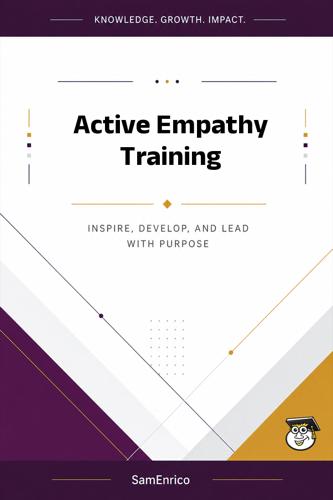
Active Empathy Training eBook
Moves beyond sympathy to truly feeling with anothe
Moves beyond sympathy to truly feeling with another person.
Formats
Free sample
Chapter 1: The Sympathy Trap--Most people believe they know how to comfort a friend in pain. They lean in, offer a gentle touch, and say the words that have been passed down through generations of well-intentioned helpers: "I'm so sorry. It's going to be okay. You'll get through this." These words feel right. They feel compassionate.
They feel like love.They are wrong.Not morally wrong. Not maliciously wrong. But strategically, biologically, and relationally wrong. The standard sympathetic response—the one we've all been trained to deliver since childhood—does not create connection. It creates distance.
It does not reduce suffering. It often increases it. And worst of all, it feels so natural that most people never notice the damage it causes.This chapter is the foundation of everything that follows. Before you learn the neuroscience of mirror neurons, before you practice the tactical tools of FBI negotiators, before you apply active empathy to your marriage or your workplace—you must first unlearn the habit that has been sabotaging your relationships your entire life. You must recognize the sympathy trap.The Day Empathy Died Let me describe a scene that has played out millions of times, in a thousand variations, across every culture and language.Your friend Sarah just lost her job.
She calls you, her voice cracking, and tells you the news. She spent three years building that team. She moved cities for that role. She turned down other offers. And now, in a fifteen-minute Zoom call with HR, it's gone.You listen for a moment.
Then you say: "I'm so sorry. That's horrible. But honestly, you're so talented. You'll find something better. This might be a blessing in disguise."What just happened?On the surface, you offered comfort.
You acknowledged her pain, expressed sympathy, and tried to provide hope. But beneath the surface, something else occurred. You shifted the focus from her present suffering to a hypothetical future solution. You minimized the magnitude of her loss by suggesting it might actually be good for her. And most critically, you moved yourself from the arena—standing alongside her in the mud of her grief—to the bleachers, where you could observe her pain from a safe distance without getting your own feet wet.This is the sympathy trap.The Triad of Compassion: Three Ways to Respond to Pain To understand why sympathy fails, we must first understand what it is—and what it is not.
The Triad of Compassion maps the three distinct ways human beings respond to another person's suffering. Each occupies a different position on the spectrum of emotional proximity.Pity: "Poor you."Pity is the most distant response. It implies a power differential: I am above you, looking down at your misfortune. The language of pity is "poor thing," "how awful for you," "you poor dear." Pity contains a subtle judgment—the person being pitied is somehow lesser, weaker, or more unfortunate than the one offering pity. No connection occurs here.
Only hierarchy. Pity is the emotional equivalent of tossing a coin to a beggar and walking away.Sympathy: "I feel sad for you."Sympathy is closer than pity, but it still maintains separation. When you feel sympathy, you experience your own emotion—sadness, concern, tenderness—in response to someone else's situation. But notice the grammar: "I feel sad for you." The feeling is yours. The situation is theirs.
The two remain distinct. Sympathy says, "I see your pain from over here, and it makes me feel something over here." It is a vicarious emotion, not a shared one. Sympathy is the place where most well-meaning people live. It feels compassionate. It looks compassionate.
But it creates an invisible wall.Active Empathy: "I am here with you."Active Empathy dissolves the wall. It does not observe from a distance or feel its own separate emotion. It steps into the arena, sits down in the mud, and says, "I am here. I am with you. I do not know your exact pain, but I am willing to feel alongside you." Active Empathy is not about words.
It is about presence. It is about co-regulation—the biological process by which one nervous system calms another through sheer proximity and attention. Sympathy says, "I feel sad about your situation." Active Empathy says, "I feel with you in this moment."The difference is the difference between watching someone drown from the shore and jumping into the water. You cannot rescue anyone from the bleachers.Why Sympathy Disguises Itself as Kindness If sympathy is so problematic, why does it feel so right? Why do we reach for "I'm sorry" as instinctively as we flinch from heat?The answer is uncomfortable: Sympathy often serves the speaker more than the listener.When someone shares pain with you, your brain processes it as a mild threat.
Not because you are selfish or callous, but because you are biologically wired for self-preservation. The same mirror neurons that allow you to feel another person's pain also trigger your own stress response. Your heart rate increases. Your cortisol rises. Your body prepares to either fight, flee, or freeze.Sympathy is a flight response dressed in Sunday clothes."I'm so sorry" creates distance.
"You'll get through this" terminates the emotional exposure. "At least you have your health" reframes the pain as something smaller, less threatening, more manageable—not for the sufferer, but for you. The sympathetic response is often an attempt to end your own discomfort, not theirs. And because it wears the mask of kindness, no one ever calls it out.A study from the University of Virginia found that when people were told they could either sit in silence with a grieving person or offer verbal comfort, the majority chose verbal comfort—and rated their own anxiety levels as significantly lower afterward. The grieving people, however, rated the silent companions as more comforting.
The silence made the listener more uncomfortable and the speaker more comforted. The verbal comfort did the opposite: it relieved the listener at the expense of the speaker.This is the sympathy trap in action. We choose the response that makes us feel better, while believing—sincerely, genuinely believing—that we are helping.The Four Faces of False Comfort Sympathy wears many disguises. Learn to recognize them, because they will appear in your next difficult conversation.Face One: Premature Problem-Solving This is the most common face. Someone shares a problem, and you immediately jump to solutions.
"Have you tried updating your resume?" "Why don't you talk to your manager?" "Here's what worked for me when I lost my job..."Premature problem-solving signals that you find the emotion itself unbearable. You need to replace it with action, because action is manageable and emotion is not. The message received is not "you care about me" but "you can't tolerate my pain."Face Two: The Minimizing Reframe This face sounds optimistic but functions as dismissal. "It's not that bad." "Look on the bright side." "Everything happens for a reason." "At least you have your freedom now."These statements take the speaker's subjective experience of suffering and declare it inaccurate. You are telling them that their pain is too large, too dramatic, too unwarranted.
You are asking them to shrink their experience to a size that fits your comfort level.Face Three: The One-Upmanship This…
This is the end of the free sample. Get the eBook to keep going. Buy now
About this book
Details
- Author
- Lessard Lissette
- Publisher
- SamEnrico
- Language
- English
- Genre
- Non-Fiction, Self-Help / Active Listening
- Released
- 2026-06-06
- Pages (approx.)
- 114
- Available as
- eBook, Audiobook

Read better in the ZLOADR app
Your eBooks on your phone or tablet. Sign in with your SamEnrico account and start reading.
More by Lessard Lissette
 Parent Date Night PlannerLessard Lissette$11.99
 Empathy Fieldwork TechniquesLessard Lissette$11.99
 Withdrawal Emergency ResponseLessard Lissette$11.99
 Blue Zone Fruit GuideLessard Lissette$11.99
 STOP Skill DBT GuideLessard Lissette$11.99
 Anger Restructuring In TherapyLessard Lissette$11.99
 Remote Morning Routine GuideLessard Lissette$11.99
 The Lion of Kandahar: The Siege That Saved Afghanistan (1880)Lessard Lissette$11.99
 Blood on the Rubicon: Caesar's Gambit and the Fall of the RepublicLessard Lissette$11.99
 Service Providers Guide to Auto Glass ReplacementLessard Lissette$11.99
 How to Produce Toilet Bowl CleanersLessard Lissette$11.99
 Peak Load Pricing Energy CostsLessard Lissette$12.99