
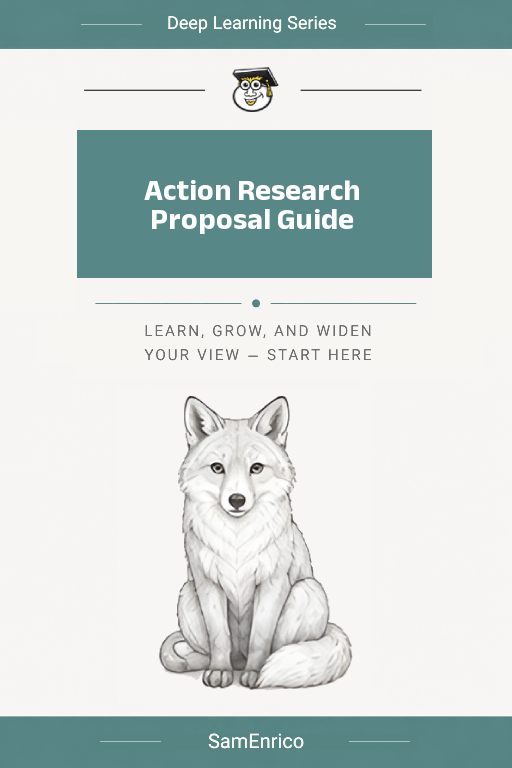
researchStudent's ShortcutAction Research
Action Research Proposal Guide eBook
Write participatory action research proposals for
by Edgar Loura
Write participatory action research proposals for grad school projects. Describe cycles of planning, action, observation, and reflection with stakeholders.
Formats
Free sample
Chapter 1: The Power We Give Away--–- Before we write a single word of your proposal, before we identify a problem, before we recruit a single stakeholder, we need to sit with an uncomfortable truth. Most graduate students enter action research backwards. They start with a method. They start with a timeline. They start with what their advisor expects.
But none of those are the actual foundation of participatory action research. The real foundation is something much harder to write down, much harder to measure, and infinitely more important than any research design. The real foundation is power. Who has it. Who doesn't.
And most critically, what we are willing to give away.This chapter is not a gentle warm-up. It is not a literature review you can skim. It is an invitation to rewire how you think about research itself. If you come from traditional social science training, much of what follows will feel wrong. It will feel unrigorous.
It will feel dangerously subjective. That discomfort is not a sign that you are doing something wrong. That discomfort is the door. Walk through it.We need to be clear from the first page: this book will not teach you how to write a proposal that looks like everyone else's. We will not give you a template that you can fill in while keeping your assumptions intact.
We are going to ask you to do something much harder. We are going to ask you to design research that you do not fully control. Research where the people you used to call "subjects" become co-authors of every decision. Research where your dissertation or thesis is not the final product but a waypoint in a longer process of collective change. That sounds noble in the abstract.
In practice, it is terrifying. Let us name that terror now so we can work with it rather than pretend it does not exist.The graduate students who succeed at participatory action research are not the ones with the most sophisticated statistics or the most elegant theories. They are the ones who learn, often painfully, how to share power without abandoning their responsibility as researchers. They are the ones who discover that giving away control does not mean giving away rigor. It means trading one kind of rigor for another.
This chapter introduces the philosophical and ethical bedrock of that trade.What Participatory Action Research Is Not Before we define what PAR is, we need to clear away the misunderstandings that clog almost every introductory conversation. We have sat in too many graduate seminars where someone says, "Oh, PAR is just qualitative research with interviews" or "PAR is community-engaged research where you ask people for feedback at the end." Those definitions miss the point so completely that they are not just wrong but harmful. They let researchers off the hook. They let us continue to hold power while performing participation.Participatory action research is not community feedback. Feedback happens after you have already made decisions.
PAR makes decisions with stakeholders from the beginning. You do not design a study, run it, and then ask people what they thought. That is consumer research. That is a satisfaction survey. That is not PAR.Participatory action research is not extended fieldwork where you happen to be nice to people.
You can spend years in a community, build genuine friendships, and still conduct research that extracts knowledge for your own career advancement. The difference between ethnography and PAR is not the length of time you spend in the field. The difference is who controls the research questions, who owns the data, and what happens to the findings. If you leave with a dissertation and the community has nothing they can use, you did not do PAR. You did traditional research with better manners.Participatory action research is not a method.
You cannot learn PAR by memorizing a set of techniques. You cannot buy a PAR software package or follow a PAR checklist and call it done. PAR is a stance. It is a way of being in relationship with research participants that prioritizes their agency, their knowledge, and their goals alongside your own. Methods emerge from that stance, but the stance itself is what matters.
That is why so many proposals fail. They list participatory methods without any participatory philosophy, and the result is a hollow shell that no stakeholder would ever recognize as collaborative.We have seen graduate students submit proposals that use words like "co-creation" and "stakeholder engagement" while the actual design leaves no room for anyone else to make a meaningful decision. That is not PAR. That is traditional research with a fresh coat of vocabulary. And it fails on two counts.
First, it fails the stakeholders, who sense immediately when their input is theatrical. Second, it fails the student, because a thesis committee that knows PAR will see through the performance and reject the proposal.So let us start with what PAR actually is.Three Core Distinctions That Change Everything Participatory action research stands apart from conventional social science on three dimensions. We will spend the rest of this chapter unpacking them. But we need to state them upfront so you have a map.Purpose. Conventional research aims to produce knowledge.
That knowledge might be descriptive (what is happening), explanatory (why it is happening), or predictive (what will happen next). PAR also produces knowledge, but knowledge is not the final destination. The final destination is action. We do PAR not just to understand the world but to change it. That does not mean PAR is activism without rigor.
It means that the rigor is measured differently. A conventional study is rigorous if its methods are transparent and its conclusions follow from the evidence. A PAR study is rigorous if it meets those criteria and also produces meaningful change for the stakeholders involved. A beautiful study that changes nothing is, by PAR standards, a failure.Power. Conventional research positions the researcher as the expert.
The researcher designs the study, recruits participants, collects data, analyzes findings, and writes the report. Participants provide information. They are sources, not co-investigators. PAR inverts this arrangement. The researcher brings research skills, but stakeholders bring lived experience, local knowledge, and decision-making authority.
The ideal PAR project is one where you, the graduate student, become less necessary over time because stakeholders have learned to conduct their own cycles of inquiry. Your success is measured not by how indispensable you become but by how effectively you transfer your skills.Validity. Conventional validity asks: does this study measure what it claims to measure? Is it generalizable? Are the findings repeatable?
PAR asks different questions. Does this research spur action? That is catalytic validity. Do multiple perspectives shape the findings? That is democratic validity.
Did we follow our own participatory process? That is process validity. These are not softer standards. They are harder standards. It is much easier to run a survey and report descriptive statistics than to convene a stakeholder group, negotiate competing priorities, and produce findings that everyone agrees are useful.
PAR validity requires constant negotiation, documentation, and self-reflection. There is no hiding behind methodological jargon.These three distinctions are not abstract philosophy. They will determine…
This is the end of the free sample. Get the eBook to keep going. Buy now
About this book
Details
- Author
- Edgar Loura
- Publisher
- SamEnrico
- Language
- English
- Genre
- research, Student's Shortcut, Action Research
- Released
- 2026-05-29
- Pages (approx.)
- 143
- Available as
- eBook, Audiobook

Read better in the ZLOADR app
Your eBooks on your phone or tablet. Sign in with your SamEnrico account and start reading.
More by Edgar Loura
 The School Toxin PreventionEdgar Loura$11.99
 LSE Online Degree AccreditationEdgar Loura$11.99
 Gaming Nonverbal GuideEdgar Loura$11.99
 Burnout and Sabbatical PlanningEdgar Loura$11.99
 Symphony of the Soul: The Timeless Love Story of Florence Price and Samuel Coleridge-TaylorEdgar Loura$11.99
 How to Start a Boot Upper Business (Beginners Guide)Edgar Loura$11.99
 How to Produce Bicycle Foot PegsEdgar Loura$11.99
 Regional Facilities ManagerEdgar Loura$11.99
You may also like
 Scientific Research On TM GuideMartens Nathanial$11.99
 Research Proposal Methodology Section MasteryPauley Debroah$11.99
 Research Proposal Appendix CompilationRaines Tyisha$11.99
 Academic Researcher Distraction GuideFord Virgil$11.99
 TM Research and ScienceCovert Nicki$11.99
 Social Anxiety Research ReviewRoberge Cole$11.99
 Research Proposal Significance Section GuideBock Tory$12.99
 Research Proposal Reviewer PsychologyLugo Tawanda$11.99
 Research Proposal Research Questions DesignLara Robbi$11.99
 Research Proposal References and CitationsPatten Shanice$11.99
 Research Proposal Mixed Methods DesignCameron Omega$11.99
 Research Proposal Data Management PlanAnderson Roberto$12.99