
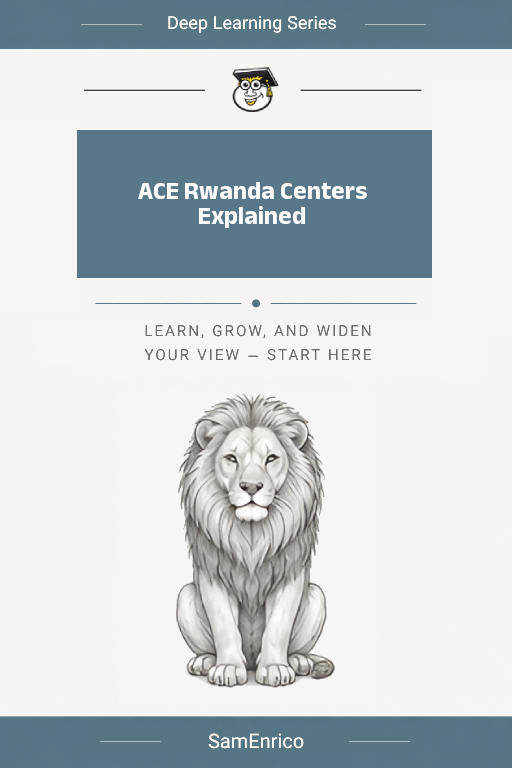
Non-FictionStudent's ShortcutCenters of Excellence
ACE Rwanda Centers Explained eBook
Profiles African Centers of Excellence in Rwanda i
Profiles African Centers of Excellence in Rwanda including ACE in Data Science, Climate, Energy, and Public Health at UR.
Formats
Free sample
Chapter 1: The Data Imperative--–- On a humid morning in Kigali, 2014, a senior official at the Ministry of ICT and Innovation stared at a spreadsheet that told a disturbing story. Rwanda had ambitious plans to become the "Singapore of Africa," a knowledge economy powered by data, algorithms, and artificial intelligence. But the country had a problem hiding in plain sight: there were barely two hundred Rwandans with advanced degrees in statistics, computer science, or econometrics. The entire public sector could field fewer than fifty data scientists. The private sector was poaching from the same shallow pool.
And the university system was producing graduates who had memorized theoretical models but could not clean a messy dataset, build a predictive model, or advise a minister on evidence-based policy.That spreadsheet became a rallying cry. Within two years, the World Bank had approved the Africa Centres of Excellence (ACE) II Project, and the University of Rwanda (UR) had won funding for what would become the continent's most ambitious experiment in graduate-level data science education. This chapter tells the story of that experiment: the African Centre of Excellence in Data Science (ACE-DS) , a institution that has trained nearly eight hundred master's and doctoral students from across East and Southern Africa, co-designed its curriculum with central banks and revenue authorities, and produced research that has reshaped public health, agriculture, and economic planning. But to understand what ACE-DS became, we must first understand the void it was created to fill.The Pre-ACE Landscape: A Continent Starved for Quantitative Talent In the years before ACE-DS opened its doors in 2016, the statistics were sobering. Sub-Saharan Africa, home to fifteen percent of the world's population, produced less than one percent of global research output.
More critically, the region had fewer than twenty doctoral graduates per year in data-intensive fields like biostatistics, econometrics, and computational statistics. Rwanda, despite its post-genocide reconstruction success, was no exception. The country's entire higher education system graduated roughly one hundred master's students annually across all quantitative disciplines—a number dwarfed by the demands of a government implementing Vision 2020 and preparing for Vision 2050.The consequences were tangible. When the Rwanda Revenue Authority wanted to build a predictive model for tax evasion, they hired consultants from Kenya. When the Ministry of Health needed to analyze disease surveillance data, they relied on World Health Organization technical advisors.
When the National Bank wanted to forecast inflation, they used Excel spreadsheets and imported expertise. This was not sustainable. Rwanda had built world-class infrastructure—four thousand kilometers of paved roads, a national fiber-optic backbone, a drone delivery network for blood supplies—but lacked the human capital to manage the data those systems generated.The problem was regional, not merely national. East Africa's growing integration meant that data flowed across borders: trade statistics, disease outbreaks, climate patterns, financial transactions. But there was no regional hub training the statisticians and data scientists who could make sense of that flow.
Students who wanted advanced training had to go to South Africa, Europe, or North America—and most never returned.The World Bank Intervention: ACE II and the Birth of a Vision The Africa Centres of Excellence project was not new. ACE I had launched in West Africa in 2014, focusing on engineering and applied sciences. But ACE II, announced in 2015, was different. It targeted Eastern and Southern Africa, and it explicitly prioritized data science, energy, health, and agriculture. The World Bank committed $150 million across twenty-four centers in eight countries, with each center required to demonstrate regional reach, private sector linkage, and a path to financial sustainability.The University of Rwanda moved aggressively.
A consortium of faculty from the former National University of Rwanda, the Kigali Institute of Science and Technology, and the School of Finance and Banking submitted a joint proposal. They argued that Rwanda's small size was an advantage: a data science center could be agile, responsive to government needs, and less encumbered by bureaucratic inertia than larger universities in Nigeria or Kenya. The proposal won funding in early 2016, and ACE-DS was born.The center's mandate was deliberately ambitious. It would offer master's and doctoral programs in statistics, econometrics, and computer science. It would attract students from across the region.
It would conduct policy-relevant research. And it would survive the initial World Bank funding by building income-generating short courses and consulting services. The first cohort of students arrived in September 2016, walking into borrowed classrooms and using donated laptops. They did not know that they were pioneers.The Academic Arsenal: The "Big Five" Exit Tracks What made ACE-DS different from a traditional statistics department was its laser focus on employability. Every course, every assignment, every thesis was designed with a single question in mind: Will this help a graduate get a job and solve a real problem?
The result was a curriculum organized around five exit tracks, informally known as the "Big Five."Track One: Data Mining and Machine Learning. This was the most popular track, attracting students who wanted to build prediction models for banks, telecoms, and e-commerce platforms. Coursework included supervised and unsupervised learning, natural language processing, and deep learning. Graduates from this track were hired by Rwanda's mobile money operators, Kenyan fintech startups, and Ugandan logistics firms.Track Two: Biostatistics. This track focused on clinical trial design, epidemiological modeling, and analysis of health surveillance data.
Students learned to work with messy, incomplete medical records and to communicate findings to doctors and policymakers. Many graduates ended up at the Rwanda Biomedical Centre, the World Health Organization, or international NGOs like Partners in Health.Track Three: Actuarial Science. The only program of its kind in the region, this track trained students in risk modeling, insurance mathematics, and pension fund analysis. Graduates were immediately snapped up by Rwanda's nascent insurance industry and by regional firms expanding into East Africa.Track Four: Econometrics. This track emphasized time series analysis, causal inference, and economic forecasting.
Students worked with central bank data, trade statistics, and household surveys. Graduates found positions at the National Bank of Rwanda, the Ministry of Finance, and the African Development Bank.Track Five: Statistical Computing and Data Engineering. The most technical track, it focused on database management, cloud computing, and reproducible research workflows. Students learned R, Python, SQL, and cloud platforms. Graduates became the infrastructure builders for the other four tracks, designing the systems that made large-scale analysis possible.Each track required a thesis that solved a real problem using local data.
No purely theoretical projects were permitted. A biostatistics student might analyze maternal mortality data from a district hospital; an econometrics student might model the impact of mobile money on household savings; a data mining student might build a fraud detection algorithm for a cooperative bank. This requirement transformed the center from a classroom into a research engine.The Regional Classroom: Students Without Borders From its first year, ACE-DS embraced a regional identity. Rwanda had no monopoly on talent, and the center's funding required that at least thirty percent of students come from outside the country. The result was a student body that looked like a map of East and Southern Africa.By 2026, ACE-DS had enrolled students from thirteen countries: Rwanda, Burundi, Democratic Republic of Congo, Tanzania, Uganda, Kenya, Ethiopia, South Sudan, Zambia, Malawi…
This is the end of the free sample. Get the eBook to keep going. Buy now
About this book
Details
- Author
- Velazquez Merrill
- Publisher
- SamEnrico
- Language
- English
- Genre
- Non-Fiction, Student's Shortcut, Centers of Excellence
- Released
- 2026-05-30
- Pages (approx.)
- 147
- Available as
- eBook, Audiobook

Read better in the ZLOADR app
Your eBooks on your phone or tablet. Sign in with your SamEnrico account and start reading.
More by Velazquez Merrill
 The Labyrinth WorkbookVelazquez Merrill$11.99
 The Black Dahlia John F. Kennedy ConnectionVelazquez Merrill$11.99
 Fear Of Failure In ArtVelazquez Merrill$11.99
 ABCDE Method Daily UseVelazquez Merrill$11.99
 ABCDE Digital Spreadsheet MethodVelazquez Merrill$11.99
 The Last Stand of the 300: Marathon’s Forgotten TriumphVelazquez Merrill$11.99
 VAT Registration Thresholds EUVelazquez Merrill$12.99
 10 Ways to Use Domaine De Canton (liqueur) (Recipe Book)Velazquez Merrill$11.99
 Understanding Rhizomelic Dysplasia Type Patterson–lowryVelazquez Merrill$17.99
 Marketing SpecialistVelazquez Merrill$11.99
You may also like
 Hong Kong Handover 1997Dunn Johnnie$11.99
 Zumba For Postnatal Recovery CourseNeal Christian$11.99
 Zumba for BeginnersLadner Nikia$11.99
 YouTube Comment Mining GuideHumes Pandora$12.99
 Worry Box MeditationCarlin Rudy$11.99
 Workplace Stress MeditationNguyen Lynn$11.99
 Workplace Stress and Sleep RepairHawley Ivory$11.99
 Workplace Perfectionism CureDelaney Jeffry$11.99
 Workplace Injustice Anger GuideWallen Isabelle$11.99
 Work Addiction and Burnout LinkGreenwood Ester$11.99
 Women in Yoga and WellnessBeattie Galina$11.99
 Women in Stand Up ComedyChun Evangeline$11.99