
Non-FictionSelf-HelpAccounting Profession
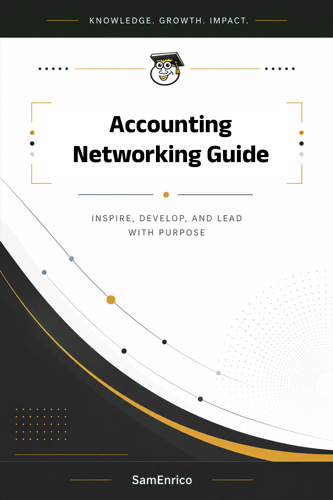
Accounting Networking Guide eBook
Build client and referral relationships in financi
Build client and referral relationships in financial services.
Formats
Free sample
Chapter 1: The Competence Trap--–- The email arrived at 11:47 on a Tuesday night. Clara had been reviewing a client’s quarterly estimates for three hours, cross-referencing every deduction, running the numbers twice, then a third time. She was good at this. She was precise. She had never missed a filing deadline in her entire career, and she took a quiet, unspoken pride in that fact.
The email was from her largest client, a dental group with seven locations. The subject line read: “Moving in a different direction.”Clara read it three times. Then she closed her laptop, poured a glass of wine she did not want, and sat in the dark of her home office. She was not confused about the technical aspects of her work. She knew the returns were flawless.
She knew the bookkeeping was immaculate. What she did not know—what she had never bothered to learn—was why a client who received perfect work would leave without warning.That question would haunt her for the next six months. And it would eventually force her to confront a truth that most accountants spend their entire careers avoiding: technical excellence is not the same as trust, and trust is the only thing that generates referrals.The Myth of the Perfect Return Every accounting firm operates on an unspoken assumption. It is rarely written in any mission statement, rarely discussed in partnership meetings, but it governs almost every hiring decision, every training program, and every billing structure. The assumption is this: if you do excellent technical work, clients will stay, and they will refer their friends.
This is the Competence Trap.The Competence Trap is the belief that being right is the same as being referable. It is seductive because it feels noble. You are not selling. You are not schmoozing. You are simply doing good work and letting the results speak for themselves.
The problem is that the results do not speak. Clients do not walk around telling stories about accurate depreciation schedules. They do not rave about properly categorized expenses. They do not wake up in the middle of the night grateful that their Section 179 election was filed correctly. They expect those things.
Accuracy is the price of admission, not the reason for loyalty.Clara had fallen into the Competence Trap years ago without realizing it. She had built her entire professional identity around being the smartest person in the room. When a client asked a question, she answered immediately—not because she had considered it carefully, but because she wanted to demonstrate her expertise. When a client proposed a risky strategy, she shot it down with data, proud of her rigor. When a referral partner asked about her ideal client, she said “small businesses” and moved on.
She was technically brilliant. And she was invisible.The week after losing the dental group, Clara did something she had never done before. She called the client and asked for an exit interview. The conversation lasted twelve minutes. The client was polite, evasive, and ultimately honest.
“Clara,” he said, “you never made a mistake. But you also never made me feel like you cared whether I succeeded. You answered my questions like I was bothering you. You never asked what kept me up at night. You just… did the work and sent the bill.
I need more than that.”Clara hung up and sat in silence. She had been so focused on being right that she had forgotten to be helpful.The Trust Equation for Accountants This is the moment where most business development books would offer a simple checklist. Smile more. Send handwritten notes. Ask about the client’s kids.
Those things are not wrong, but they are superficial. They miss the deeper structural issue, which is that trust is not a feeling—it is a formula. And if you do not understand the formula, you cannot improve your score.The Trust Equation comes from the consulting bestseller The Trusted Advisor, written by David Maister, Charles Green, and Robert Galford. In its original form, the equation is:Trust = (Credibility + Reliability + Intimacy) / Self-Orientation Every component matters. But for accountants, the equation requires a specific translation.
Let us walk through each element.Credibility is what you know. It is your license, your technical expertise, your ability to produce an accurate return, your knowledge of the tax code, your familiarity with accounting standards. In the Competence Trap, accountants believe that credibility is everything. They pour their energy into continuing education, specialization, and technical precision. They are right to do so—credibility is essential.
But it is not sufficient. Credibility is the floor, not the ceiling. Without it, you cannot even enter the room. But once you are in the room, credibility stops differentiating you. Every competent accountant has credibility.
The question is what you add on top of it.Reliability is doing what you said you would do, when you said you would do it. This sounds simple, but in accounting, reliability is surprisingly rare. Clients tell stories about accountants who disappear during tax season, who miss emails, who promise a return on Friday and deliver it on Tuesday. Reliability is about follow-through, about returning calls within 24 hours, about setting clear expectations and meeting them. Like credibility, reliability is table stakes.
Clients expect it. They will punish you for lacking it, but they will not reward you for having it.Intimacy is where trust begins to take shape. In the context of professional services, intimacy does not mean friendship or personal disclosure. It means the client’s belief that you understand their situation, their fears, their goals, and their constraints. It means you have asked questions beyond the numbers.
It means you know that the dental group owner is terrified of a lawsuit, that the pharmacy chain owner is losing sleep over a PBM audit, that the contractor is worried about making payroll in the slow season. Intimacy is the willingness to say “I do not know” because that vulnerability signals that you care more about accuracy than about looking smart. Intimacy is what Clara had never offered. She had answered questions efficiently, but she had never asked the right ones.Self-Orientation is the denominator of the trust equation, and it is the single most important variable. Self-orientation is the degree to which you are focused on yourself—your billable hours, your firm’s profitability, your reputation, your convenience.
When self-orientation is high, trust collapses. Clients can smell it. They know when you are rushing to get to your next call. They know when you are padding your hours. They know when you care more about their check than their business.
The paradoxical truth is that the best way to build trust is to lower your self-orientation, which means caring less about your own outcomes and more about the client’s. This feels counterintuitive to accountants who have been trained to maximize utilization and realization. But the math is unforgiving: a high denominator destroys even the strongest numerator.Clara took out a piece of paper and scored herself on each component of the trust equation. She gave herself a 9 out of 10 for credibility. A 7 for reliability—she was good but not…
This is the end of the free sample. Get the eBook to keep going. Buy now
About this book
Details
- Author
- Merrick Ivory
- Publisher
- SamEnrico
- Language
- English
- Genre
- Non-Fiction, Self-Help, Accounting Profession
- Released
- 2026-06-10
- Pages (approx.)
- 142
- Available as
- eBook, Audiobook

Read better in the ZLOADR app
Your eBooks on your phone or tablet. Sign in with your SamEnrico account and start reading.
More by Merrick Ivory
 Hair Fibers Concealer GuideMerrick Ivory$11.99
 Side Hustle Task PriorityMerrick Ivory$11.99
 Toddler Sleep Resistance HandbookMerrick Ivory$11.99
 The Senior Driving Cessation GuideMerrick Ivory$11.99
 The Opium Wars of the East: Alexander's Campaign Against the Bactrian TribesMerrick Ivory$11.99
 How to Start a Payroll Bureau Business (Beginners Guide)Merrick Ivory$11.99
 World Bank Agriculture and Food SecurityMerrick Ivory$12.99
 Promotion Business Case For ProductMerrick Ivory$12.99
 Understanding Mental Retardation Short Stature Bombay PhenotypeMerrick Ivory$17.99
 Site ManagerMerrick Ivory$11.99
You may also like
 Hong Kong Handover 1997Dunn Johnnie$11.99
 Zumba For Postnatal Recovery CourseNeal Christian$11.99
 Zumba for BeginnersLadner Nikia$11.99
 YouTube Comment Mining GuideHumes Pandora$12.99
 Worry Box MeditationCarlin Rudy$11.99
 Workplace Stress MeditationNguyen Lynn$11.99
 Workplace Stress and Sleep RepairHawley Ivory$11.99
 Workplace Perfectionism CureDelaney Jeffry$11.99
 Workplace Injustice Anger GuideWallen Isabelle$11.99
 Work Addiction and Burnout LinkGreenwood Ester$11.99
 Women in Yoga and WellnessBeattie Galina$11.99
 Women in Stand Up ComedyChun Evangeline$11.99