
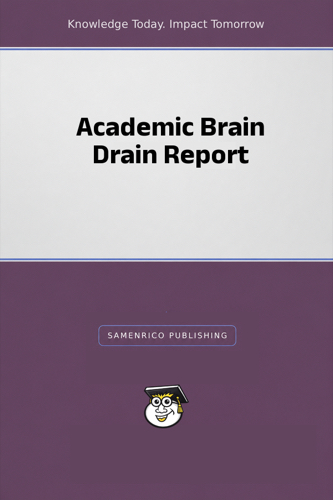
Non-FictionForecast & OutlookEducation
Academic Brain Drain Report
Analyzes professor and researcher migration from d
by Ogle Ashly
Analyzes professor and researcher migration from developing to developed nations.
Formats
About this book
Free sample
Chapter 1: The Invisible Exodus–- In 2019, a professor of biomedical engineering at the University of Zimbabwe published her tenth paper in an international journal. It was her finest work—a novel approach to low-cost diagnostic tools for rural clinics. Six months later, she packed two suitcases, kissed her teenage children goodbye, and boarded a flight to Manchester, England. She had accepted a three-year visiting position at a British university. She told her colleagues she would return.
Two years after that, she applied for permanent residency. She never came back.This is not an anecdote. It is a pattern. And it is happening thousands of times each year, across dozens of countries, in every academic discipline from theoretical physics to postcolonial literature. Yet for decades, the global conversation about academic migration has been trapped between two simplistic poles: the alarmist panic of the 1960s, which saw every departing scholar as a national catastrophe, and the blithe cosmopolitanism of the 2010s, which celebrated mobility as an unqualified good.
Both perspectives miss the essential truth. Academic migration is neither uniformly destructive nor uniformly beneficial. It is a complex, contingent, and deeply uneven process that redistributes the world's cognitive wealth from those who can least afford to lose it to those who have the most to gain.This chapter establishes the conceptual foundation for understanding that redistribution. It introduces a precise vocabulary for talking about academic migration—a vocabulary that moves beyond the tired clichés of "brain drain" and "brain gain" to capture the full range of movements, outcomes, and feedback loops that characterize the contemporary global academy. It distinguishes between permanent loss and temporary circulation, between underemployment within academia and complete occupational exit, between the financial costs to sending nations and the unexpected benefits that sometimes flow back through diaspora networks.
And it introduces the central argument that will structure the entire book: that the net effect of academic migration depends fundamentally on the size, capacity, and stage of development of the sending nation. What is catastrophic for Sierra Leone may be neutral or even positive for India. Understanding why requires that…
This is the end of the free sample. Get the eBook to keep going. Buy now
Contents
- Chapter 1
- Chapter 2
- Chapter 3
- Chapter 4
- Chapter 5
- Chapter 6
- Chapter 7
- Chapter 8
- Chapter 9
- Chapter 10
- Chapter 11
- Chapter 12
Details
- Author
- Ogle Ashly
- Publisher
- SamEnrico
- Language
- English
- Genre
- Non-Fiction, Forecast & Outlook, Education
- Released
- 2026-06-10
- Pages (approx.)
- 151
- Available as
- eBook, Audiobook

Read better in the ZLOADR app
Your eBooks on your phone or tablet. Sign in with your SamEnrico account and start reading.
More by Ogle Ashly
 Vietnamese Green Incentives ManualOgle Ashly$11.99
 The Teething Baby Sleep GuideOgle Ashly$11.99
 Innocence Project Iowa CasesOgle Ashly$11.99
 Portion Control Mastery GuideOgle Ashly$11.99
 The Lost Vikings: The Doomed Expedition of the Northmen and Their Miraculous RescueOgle Ashly$11.99
 The Vermeer Vanishing: How a Forger Fooled the WorldOgle Ashly$11.99
 Understanding Chromosome 2, Trisomy 2q37Ogle Ashly$17.99
 How to Start a Hobby in Performing artsOgle Ashly$11.99
 Wellness In PDP GuideOgle Ashly$12.99
 EE for Master's GraduatesOgle Ashly$12.99
 Developmental Disability Support CoordinationOgle Ashly$11.99
You may also like
 Hong Kong Handover 1997Dunn Johnnie$11.99
 Zumba For Postnatal Recovery CourseNeal Christian$11.99
 Zumba for BeginnersLadner Nikia$11.99
 YouTube Comment Mining GuideHumes Pandora$12.99
 Worry Box MeditationCarlin Rudy$11.99
 Workplace Stress MeditationNguyen Lynn$11.99
 Workplace Stress and Sleep RepairHawley Ivory$11.99
 Workplace Perfectionism CureDelaney Jeffry$11.99
 Workplace Injustice Anger GuideWallen Isabelle$11.99
 Work Addiction and Burnout LinkGreenwood Ester$11.99
 Women in Yoga and WellnessBeattie Galina$11.99
 Women in Stand Up ComedyChun Evangeline$11.99