
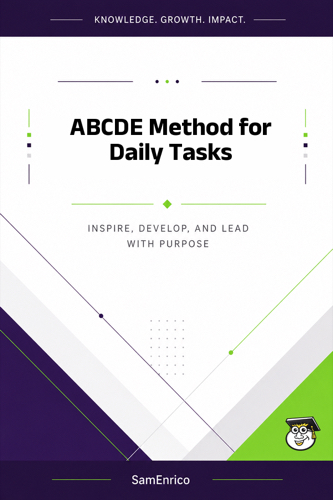
Non-FictionSelf-HelpProductivity
ABCDE Method for Daily Tasks eBook
Teaches labeling tasks A-E based on consequence to
Teaches labeling tasks A-E based on consequence to rank daily to-do lists.
Formats
Free sample
Chapter 1: The Busyness Trap--–- Maria was a high-performing marketing director who worked sixty-hour weeks, answered emails before sunrise, and never left the office before 7 PM. She was proud of her work ethic. Her to-do list averaged twenty-two items per day, and she typically crossed off eighteen of them. By every conventional measure, Maria was productive. And yet, at her annual review, her boss delivered a devastating verdict: her key project was three months behind schedule, her team's morale had cratered, and two major clients had quietly asked to be reassigned to other directors.Maria had done everything right according to the rules she had been taught.
She worked hard. She stayed busy. She never said no. But she had fallen into what this book will call the Busyness Trap: the seductive belief that crossing off many tasks is the same as accomplishing important ones. Her eighteen completed tasks were almost entirely low-impact activities—approving minor expenses, attending status meetings that could have been emails, reorganizing shared drives, and answering hundreds of non-urgent messages.
The four tasks she left undone each day were the ones that mattered: the strategic plan for the upcoming quarter, the difficult conversation with an underperforming employee, the proposal for a new client, and the ninety minutes of deep thinking about where her department needed to go next.Maria is not lazy. She is not unintelligent. She is not unmotivated. Maria is a victim of a broken prioritization system—or more accurately, no system at all. Like most professionals, she was using a flat to-do list: a simple, chronological, undifferentiated list of tasks written in the order they occurred to her.
This is the equivalent of a pilot flying without instruments or a chef cooking without recipes. It is not a system; it is a confession of chaos.The purpose of this chapter is to name the enemy. You cannot defeat a problem you refuse to see. The enemy is not procrastination, though procrastination is a symptom. The enemy is not laziness, though laziness is a comfortable excuse.
The enemy is the Busyness Trap itself—the psychological and environmental forces that reward low-value work while punishing high-value work. This chapter will expose the three pillars of the Busyness Trap: the Flat List Fallacy, the Urgency Bias, and the Visibility Reward. By the end, you will understand why your current to-do list is secretly sabotaging you and why the ABCDE Method is the only reliable escape.The Flat List Fallacy: Why Your To-Do List Is Lying to You Every morning, millions of professionals sit down with a cup of coffee and write a list. Some use paper notebooks. Some use digital apps.
Some use sticky notes that multiply across their monitors like invasive species. The format varies, but the structure is almost always the same: a vertical list of tasks in the order they were thought of, often with little squares next to each item waiting to be checked.This is the Flat List. And it is a lie.The Flat List lies because it presents all tasks as if they exist on the same plane of importance. When you write "Call client about contract renewal" directly above "Order more printer paper," the list implies that these two tasks are comparable. They are not.
Losing the client could cost your company fifty thousand dollars. Ordering printer paper costs twelve dollars and can be done by anyone. But on a flat list, they occupy the same visual space, receive the same little square, and deliver the same dopamine hit when checked.The Flat List also lies because it prioritizes by recency rather than consequence. Humans have a cognitive bias called the recency effect: we remember and privilege the last thing we thought about. When you write your list in the morning, the task you just remembered—perhaps a minor request from a colleague—goes at the top, while the strategic project you have been avoiding for three weeks goes somewhere in the middle or bottom.
The list becomes a map of your anxiety, not a map of your priorities.Consider a simple experiment conducted by productivity researchers at a Fortune 500 company. They asked one hundred managers to write their daily to-do lists as usual. Then, without warning, they asked each manager to circle the three tasks on their list that would have the most severe negative consequences if left undone for one week. On average, those three tasks were located at positions four, seven, and eleven on the original list. In other words, the most important tasks were buried under less important ones.
The managers were not stupid. They had simply never been taught a better way to organize their obligations.The Flat List also suffers from what psychologists call "availability cascades." The tasks that are easiest to remember—usually because they are urgent, recent, or associated with a person standing in front of you—crowd out tasks that are harder to remember but more consequential. Your brain gives you the list it can generate quickly, not the list that serves your long-term interests. This is why you will reliably remember to "Send the team calendar invite" (urgent, recent, requested by a person) while forgetting to "Update the five-year strategic forecast" (not urgent, not recent, requested by no one).The ABCDE Method begins by declaring war on the Flat List. Instead of a flat, chronological, undifferentiated list, the ABCDE Method creates a hierarchical, consequence-ranked, differentiated list.
Tasks are no longer presented as equals. They are labeled A, B, C, D, or E based on the severity of their consequences. This single act of labeling transforms a chaotic brain dump into a strategic weapon.The Urgency Bias: Why Your Brain Prefers Trivial Tasks If the Flat List is the battlefield, the Urgency Bias is the enemy general. The Urgency Bias is a well-documented cognitive distortion in which the human brain systematically overvalues tasks that are immediate, time-sensitive, or accompanied by social pressure, while systematically undervaluing tasks that are important but not urgent.This bias has evolutionary roots. Your prehistoric ancestors did not need to worry about long-term strategic planning; they needed to worry about the saber-toothed tiger that was currently running toward them.
The brain that prioritized the urgent tiger over the non-urgent cave maintenance was the brain that survived to reproduce. You are the descendant of urgent-task-prioritizers. The problem is that your modern workplace has replaced saber-toothed tigers with email notifications, Slack messages, and colleagues who say "I need this by end of day" for requests that could actually wait until next week. Your ancient urgency-detection system cannot tell the difference.The Urgency Bias manifests in predictable ways. When you see a notification badge on your email icon, your brain releases a small amount of dopamine—the same neurotransmitter involved in addiction.
Checking the email provides immediate relief. The task of checking email feels urgent because someone is waiting, because the notification is red, because the badge says "14 unread." But what are the actual consequences of checking email right now versus checking it in two hours? In most cases, the consequences are trivial. Yet the Urgency Bias makes you feel as if the world will collapse if…
This is the end of the free sample. Get the eBook to keep going. Buy now
About this book
Details
- Author
- Fogle Nakisha
- Publisher
- SamEnrico
- Language
- English
- Genre
- Non-Fiction, Self-Help, Productivity
- Released
- 2026-06-10
- Pages (approx.)
- 148
- Available as
- eBook, Audiobook

Read better in the ZLOADR app
Your eBooks on your phone or tablet. Sign in with your SamEnrico account and start reading.
More by Fogle Nakisha
 Personal Ing For Success Negotiation LeverageFogle Nakisha$11.99
 Intuitive Eating Perfectionism Recovery HandbookFogle Nakisha$11.99
 Pregabalin Withdrawal TaperFogle Nakisha$11.99
 The Homeless CoderFogle Nakisha$11.99
 The Vanishing of the Princess of WalesFogle Nakisha$11.99
 The Unbreakable Bowl: The Legend of the 1975 Little League World SeriesFogle Nakisha$11.99
 Understanding Birdshot ChorioretinopathyFogle Nakisha$17.99
 US LLC for Software EntrepreneursFogle Nakisha$12.99
 Bootcamp Background Check RealityFogle Nakisha$12.99
 Short MoviesFogle Nakisha$11.99
 How to Start a Poultry Keeping Machinery Business (Beginners Guide)Fogle Nakisha$11.99
You may also like
 Hong Kong Handover 1997Dunn Johnnie$11.99
 Zumba For Postnatal Recovery CourseNeal Christian$11.99
 Zumba for BeginnersLadner Nikia$11.99
 YouTube Comment Mining GuideHumes Pandora$12.99
 Worry Box MeditationCarlin Rudy$11.99
 Workplace Stress MeditationNguyen Lynn$11.99
 Workplace Stress and Sleep RepairHawley Ivory$11.99
 Workplace Perfectionism CureDelaney Jeffry$11.99
 Workplace Injustice Anger GuideWallen Isabelle$11.99
 Work Addiction and Burnout LinkGreenwood Ester$11.99
 Women in Yoga and WellnessBeattie Galina$11.99
 Women in Stand Up ComedyChun Evangeline$11.99