
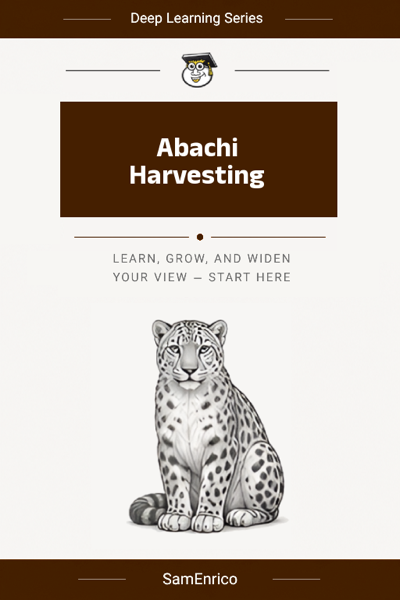
Non-FictionInformativeEducational
Abachi Harvesting
A Coursebook on Abachi Harvesting
by Roy Christie
A Coursebook on Abachi Harvesting
Formats
About this book
Free sample
Chapter 1: The Ghost Tree...–- The first time I saw an Abachi log, I thought someone was playing a joke on me. It lay at the edge of a logging road in eastern Cameroon, stripped of its bark and gleaming pale in the afternoon heat, and when I walked up to kick it—the way you kick any tropical hardwood to test its weight—my boot nearly swung through empty air. The log rolled. Not with the stubborn, grinding resistance of iroko or the dense thud of sapele, but with the almost buoyant lightness of cork. I was twenty-three years old, fresh out of forestry school in Belgium, and I had spent the previous six months learning to chainsaw through trees that fought back—woods that dulled blades in an hour and required three men to drag a single plank.
This thing weighed less than my backpack. I turned to the old harvester standing behind me, a man named Joseph who had worked these forests since before I was born, and he just laughed. "That," he said, "is the ghost tree. You will chase it your whole career. And if you blink, it will disappear on you."The Many Names of a Single Mystery Every commercially valuable tree in West and Central Africa accumulates nicknames the way a river accumulates tributaries.
Abachi is no exception. In Cameroon, where Joseph and I stood that afternoon, the wood is called Abachi—a name that has traveled intact to European timber markets and now appears on FSC certificates and shipping manifests from Douala to Rotterdam. Cross the border into Côte d'Ivoire, and the same tree becomes Ayous. Move east into Nigeria, and loggers call it Samba. In Ghana, where the tree grows in the moist semi-deciduous forests between Lake Volta and the Tano River, it goes by Waya.
These are not merely regional dialects; they represent different harvesting traditions, different milling techniques, and different market expectations. A container of Ayous bound for France will be graded differently than a shipment of Waya destined for the United Kingdom, even though both contain the…
This is the end of the free sample. Get the eBook to keep going. Buy now
Contents
- Chapter 1
- Chapter 2
- Chapter 3
- Chapter 4
- Chapter 5
- Chapter 6
- Chapter 7
- Chapter 8
- Chapter 9
- Chapter 10
- Chapter 11
- Chapter 12
Details
- Author
- Roy Christie
- Publisher
- SamEnrico
- Language
- English
- Genre
- Non-Fiction, Informative, Educational
- Released
- 2026-05-11
- Pages (approx.)
- 144
- Available as
- eBook, Audiobook

Read better in the ZLOADR app
Your eBooks on your phone or tablet. Sign in with your SamEnrico account and start reading.
More by Roy Christie
 Assisted Living Financial GuideRoy Christie$11.99
 The Loneliness of SuccessRoy Christie$11.99
 Metta for Incarcerated Persons CourseRoy Christie$11.99
 Sports Insurance Agency DatabaseRoy Christie$11.99
 Beginner Fitness for ExtrovertsRoy Christie$11.99
 The Phantom Fleet: The Vanishing of the SS Marine Sulphur QueenRoy Christie$11.99
 The Frozen Conquest: Nansen and the Race for the North PoleRoy Christie$11.99
 Series LLC CTA ReportingRoy Christie$12.99
 CTA Penalty Calculator GuideRoy Christie$12.99
 Understanding Diabetes Insipidus, Nephrogenic, Dominant TypeRoy Christie$17.99
 How to Start a Hobby in JukskeiRoy Christie$11.99
You may also like
 Hong Kong Handover 1997Dunn Johnnie$11.99
 Zumba For Postnatal Recovery CourseNeal Christian$11.99
 Zumba for BeginnersLadner Nikia$11.99
 YouTube Comment Mining GuideHumes Pandora$12.99
 Worry Box MeditationCarlin Rudy$11.99
 Workplace Stress MeditationNguyen Lynn$11.99
 Workplace Stress and Sleep RepairHawley Ivory$11.99
 Workplace Perfectionism CureDelaney Jeffry$11.99
 Workplace Injustice Anger GuideWallen Isabelle$11.99
 Work Addiction and Burnout LinkGreenwood Ester$11.99
 Women in Yoga and WellnessBeattie Galina$11.99
 Women in Stand Up ComedyChun Evangeline$11.99