
Non-FictionBiographyMeta Musical
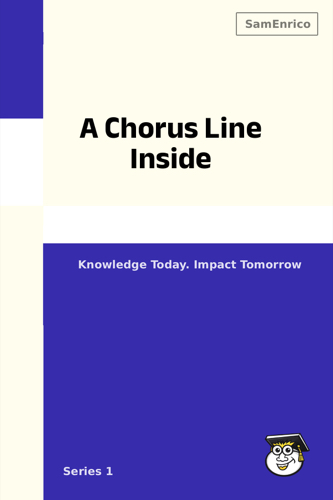
A Chorus Line Inside eBook
Documents the original 1975 cast who shared their
Documents the original 1975 cast who shared their real audition stories on stage.
Formats
Free sample
Chapter 1: The Tuesday Night Crucible...--The Nickolaus Exercise Center at 215 West 11th Street in Manhattan’s Greenwich Village was, by all accounts, an unremarkable place. It had mirrored walls designed for calisthenics, a wooden floor scuffed by countless aerobic classes, and the faint lingering smell of sweat mingled with lavender disinfectant. On the evening of January 29, 1974, however, that mundane studio became the unlikely womb of a theatrical revolution.The hour was late, nearly ten o’clock. Most of the two dozen dancers who climbed the narrow stairs that night had already completed a full day—teaching classes, attending auditions, or performing in Broadway musicals such as Seesaw, Pippin, and Follies. They were tired, puzzled, and more than a little suspicious.
The invitation had been deliberately vague: a conversation, hosted by a rising star choreographer named Michael Bennett. That was all. No promise of work. No audition piece to prepare. No cattle call.
Just a request to gather, to talk, and perhaps to drink some wine.What happened over the next five hours would transform American musical theater. But on that cold January night, no one in that room knew they were about to sing for their emotional supper. They only sensed that something strange—something entirely unfamiliar—was beginning.The Gathering of the Gypsies The term “gypsy” was already embedded in Broadway’s vocabulary by 1974, though it had never been used with the reverence Bennett would soon bestow upon it. It referred to the anonymous chorus dancers who moved from show to show, their faces familiar to audiences but their names unknown, their personal histories untold, their struggles invisible. They were the infrastructure of musical theater—the bodies that made the spectacle possible, the shadows that made the stars shine brighter, the interchangeable parts in a machine designed to produce wonder.But they were also human beings with childhoods, disappointments, secret shames, and unspoken dreams.The dancers who arrived at the Nickolaus Center that night represented a cross-section of the gypsy experience.
Patricia Garland was there, a veteran of Cabaret and Follies, accompanied by her older sister Jackie. The sibling dynamic would prove unexpectedly volatile—Trish worried about revealing too much in front of a family member who had shaped her identity in ways she was only beginning to understand. Nicholas Dante, a young dancer and aspiring writer who would later co-write the show’s book, walked in carrying secrets he had never spoken aloud to anyone outside his closest circle. Kelly Bishop, twenty-nine years old and already considered “old” for a chorus dancer, came prepared to listen before she spoke; she had learned the hard way that the first person to open up in a group was often the first person to be hurt.Priscilla Lopez arrived with her own quiet desperation. She had been attending group therapy for nearly a year without ever finding the courage to speak.
The therapist had gently suggested that perhaps she needed a different kind of environment—one where her silence would be challenged more directly. When she heard about Bennett’s invitation, something clicked. “I thought, if I can’t talk in therapy, maybe I can talk in a dance studio,” she later recalled.Then there was Baayork Lee, barely five feet tall, a veteran of the original King and I as a child performer, still fighting the typecasting that came with being Asian-American in a predominantly white industry. She had learned to smile through rejection, to deflect pain with professionalism. But she was tired.
They were all tired.Michon Peacock and Tony Stevens, two dancers who had initially conceived the idea of a workshop, had invited Bennett to observe. They had expected him to listen, to take notes, perhaps to offer some guidance. But Bennett, ever the opportunist, seized control of the evening almost immediately. He understood something that the others did not yet grasp: that the collective voice of the gypsy was a story waiting to be told, and that he—with his ambition, his theatrical instincts, and his willingness to push past boundaries—might be the one to tell it.The Tape Recorder and the Wine Bennett set up a portable reel-to-reel tape recorder in the center of the room. The machine was unremarkable—silver, functional, the kind of device used in offices and college classrooms across America.
Its small reels were empty, waiting. But its presence that night was nothing less than totemic. Every word spoken would be preserved. Every hesitation, every tear, every confession would be captured for posterity—though no one yet understood that posterity was listening, or that those tapes would become the most valuable raw material in Broadway history.Wine was poured. Paper cups were distributed.
The dancers, still in their street clothes—leotards under sweaters, leg warmers, jeans worn thin at the knees—settled onto the floor or leaned against the mirrored walls. Bennett did not stand behind a podium or position himself as an authority figure. He sat among them, cross-legged, his voice soft and inviting. He began with questions that seemed almost too simple: Where were you born? When did you start dancing?
Why do you keep doing it when it’s so hard?The answers were cautious at first. Dancers are trained to compete, not to confide. They are taught to present a polished surface, to hide the exhaustion and the rejection and the fear behind a bright, professional smile. The idea of opening up to strangers—to potential rivals for the next job—ran against every instinct they had cultivated since their first audition.Trish Garland was particularly guarded. Her sister Jackie was in the room, and Trish worried about what she might reveal.
“I thought she was going to hate me for the rest of my life because I’m now telling them that I’m the way I am because she was always first,” Garland recalled decades later. The tension between the sisters was palpable, a reminder that family dynamics did not disappear when one walked into a rehearsal studio.But as the night deepened and the wine loosened tongues, the walls began to crumble. Bennett had a gift for making people feel safe, or at least safe enough to speak. He asked about childhoods, about parents, about the moment each dancer had decided that this precarious life—the endless auditions, the rejection letters, the starvation wages, the constant uncertainty—was worth it.The Breaking Open The first real breakthrough came from an unexpected source. One of the dancers—accounts differ on exactly who, and the surviving participants have chosen to protect her privacy—began describing a humiliating sexual experience involving a tampon.
The story was raw, graphic, and utterly unlike anything that had ever been discussed in a Broadway rehearsal studio. Some dancers laughed nervously, unsure whether this was a joke or a confession. Others sat in stunned silence, realizing that the rules of this gathering were not the rules of any gathering they had ever attended.The story served a crucial purpose: it established that this was not a standard Q&A session. This was confession.The tampon story never made it into A Chorus Line. It was deemed too explicit, too graphic for Broadway audiences in 1975…
This is the end of the free sample. Get the eBook to keep going. Buy now
About this book
Details
- Author
- Mathis Darren
- Publisher
- SamEnrico
- Language
- English
- Genre
- Non-Fiction, Biography, Meta Musical
- Released
- 2026-06-06
- Pages (approx.)
- 114
- Available as
- eBook, Audiobook

Read better in the ZLOADR app
Your eBooks on your phone or tablet. Sign in with your SamEnrico account and start reading.
More by Mathis Darren
 Chinese Visa Interview PrepMathis Darren$11.99
 Carson Cancer Connection TruthMathis Darren$11.99
 Anger Repetition BreakthroughMathis Darren$11.99
 Prostate Cancer Survivorship PlanMathis Darren$11.99
 Body Scan for Long COVIDMathis Darren$11.99
 Joyful Retirement GuideMathis Darren$11.99
 Creative Confidence for Social WorkersMathis Darren$11.99
 The Hollow Ones: Lost in the Black ForestMathis Darren$11.99
 The Battle of Cape St. Vincent: Nelson's First TriumphMathis Darren$11.99
 Pop Up Retail Financial PlanningMathis Darren$12.99
 European Business Phone Number GuideMathis Darren$12.99
 How to Produce Other Environmental ProductsMathis Darren$11.99
You may also like
 Hong Kong Handover 1997Dunn Johnnie$11.99
 Zumba For Postnatal Recovery CourseNeal Christian$11.99
 Zumba for BeginnersLadner Nikia$11.99
 YouTube Comment Mining GuideHumes Pandora$12.99
 Worry Box MeditationCarlin Rudy$11.99
 Workplace Stress MeditationNguyen Lynn$11.99
 Workplace Stress and Sleep RepairHawley Ivory$11.99
 Workplace Perfectionism CureDelaney Jeffry$11.99
 Workplace Injustice Anger GuideWallen Isabelle$11.99
 Work Addiction and Burnout LinkGreenwood Ester$11.99
 Women in Yoga and WellnessBeattie Galina$11.99
 Women in Stand Up ComedyChun Evangeline$11.99