
Non-FictionHealth & WellnessSafety
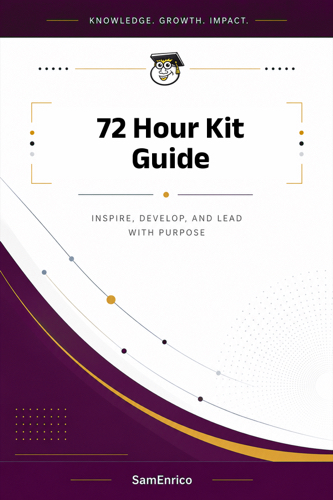
72 Hour Kit Guide eBook
Teaches essentials for three day survival.
Teaches essentials for three day survival.
Formats
Free sample
Chapter 1: The Unpackable Item--–- The rain had stopped twenty minutes ago, but the family of four standing in their driveway was still soaked. Their SUV was packed to the windows—suitcases, pillows, a cooler, three backpacks, and a plastic bin of "emergency supplies" they had thrown together at 2 AM. The father clutched a printout from a popular survival website: "Top 50 Items You Need for the Apocalypse." They had acquired 47 of them. They also had a flat tire, a dead phone battery, and no coherent idea where they were going.They are not unusual. They are, in fact, the average American family during the first hours of an evacuation order.
And they are failing not because they lack gear, but because they lack something far more fundamental. They have stuffed their car with stuff, but they have left behind the one item that cannot be bought, packed, or borrowed.This chapter is not about gear lists or brand recommendations. It is about the operating system that runs the hardware. Your brain. Because when the disaster comes—and it will come for you or someone you love—you will not rise to the occasion.
You will sink to the level of your training. And if your training is nothing more than a shopping list, you will sink all the way to panic.The 72-Hour Window: Why Three Days Changes Everything Before we can discuss how to think, we must understand the timeline that governs every decision in this book. The "72-hour kit" is not an arbitrary number plucked from a government manual. It is the product of decades of disaster response data, military logistics, and painful real-world experience.When a large-scale disaster strikes—a Category 4 hurricane making landfall, a 7.0 earthquake shattering a city's infrastructure, a terrorist attack shutting down transportation hubs, a wildfire jumping a freeway and racing toward suburban neighborhoods—local emergency services are immediately overwhelmed. Police, fire, and EMS agencies begin to triage.
They prioritize mass casualties: the person trapped under a collapsed beam, the family on a roof surrounded by rising floodwater, the cardiac arrest victim at a public shelter. Your empty stomach, your minor cut, your lack of a place to sleep? Those are low priority for the first 24 to 72 hours.The Federal Emergency Management Agency (FEMA), the American Red Cross, and the Department of Homeland Security all use the same baseline recommendation: every citizen should be self-sufficient for a minimum of 72 hours. That is the time required for mutual aid agreements to bring resources from neighboring jurisdictions, for the National Guard to mobilize and deploy, and for supply chains to reroute around damaged infrastructure.Three days. That is the gap between "something happened" and "organized help arrives."But here is what most people miss, and this is critical: the 72-hour window is not a guarantee.
It is a best-case scenario. In Hurricane Katrina in 2005, some neighborhoods waited seven days for federal assistance. In the 2010 Haiti earthquake, it was two weeks before organized aid reached rural areas. In the 2021 Texas winter storm, some rural communities went without power, water, or passable roads for ten days. The 72-hour kit is a minimum, not a maximum.
It is the baseline. It is the price of entry into the survival game. And the difference between surviving those three days with clarity versus surviving them in a fog of panic is not your gear list. It is your mental framework.The Rule of Threes: The Hierarchy of Survival Every survival instructor worthy of the title teaches some version of the Rule of Threes. It is not a law of physics—you will not die precisely at the three-hour mark if you lack shelter.
But it is a prioritization tool, and it is the single most effective method for preventing the decision paralysis that kills more people than any disaster.Here is the rule, committed to memory:You can survive approximately 3 minutes without breathable air.You can survive approximately 3 hours without shelter in extreme conditions (hypothermia in cold environments, hyperthermia in heat).You can survive approximately 3 days without water.You can survive approximately 3 weeks without food.Notice what is conspicuously absent from this list. Cell phone service. Social media updates. A hot meal. A comfortable bed.
A blanket. A pillow. Electricity. These are comforts, desires, wants. They are not survival needs.
The Rule of Threes forces you to ask one brutally honest question: What is going to kill me first?Let us examine each tier in detail, because understanding the timeline is the first step toward mastering it.Three minutes without air. This is the most urgent category, yet it is rarely discussed in survival books because it happens so fast. Smoke inhalation from a wildfire or house fire. Carbon monoxide poisoning from a portable generator used indoors or in an attached garage. Drowning in a flash flood or a vehicle that has driven into rising water.
Chemical exposure from a derailed tanker car or an industrial accident. Suffocation from a collapsed structure. If you cannot breathe, nothing else matters. Your water filter, your food bars, your expensive knife—all useless. The only defense against the three-minute category is avoidance.
That means situational awareness before the disaster: knowing your evacuation routes, understanding the specific hazards in your geographic region, and leaving early if officials recommend it. Do not wait until you smell smoke or see water rising. By then, you may already be in the three-minute window.Three hours without shelter. This is where most people make catastrophic errors, and this is where the survival mindset separates from the consumer mindset. In cold weather—anything below 50°F (10°C) with wind and rain—your body loses heat faster than it can produce it.
Hypothermia sets in within an hour. Shivering gives way to confusion, then to drowsiness, then to unconsciousness. In hot weather—above 90°F (32°C) with high humidity—hyperthermia kills through heat stroke. Your core temperature rises, your sweating mechanism fails, your organs begin to shut down. Notice that shelter is not a luxury.
Shelter is a three-hour priority.But what counts as shelter? Not a four-walled cabin with a wood stove. Shelter means protection from the elements. A tarp tied between two trees. A bivvy sack inside an abandoned construction dumpster.
The leeward side of a concrete building. Your car with the windows cracked for ventilation. Your emergency space blanket wrapped around your shoulders like a cape. The three-hour rule is a warning bell: if you are exposed to extreme temperatures and you are not actively seeking or building shelter, you are dying. Stop walking.
Stop searching for the perfect location. Stop hoping help will arrive. Shelter. Then think.Three days without water. Your body is approximately 60 percent water.
Lose just 2 percent of that, and your physical performance drops by 20 percent. Lose 5 percent, and you experience headache, dizziness, and cognitive confusion. Lose 10 percent, and you are in medical emergency territory: organ failure, hallucinations, seizures, death. Most people dramatically underestimate their water needs. In a stressful evacuation scenario, you will sweat more than usual.
You will breathe faster, losing moisture with every exhale. You may experience diarrhea from stress, contaminated food, or the simple fact that your digestive system is not designed…
This is the end of the free sample. Get the eBook to keep going. Buy now
About this book
Details
- Author
- Marcotte Dorthey
- Publisher
- SamEnrico
- Language
- English
- Genre
- Non-Fiction, Health & Wellness, Safety
- Released
- 2026-06-06
- Pages (approx.)
- 141
- Available as
- eBook, Audiobook

Read better in the ZLOADR app
Your eBooks on your phone or tablet. Sign in with your SamEnrico account and start reading.
More by Marcotte Dorthey
 Forgiveness in Recovery ProgramsMarcotte Dorthey$11.99
 Step Nine Living Amends Daily Practice HandbookMarcotte Dorthey$11.99
 The Post Listening GapMarcotte Dorthey$11.99
 Cash Flow for Law FirmsMarcotte Dorthey$12.99
 Sudden Pet Death GriefMarcotte Dorthey$11.99
 Omega 3 for Brain HealthMarcotte Dorthey$11.99
 Virtual Networking GuideMarcotte Dorthey$11.99
 The Phoenix of Manila: How a War-Torn Artist Rebuilt Filipino ArtMarcotte Dorthey$11.99
 The Dragon-Tamer of the Black Forest: A Beastmaster’s Last LessonMarcotte Dorthey$11.99Cash Flow for Law FirmsMarcotte Dorthey$12.99
 Three City Pop Up Comparison WorkbookMarcotte Dorthey$12.99
 A Collector's Handbook to the Plymouth PEMarcotte Dorthey$11.99
You may also like
 Hong Kong Handover 1997Dunn Johnnie$11.99
 Zumba For Postnatal Recovery CourseNeal Christian$11.99
 Zumba for BeginnersLadner Nikia$11.99
 YouTube Comment Mining GuideHumes Pandora$12.99
 Worry Box MeditationCarlin Rudy$11.99
 Workplace Stress MeditationNguyen Lynn$11.99
 Workplace Stress and Sleep RepairHawley Ivory$11.99
 Workplace Perfectionism CureDelaney Jeffry$11.99
 Workplace Injustice Anger GuideWallen Isabelle$11.99
 Work Addiction and Burnout LinkGreenwood Ester$11.99
 Women in Yoga and WellnessBeattie Galina$11.99
 Women in Stand Up ComedyChun Evangeline$11.99