
Non-FictionBiographyPsychology
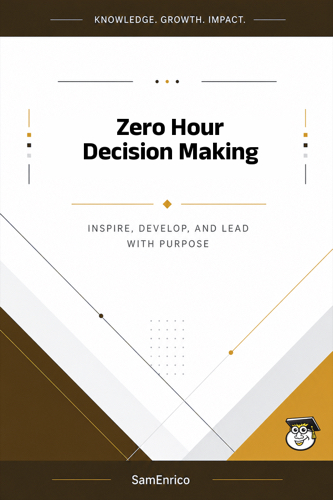
Zero Hour Decision Making eBook
Learn high-stakes choices from adventurers who fac
Learn high-stakes choices from adventurers who faced life-or-death moments in remote wilderness.
Formats
Free sample
Chapter 1: The Cognitive Abyss...--–- The fog came in at 4:17 PM. One minute, Joe Simpson could see the rope disappearing into the ice below him—a thin white line against a million years of frozen time. The next minute, the mountain wrapped itself in cloud, and the rope vanished into nothing. He was alone on the west face of Siula Grande, 20,000 feet above sea level, with a broken leg, a dying partner above him, and a question that would take him three days to answer: What do you do when every option looks like death?This is not a book about mountaineering. It is a book about the eight seconds between a problem arriving and a decision that changes everything.
Call it the zero hour. In military terms, zero hour is the moment an operation begins—the exact second when planning ends and action becomes inevitable. In wilderness survival, zero hour is the moment when your brain realizes, with absolute certainty, that you might die. Not later. Not tomorrow.
Now.And in that moment, something strange happens to the human mind. The same brain that can solve a quadratic equation, compose a sonnet, or negotiate a merger suddenly becomes a primitive machine running on fear, habit, and luck. Intelligent, prepared, capable people make devastatingly stupid decisions when it matters most. Not because they are weak. Not because they panic.
But because they fall into what this chapter calls the cognitive abyss.The cognitive abyss is the gap between the decision you think you are making and the decision your biology forces you to make. It is the neurological chasm that opens when mortality becomes imminent. And the first step to surviving any zero hour is understanding why your own mind becomes your greatest enemy exactly when you need it most.The Two Brains Inside Your Skull To understand the cognitive abyss, you must first understand a fundamental truth about human cognition: you do not have one brain. You have two.In his seminal work Thinking, Fast and Slow, Nobel Prize-winning psychologist Daniel Kahneman described two systems that compete for control of your decisions. System 1 is fast, automatic, emotional, and unconscious.
It is the brain that pulls your hand off a hot stove before you feel the pain. System 2 is slow, deliberate, logical, and exhausting. It is the brain that solves math problems, considers consequences, and plans for next week.Here is the problem: System 1 is ancient. It evolved to help you survive predators, find food, and avoid falling off cliffs. System 2 is new.
It evolved to help you build cities, write poetry, and save for retirement. In normal life, these two systems work together. System 1 handles the millions of small decisions—what to eat, which way to walk, whether to trust a stranger's face—while System 2 lounges in the background, ready to step in when something requires attention.But in a zero-hour moment, that partnership collapses. The amygdala—an almond-shaped cluster of neurons deep in your brain that serves as your threat-detection system—takes over. It senses danger and floods your body with cortisol and adrenaline.
Your heart rate spikes. Your pupils dilate. Blood rushes to your large muscle groups. And most critically, your prefrontal cortex—the seat of System 2 thinking—gets partially shut down.This is called amygdala hijack, a term coined by psychologist Daniel Goleman. In milliseconds, your ancient survival brain seizes control from your modern reasoning brain.
You do not choose this. It happens to you. And the result is tunnel vision, binary thinking, and the loss of temporal perspective.You stop seeing options. You stop imagining futures. You stop thinking about consequences beyond the next thirty seconds.
You become a creature of fight, flight, or freeze.And most dangerously of all, you do not realize it is happening.The Illusion of Clarity This is the cruelest trick of the cognitive abyss: the hijacked brain does not feel hijacked. It feels clear. It feels certain. It feels like you have finally cut through all the noise and see the situation for what it really is.Laurence Gonzales, in his masterful book Deep Survival, studied hundreds of wilderness accidents and found a chilling pattern. Survivors often reported feeling a strange sense of calm and clarity just before making a catastrophic decision.
They were not panicking. They were not confused. They were absolutely sure they knew what to do.And they were wrong.Gonzales calls this perceptual narrowing. As stress increases, your brain progressively filters out information that does not seem immediately relevant to survival. At low stress, this is useful—it helps you focus.
At moderate stress, it becomes limiting—you miss important cues. At high stress, it becomes deadly—you literally cannot see options that would be obvious to you while sitting in a comfortable chair reading this book.Consider the case of John and Irene. Two experienced climbers on Mount Hood. Caught in a sudden storm. Visibility dropping to near zero.
Temperatures plummeting. They had a tent. They had food. They had fuel. They had a GPS beacon.
They had every reason to dig in, wait out the storm, and descend when conditions improved.Instead, they decided to keep climbing.Not because they were stupid. Not because they lacked training. But because their hijacked brains had narrowed their perception to a single thought: we have to get off this mountain. The idea of waiting—which from the outside seems obviously safer—simply did not exist in their cognitive field. They could not see it.
Not because they were blind, but because their brains had literally filtered it out.Both died on the mountain. Their bodies were found three days later, two hundred feet from a shelter they had passed six hours before the storm hit.This is the cognitive abyss. And it does not care how smart you are, how much you have trained, or how many books you have read. It cares only about one thing: whether you recognize it before it consumes you.Joe Simpson's Impossible Choice Let us return to Joe Simpson, hanging above a crevasse on Siula Grande. His story, told in the classic Touching the Void, is perhaps the most famous zero-hour decision in mountaineering history.
But most retellings miss the crucial cognitive detail: Simpson did not make one decision. He made dozens. And only one of them saved his life.To understand why, you need the full context. Simpson and his climbing partner, Simon Yates, had successfully summited Siula Grande, a 20,814-foot peak in the Peruvian Andes. On the descent, Simpson fell and shattered his right tibia—the bone pushing through his knee joint.
He could not walk. He could not stand. He could barely crawl.They were still at 19,000 feet. The nearest help was days away. The weather was deteriorating.
Their supplies were limited.Yates made a decision: he would lower Simpson down the mountain using two ropes tied together. He would anchor himself, lower Simpson one hundred feet, then climb down and repeat. It was slow, dangerous, and their only option.For hours, it worked. Then Simpson went over a cliff.Yates could not see where Simpson had fallen. He could only feel the rope—taut, then slack, then impossibly heavy.…
This is the end of the free sample. Get the eBook to keep going. Buy now
About this book
Details
- Author
- Ames Brittaney
- Publisher
- SamEnrico
- Language
- English
- Genre
- Non-Fiction, Biography, Psychology
- Released
- 2026-06-09
- Pages (approx.)
- 160
- Available as
- eBook, Audiobook

Read better in the ZLOADR app
Your eBooks on your phone or tablet. Sign in with your SamEnrico account and start reading.
More by Ames Brittaney
 Pitta Cooling Healing GuideAmes Brittaney$11.99
 The Anger and Exercise GuideAmes Brittaney$11.99
 Incontinence Caregiving RealityAmes Brittaney$11.99
 Free Shipping TrapAmes Brittaney$11.99
 The Self Ban Success GuideAmes Brittaney$11.99
 Low Sodium Cooking GuideAmes Brittaney$11.99
 Situational ExposureAmes Brittaney$11.99
 The Healers of Nubia: Ancient Medicine and the Secrets of the NileAmes Brittaney$11.99
 The Silent Architects: Rome's Forgotten InnovatorsAmes Brittaney$11.99
 How to Produce Hole SawsAmes Brittaney$11.99
 A Collector's Handbook to the Ford Corsair V4Ames Brittaney$11.99
 Mastering The Art of Yuejiaquan (岳家拳) Yue Family Fist/boxingAmes Brittaney$11.99
You may also like
 Hong Kong Handover 1997Dunn Johnnie$11.99
 Zumba For Postnatal Recovery CourseNeal Christian$11.99
 Zumba for BeginnersLadner Nikia$11.99
 YouTube Comment Mining GuideHumes Pandora$12.99
 Worry Box MeditationCarlin Rudy$11.99
 Workplace Stress MeditationNguyen Lynn$11.99
 Workplace Stress and Sleep RepairHawley Ivory$11.99
 Workplace Perfectionism CureDelaney Jeffry$11.99
 Workplace Injustice Anger GuideWallen Isabelle$11.99
 Work Addiction and Burnout LinkGreenwood Ester$11.99
 Women in Yoga and WellnessBeattie Galina$11.99
 Women in Stand Up ComedyChun Evangeline$11.99