
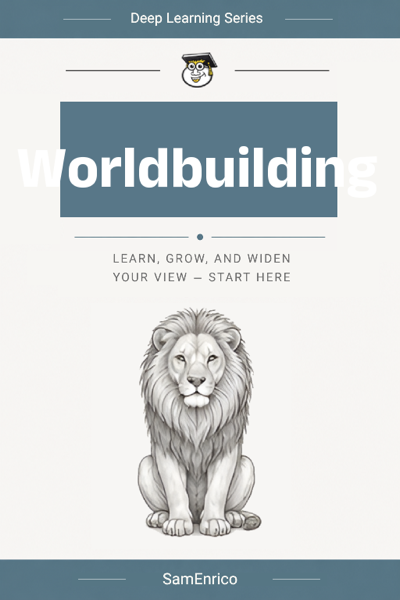
Non-FictionInformativeEducational
Worldbuilding eBook
A Coursebook on Worldbuilding
by Starr Yuette
A Coursebook on Worldbuilding
Formats
Free sample
Chapter 1: The Seed and the Spiral...--Every world you have ever fallen in love with began as something smaller than a sentence. Not a map. Not a magic system. Not a thousand years of invented history. A single image, perhaps: a girl walking through a door that should not exist.
A question: what happens if dragons remember their past lives? A feeling: the cold weight of a stone that has never been touched by sunlight.Before J.R.R. Tolkien sketched the contours of Middle-earth, he wrote a single line about a hobbit who lived in a hole in the ground. Before Suzanne Collins built the brutal architecture of Panem, she saw a flicker on a television screen: a young woman standing in a forest, wearing something that was not quite armor and not quite fashion. Before N.K.
Jemisin imagined the continent-spanning oppression of the Stillness, she felt the shudder of an earthquake and asked: what if the earth hated you back?This chapter makes a radical argument that contradicts nearly every worldbuilding guide you have ever read. You do not need to build the universe first. You do not need to map the continents, invent three languages, or chart five thousand years of dynastic succession before you write a single scene of dialogue. In fact, attempting to do so is one of the fastest ways to never finish anything at all.The problem with top-down worldbuilding—the method that begins with cosmology and works downward to character—is that it produces museums, not stories. You can spend months designing a breathtakingly detailed world that has no narrative pulse, no dramatic tension, no reason for a reader to turn the page.
You will know everything about the irrigation systems of the eastern provinces and nothing about what your protagonist wants for breakfast.This book will teach you a different way.It is called the Bottom-Up Method, and it begins where all stories actually begin: with a single point of human (or post-human, or non-human, or mechanical) consciousness. A character in a room. A problem that cannot be ignored. A question that demands an answer. From that seed, you will spiral outward—not because you have to, but because the story demands it.This chapter will give you everything you need to plant that seed.
By the end, you will have written the opening of a story that contains an entire world in miniature, a world that will grow with you as you work through the remaining chapters of this book.The Myth of the Finished Map Let us name the enemy. It is called Completion Anxiety, and it has derailed more promising worldbuilding projects than any other force in the creative universe.Completion Anxiety whispers a seductive lie: you cannot begin writing until you know everything. It tells you that your world must be fully assembled before your characters can take a single step. It convinces you that a reader will sneer at an unanswered question, that a plot hole the size of a continent will open beneath your feet if you dare to invent as you go.This lie has ruined more manuscripts than writer's block ever has.Here is the truth that professional worldbuilders understand and amateurs resist: your reader does not need to know everything. Your reader needs to feel that everything could be known—that the world has depth beyond the page—but they do not need the encyclopedia.
In fact, giving them the encyclopedia is the fastest way to lose them.Think about the first time you watched Star Wars. You did not know what the Force was. You did not know the political structure of the Galactic Empire. You did not know why droids existed or how faster-than-light travel worked. You knew one thing: a farm boy on a desert planet wanted to leave.
That was enough. The rest emerged as the story demanded it, and your imagination filled in the gaps.Think about the first chapter of Harry Potter and the Sorcerer's Stone. You learned almost nothing about the magical world's history, government, or economy. You learned that a boy lived in a cupboard under the stairs, that strange things happened around him, and that a giant would soon arrive to tell him he was a wizard. The world expanded only as Harry experienced it.Think about the opening of The Hunger Games.
You did not receive a briefing on the history of Panem's districts, the mechanics of the Games, or the political philosophy of President Snow. You stood in District 12 with Katniss, watching her hunt with a bow she was not supposed to own, feeling her hunger, her fear, her rage. The Capitol emerged in fragments: a television screen, a cruel laugh, a uniform.These works succeeded because their creators trusted the reader. They understood that mystery is not a flaw to be eliminated but a tool to be wielded. A reader who understands everything has nothing to discover.
A reader who is confused has nothing to hold onto. But a reader who has just enough—enough to orient themselves, enough to care, enough to wonder what happens next—that reader will turn the page.The Bottom-Up Method is the practical application of this trust.The Three Principles of Bottom-Up Worldbuilding Before we begin the workshop exercises that will generate your story's seed, you need to understand the three principles that govern everything else in this book.Principle One: The Innocent Eye Every world needs a point of entry. That point of entry is a character who does not fully understand the world they inhabit.This character might be a child, like Harry Potter discovering Diagon Alley for the first time. They might be an amnesiac, like the protagonist of a thriller waking up in a locked room with no memory of how they arrived. They might be a foreigner, like a diplomat arriving in an unfamiliar culture.
They might be a prisoner released after decades of isolation, or a clone activated without a memory download, or a ghost returned to a world that has moved on without them.The Innocent Eye serves a mechanical function: it gives you permission to explain things without sounding like a textbook. When Harry asks "What's that?" and Hagrid answers, the reader learns alongside the character. The exposition is disguised as curiosity.But the Innocent Eye serves a more important function as well. It forces you, the writer, to see your world through fresh eyes. You cannot assume your reader knows anything.
You cannot rely on jargon or shorthand. You must earn every piece of understanding, and in doing so, you will discover which details actually matter.A character who belongs to their world does not notice the things that make that world strange. A character who is new to the world—or newly aware of it—notices everything. That noticing is the engine of discovery.Principle Two: Implied History History exists in the negative spaces of your story. It is the thing you do not say but cannot avoid.Implied History is the art of mentioning events, names, and places without explaining them.
A line like "the old bridge, built before the Scouring" does more narrative work than three paragraphs of backstory. It…
This is the end of the free sample. Get the eBook to keep going. Buy now
About this book
Details
- Author
- Starr Yuette
- Publisher
- SamEnrico
- Language
- English
- Genre
- Non-Fiction, Informative, Educational
- Released
- 2026-05-18
- Pages (approx.)
- 146
- Available as
- eBook, Audiobook

Read better in the ZLOADR app
Your eBooks on your phone or tablet. Sign in with your SamEnrico account and start reading.
More by Starr Yuette
 Self Hypnosis for Prostatitis PainStarr Yuette$11.99
 Collaborative Sketching GuideStarr Yuette$11.99
 Body Scan for Sleep ProblemsStarr Yuette$11.99
 Shoulder Shrug MeaningStarr Yuette$11.99
 Small Talk for Farmers MarketsStarr Yuette$11.99
 Self Esteem for DoctorsStarr Yuette$11.99
 Parental Anger Self ForgivenessStarr Yuette$11.99
 Design Thinking for Product DesignStarr Yuette$11.99
 The Hollow Crown: When a King Refused to DieStarr Yuette$11.99
 The Iron Trail: Sandford Fleming and the Birth of Canada's Transcontinental RailwayStarr Yuette$11.99
 A Collector's Handbook to the Steyr 16Starr Yuette$11.99
 Launching A Youtube Channel For Your Brand ShortcutsStarr Yuette$12.99
You may also like
 Hong Kong Handover 1997Dunn Johnnie$11.99
 Zumba For Postnatal Recovery CourseNeal Christian$11.99
 Zumba for BeginnersLadner Nikia$11.99
 YouTube Comment Mining GuideHumes Pandora$12.99
 Worry Box MeditationCarlin Rudy$11.99
 Workplace Stress MeditationNguyen Lynn$11.99
 Workplace Stress and Sleep RepairHawley Ivory$11.99
 Workplace Perfectionism CureDelaney Jeffry$11.99
 Workplace Injustice Anger GuideWallen Isabelle$11.99
 Work Addiction and Burnout LinkGreenwood Ester$11.99
 Women in Yoga and WellnessBeattie Galina$11.99
 Women in Stand Up ComedyChun Evangeline$11.99