
Non-FictionHealth & WellnessWorkplaceDisability
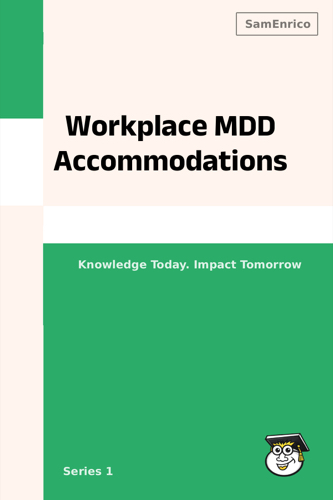
Workplace MDD Accommodations eBook
Request and implement reasonable adjustments for d
by Buck Corrie
Request and implement reasonable adjustments for depression at work.
Formats
Free sample
Chapter 1: Beyond the Myth...–- On a Tuesday morning in March, a senior accountant named David sat in his parked car outside the office building where he had worked for eleven years. He had been sitting there for forty-seven minutes. His coffee had gone cold. His phone buzzed with three emails he could not bring himself to open. He was not sick.
He was not hungover. He was not lazy. He had already taken his antidepressant, eaten breakfast, and slept seven hours. By every external measure, David was ready to work. And yet, he could not open the car door.David had Major Depressive Disorder (MDD).
He had been diagnosed eight years earlier, after his first major episode nearly cost him his marriage. He had learned to manage his symptoms with medication and therapy. He had returned to being a top performer, praised by managers for his attention to detail and ability to handle complex reconciliations. But six months ago, a second episode had begun—insidiously, without the dramatic sadness that marked the first one. This time, the primary symptom was not emotion.
It was paralysis.What David was experiencing is one of the most misunderstood and under-accommodated symptoms of MDD: executive dysfunction. Not laziness. Not lack of willpower. Not a character flaw. A neurobiological failure of the brain’s management system, as real and measurable as a broken bone on an X-ray.
And yet, when David finally walked into the office forty-seven minutes late, his manager did not see a medical condition. She saw someone who “just didn’t seem motivated anymore.”This book exists because that gap—between what MDD actually does to the brain and what workplaces are equipped to recognize—destroys careers, families, and lives. The most up-to-date research tells us that MDD affects approximately 21 million adults in the United States in any given year. It is the leading cause of disability worldwide for people aged fifteen to forty-four. And yet, the vast majority of workplace accommodation policies treat depression as if it were a temporary bout of sadness requiring nothing more than a “wellness day” and a subscription to a meditation app.This chapter will dismantle the myths that keep employees like David trapped in their parked cars.
It will explain what MDD actually is—a neurobiological condition with specific, measurable impacts on cognitive function—and why the traditional “grit and grind” approach to workplace performance fails so catastrophically for people with this condition. Most importantly, it will introduce the central framework of this book: the shift from asking “How do you feel?” to asking “What can’t you do?” That shift is the key that unlocks effective, legally protected, and career-sustaining accommodations.The $44 Billion Misunderstanding Before we dive into the neuroscience, let us talk about money. Because in most workplaces, the only language that truly moves the needle is the language of cost.Presenteeism—the phenomenon of being physically present at work but mentally unable to perform—costs U.S. employers an estimated $44 billion annually due to depression alone. To put that number in perspective, that is more than the gross domestic product of Iceland.
It is more than the combined annual revenues of Starbucks and Nike. And it is a problem that generic wellness programs have consistently failed to solve.Why? Because presenteeism is not caused by a lack of “resilience training” or “mindfulness apps.” It is caused by specific, untreated, and unaccommodated functional impairments. An employee with MDD does not need to learn to breathe deeply. They need to be able to initiate a task.
They do not need a gratitude journal. They need to remember a verbal instruction for longer than two minutes. They do not need a wellness stipend. They need a work schedule that accounts for the fact that their medication causes crushing fatigue between 2 PM and 4 PM.The research is unequivocal: A 2016 study in the Journal of Occupational and Environmental Medicine found that employees who received targeted accommodations for depression showed a 36% improvement in work performance within six months, compared to a 7% improvement among those who received only standard medical treatment without workplace adjustments. A 2018 meta-analysis of forty-one studies concluded that workplace accommodations for mental health conditions are among the highest-ROI interventions available to employers, with an average return of $4.50 for every dollar spent.And yet, most employees with MDD never request accommodations.
According to the U.S. Equal Employment Opportunity Commission (EEOC), fewer than 3% of employees with psychiatric disabilities formally request workplace accommodations, compared to over 30% of employees with physical disabilities. The gap is not due to a lack of legal protection—the Americans with Disabilities Act (ADA) has covered psychiatric disabilities since its passage in 1990. The gap exists because employees with MDD do not know what to ask for, how to ask for it, or even that they have the right to ask at all.This book closes that gap. Every chapter builds toward a single goal: giving you the vocabulary, the legal knowledge, the practical tools, and the confidence to request and implement accommodations that actually work for your specific presentation of MDD.What MDD Actually Is (And What It Is Not)Let us start with clarity.
The term “depression” is used so loosely in everyday language that it has become nearly meaningless. People say they are “depressed” when their favorite sports team loses, when it rains on their vacation, when they have a bad day at work. Clinical depression is not that. It is not even in the same universe.Major Depressive Disorder is defined by the Diagnostic and Statistical Manual of Mental Disorders, Fifth Edition, Text Revision (DSM-5-TR) as the presence of five or more of the following symptoms during the same two-week period, representing a change from previous functioning, with at least one symptom being either depressed mood or loss of interest or pleasure:Depressed mood most of the day, nearly every day Markedly diminished interest or pleasure in all, or almost all, activities (anhedonia)Significant weight loss or gain, or decrease or increase in appetite Insomnia or hypersomnia nearly every day Psychomotor agitation or retardation nearly every day Fatigue or loss of energy nearly every day Feelings of worthlessness or excessive or inappropriate guilt Diminished ability to think or concentrate, or indecisiveness, nearly every day Recurrent thoughts of death, suicidal ideation, or suicide attempt Notice what is not on that list: laziness. Weakness.
Lack of character. Poor attitude. These are not symptoms because they are not medical phenomena. They are judgments that observers make when they do not understand what they are seeing.The Neurobiology of Executive Dysfunction The symptoms that most directly affect work performance—diminished concentration, indecisiveness, fatigue, psychomotor retardation—all trace back to dysfunction in the brain’s frontal lobe, specifically the prefrontal cortex. This region is often called the brain’s “executive center.” It is responsible for planning, decision-making, impulse control, working memory, and task initiation.Functional MRI studies have consistently shown reduced metabolic activity in the prefrontal cortex of individuals experiencing a depressive episode.
This is not a metaphor. The brain literally burns less fuel in the regions required for getting things done. In the same way that a sprained ankle cannot bear weight, a…
This is the end of the free sample. Get the eBook to keep going. Buy now
About this book
Details
- Author
- Buck Corrie
- Publisher
- SamEnrico
- Language
- English
- Genre
- Non-Fiction, Health & Wellness, Workplace, Disability
- Released
- 2026-06-10
- Pages (approx.)
- 155
- Available as
- eBook, Audiobook

Read better in the ZLOADR app
Your eBooks on your phone or tablet. Sign in with your SamEnrico account and start reading.
More by Buck Corrie
 Zinc for Insulin ProductionBuck Corrie$11.99
 Bluesky Starter Pack StatusBuck Corrie$11.99
 The Charity Executive Embezzlement GuideBuck Corrie$11.99
 The Boomers' Rise: How Australia Conquered the NBA (2000-Present)Buck Corrie$11.99
 Client Solutions ManagerBuck Corrie$11.99
 Ferry Terminal MarketingBuck Corrie$12.99
 Learn to Play the HulusiBuck Corrie$11.99
 How to Start a Acrylic Polymers in Primary Forms (wholesale) Business (Beginners Guide)Buck Corrie$11.99
You may also like
 Hong Kong Handover 1997Dunn Johnnie$11.99
 Zumba For Postnatal Recovery CourseNeal Christian$11.99
 Zumba for BeginnersLadner Nikia$11.99
 YouTube Comment Mining GuideHumes Pandora$12.99
 Worry Box MeditationCarlin Rudy$11.99
 Workplace Stress MeditationNguyen Lynn$11.99
 Workplace Stress and Sleep RepairHawley Ivory$11.99
 Workplace Perfectionism CureDelaney Jeffry$11.99
 Workplace Injustice Anger GuideWallen Isabelle$11.99
 Work Addiction and Burnout LinkGreenwood Ester$11.99
 Women in Yoga and WellnessBeattie Galina$11.99
 Women in Stand Up ComedyChun Evangeline$11.99