
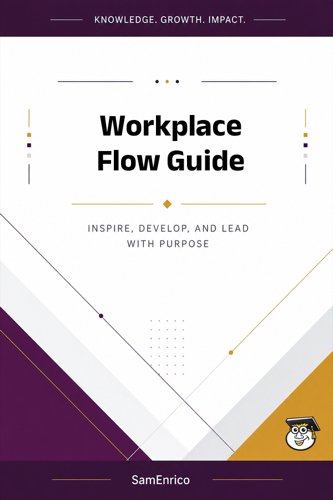
Workplace Flow Guide eBook
Structure your workday for maximum flow and minimu
Structure your workday for maximum flow and minimum distraction.
Formats
Free sample
Chapter 1: The 11-Minute Thief--The average knowledge worker switches tasks every eleven minutes. It then takes over twenty-three minutes to fully refocus on the original task. Do the math on a eight-hour workday, and you will discover something terrifying: most people never experience a single uninterrupted hour of deep thought. Their day is not a flowing river of productive work. It is a shattered windshield—cracked, fragmented, and barely holding together.This is not your fault.You have been told, probably hundreds of times, that you need better discipline, stronger willpower, or a more efficient to-do list.
You have been sold apps, planners, and time-management systems that promise to fix your scattered attention. And when those systems failed—not because they were poorly designed but because they were fighting the wrong enemy—you were left feeling lazy, undisciplined, or somehow broken.You are not broken. Your workday is.The modern workplace has been meticulously engineered to destroy your attention. Every ping, every pop-up, every open-office conversation, every Slack notification, every email chime is not an accident. These are the products of billions of dollars in behavioral psychology research aimed at capturing one thing: your focus.
Your attention is the raw material of the attention economy, and every interruption is a tiny tax collected by companies that profit when you cannot concentrate.This book is about building a fortress around that attention. It is about engineering a workday where flow—that elusive state of effortless absorption where time disappears and work feels almost automatic—becomes your default, not your exception. But before we can build that fortress, we must understand the enemy we are fighting. And that enemy begins with a single, devastating number: eleven minutes.The Myth of Multitasking Let us start with a confession that will sound like heresy in most offices: multitasking does not exist.What we call multitasking is actually task-switching. When you believe you are simultaneously writing a report, answering emails, and listening to a colleague, your brain is doing something far less efficient.
It is rapidly switching its attention from one task to another to another, pausing and restarting each time. And every switch carries a cost.The research on this is overwhelming. In a landmark study at the University of Michigan, researchers asked participants to perform two simple tasks simultaneously: solving math problems and identifying geometric shapes. The participants believed they were multitasking effectively. In reality, their performance on both tasks dropped by over 50 percent compared to when they performed each task alone.
The switching cost—the mental overhead of stopping one task and starting another—was so high that it effectively halved their cognitive capacity.More recent research using functional MRI scans has shown why this happens. When you switch tasks, your brain must perform a sequence of operations: disengage from the previous task (which requires suppressing the neural networks that were active), activate the rules and goals for the new task, and then reorient your attention to the new information. This sequence takes time—usually a fraction of a second, but those fractions add up. And they add up in ways that most people never notice because the cost is hidden inside the feeling of mental fatigue.The most famous study on this topic, conducted by Gloria Mark at the University of California, Irvine, found that the average knowledge worker switches tasks every eleven minutes. But here is the truly disturbing finding: after an interruption, it takes an average of twenty-three minutes and fifteen seconds to return to the original task with the same level of focus.
Twenty-three minutes. In that time, you could have written several paragraphs, analyzed a dataset, or solved a complex problem. Instead, you spent those minutes mentally rebooting.And here is the kicker: most interruptions are self-inflicted. In the same study, researchers found that 44 percent of all task switches were caused by the workers themselves—checking email, opening social media, switching to a different document, or simply losing focus. We are not only victims of our environment; we are active participants in our own fragmentation.Deep vs.
Shallow: The Two Speeds of Knowledge Work Not all work is created equal. One of the most useful distinctions in understanding workplace productivity comes from Cal Newport, who divided knowledge work into two categories: deep work and shallow work.Deep work is cognitively demanding activity performed in a state of distraction-free concentration. It pushes your cognitive capabilities to their limit. Examples include writing a strategic plan, analyzing a complex dataset, coding a new feature, designing a marketing campaign, learning a difficult skill, or solving an ambiguous problem with no obvious answer. Deep work creates breakthroughs.
It produces value that is hard to replicate. It builds your skills and your portfolio. But deep work cannot survive fragmentation. It requires sustained, uninterrupted attention—precisely the thing that the eleven-minute switching cycle destroys.Shallow work is the opposite. It is logistical, low cognitive load, and often performed while distracted.
Examples include answering emails, scheduling meetings, filing documents, updating spreadsheets with routine data, responding to Slack messages, and processing expense reports. Shallow work feels productive because it creates a sense of motion. Your inbox gets emptier. Your calendar fills up. You check boxes.
But shallow work rarely creates lasting value. It is the administrative tax you pay before you can do the work that matters.Here is the problem: most knowledge workers spend 60 to 80 percent of their day on shallow work. They answer emails, attend meetings, and respond to messages. And then they wonder why they feel exhausted without having accomplished anything meaningful. They have mistaken motion for progress, busyness for productivity.The solution is not to eliminate shallow work entirely—that is impossible in most jobs.
The solution is to contain it. To compress shallow work into specific, time-bound blocks so that the rest of your day can be dedicated to deep work. This is a theme we will return to throughout this book. But first, we need to understand why simply trying harder will not work.The Myth of Willpower If you have ever tried to resist checking your phone during a focused work session, you have experienced the limits of willpower. You tell yourself, "I will not check email for the next hour." Ten minutes later, your hand reaches for your phone.
You stop it. Twenty minutes later, you open a new browser tab. You close it. By the forty-minute mark, you are negotiating with yourself: "Just a quick check. It will only take a second."This is not a character flaw.
It is neurology.The prefrontal cortex—the part of your brain responsible for focus, impulse control, and decision-making—is metabolically expensive. It consumes glucose and oxygen at a high rate. And like any muscle, it fatigues with use. This phenomenon, studied extensively by Roy Baumeister and his colleagues, is called ego depletion. Each time you resist a temptation, you use a small amount of your limited willpower reserves.
Over the course of a day, those reserves deplete. By late afternoon, your prefrontal cortex is tired, and distractions that you easily resisted in the morning become irresistible.This is why relying on willpower to protect your focus is a losing strategy. You…
This is the end of the free sample. Get the eBook to keep going. Buy now
About this book
Details
- Author
- Macias Valorie
- Publisher
- SamEnrico
- Language
- English
- Genre
- Non-Fiction, Self-Help, Workplace
- Released
- 2026-06-07
- Pages (approx.)
- 135
- Available as
- eBook, Audiobook

Read better in the ZLOADR app
Your eBooks on your phone or tablet. Sign in with your SamEnrico account and start reading.
More by Macias Valorie
 Faith Based Charity Embezzlement CourseMacias Valorie$11.99
 Protein Increase for CravingsMacias Valorie$11.99
 Pandemic Relationship ResilienceMacias Valorie$11.99
 The Digital Study Tools GuideMacias Valorie$11.99
 Lilith and the First Beast: A Love Forbidden by the GodsMacias Valorie$11.99
 Sports AnalyticsMacias Valorie$11.99
 How to Start a Blasting Powder Business (Beginners Guide)Macias Valorie$11.99
 ARIPO Language GuideMacias Valorie$12.99
 Venture Debt Mistakes GuideMacias Valorie$12.99
 Understanding Weber–sturge–dimitri SyndromeMacias Valorie$17.99Understanding Weber–sturge–dimitri SyndromeMacias Valorie$17.99
You may also like
 Hong Kong Handover 1997Dunn Johnnie$11.99
 Zumba For Postnatal Recovery CourseNeal Christian$11.99
 Zumba for BeginnersLadner Nikia$11.99
 YouTube Comment Mining GuideHumes Pandora$12.99
 Worry Box MeditationCarlin Rudy$11.99
 Workplace Stress MeditationNguyen Lynn$11.99
 Workplace Stress and Sleep RepairHawley Ivory$11.99
 Workplace Perfectionism CureDelaney Jeffry$11.99
 Workplace Injustice Anger GuideWallen Isabelle$11.99
 Work Addiction and Burnout LinkGreenwood Ester$11.99
 Women in Yoga and WellnessBeattie Galina$11.99
 Women in Stand Up ComedyChun Evangeline$11.99