
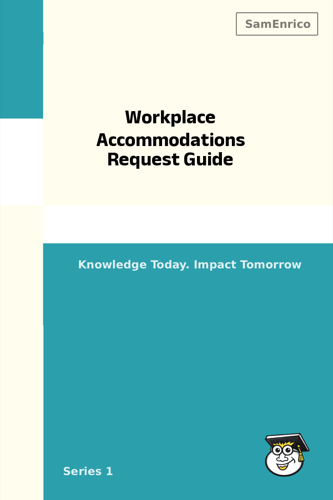
Workplace Accommodations Request Guide eBook
Document needs, approach HR, and secure flex time
Document needs, approach HR, and secure flex time or ergonomic support for medical conditions.
Formats
Free sample
Chapter 1: The Three-Box Test--–- Every year, millions of employees walk into work with a secret. Their back has been aching for months. Their hands go numb after an hour of typing. Their anxiety spikes every time the phone rings. Or they are so exhausted by 2 p.m.
that they cannot remember what they read five minutes ago. They tell themselves: Everyone feels this way. I just need to try harder. If I were stronger, this wouldn't be a problem.And so they suffer in silence.Others take the opposite path. They march into their manager's office and announce, "I need to work from home because I'm stressed." Or "I have a medical condition, so I need Fridays off." Or "My doctor says I can't do mornings anymore." When the manager says no, they feel crushed, angry, and convinced the system is rigged against them.Both groups make the same mistake.
The first group fails to recognize a legitimate medical need when they see one. The second group fails to distinguish between a legally protected disability, a personal preference, and a performance problem. Neither group has taken the most important step before approaching anyone at work.They have not taken the Three-Box Test.This chapter is the foundation upon which your entire accommodation request will be built – or crumble. Before you talk to a doctor, before you write an email to HR, before you even mention the word "accommodation" to your boss, you must answer three questions. They seem simple.
But getting them wrong is the number one reason accommodation requests fail, are delayed, or backfire into retaliation.Here are the three questions that will determine everything:Box One: Is this a legally protected medical need, or is it a personal preference?Box Two: Is this a functional limitation at work, or is it a general life difficulty?Box Three: Is this an accommodation that will be effective, or could it be seen as a performance excuse?By the end of this chapter, you will not only answer these questions for your own situation. You will also understand three legal pillars that protect your request, the distinct tools available to you (intermittent leave, flex time, and ergonomic supports), and a critical decision rule that will save you from the most common timing mistake. And you will do all of this before you have spent a single dollar on a doctor's note or a single minute in a stressful conversation with HR.Let us begin with the story of two employees who thought they had the same problem. They were both wrong – but for completely different reasons.The Parable of Two Employees Maria is a marketing manager at a mid-sized software company. She has worked there for four years.
Her reviews have always been solid – "meets expectations" across the board. Over the past six months, she has noticed that her back starts to ache about ninety minutes into sitting at her desk. By 3 p.m., the pain is distracting. By 5 p.m., she can barely focus. She mentioned this to her chiropractor, who said, "Sitting is hard on everyone.
Try a standing desk."Maria thought about asking her employer for a sit-stand desk converter. But she felt guilty. Other people sit all day too, she thought. I'm not special. I should just stand up more on my own.
So she bought a $30 laptop riser from Amazon and kept quiet. Six months later, her back pain had become so severe that she needed physical therapy. She missed eleven days of work. Her performance review dropped to "needs improvement."David works in customer support at the same company. He has been there eight months.
He has always struggled with mornings – he is not a "morning person." Recently, he started seeing a therapist for generalized anxiety. His therapist suggested that a later start time might reduce his morning panic attacks. David walked into his manager's office and said, "I have an anxiety disorder. I need to start at 10 a.m. instead of 8 a.m.
It's a reasonable accommodation."His manager was caught off guard. "We have a core hours policy," she said. "Everyone needs to be here by 9 a.m. for the stand-up meeting." David felt dismissed. He went to HR and said he was being discriminated against.
HR asked for documentation. David's therapist wrote a note that said, "David has an anxiety disorder." HR said the note did not describe any functional limitation at work. David was put on a performance improvement plan for attendance. He quit two months later.What happened here?Maria had a legitimate medical need that she failed to recognize. She suffered needlessly, lost productivity, and hurt her career because she thought she was being "strong" by not asking for help.
Her employer would likely have approved a $150 sit-stand converter – far less than the cost of her eleven sick days and physical therapy.David had a personal preference that he mistook for a medical need. He did not like mornings. Nothing in his therapist's note said that his anxiety prevented him from working at 8 a.m. – only that a later start might feel better. His employer was within their rights to say no because David never established a functional limitation tied to his disability.Both Maria and David needed the Three-Box Test.
Maria would have discovered that she had a protected need. David would have discovered that he did not – at least not yet.Let us give you the test now.Box One: Medical Need vs. Personal Preference The first box is where most people make their biggest mistake – in both directions.A legally protected medical need has three characteristics. First, it arises from a condition that substantially limits one or more major life activities. Major life activities include walking, standing, sitting, lifting, bending, concentrating, thinking, communicating, sleeping, and working.
Second, the need is specific to a workplace barrier – not just a general wish for comfort or convenience. Third, the need can be documented by a clinician in terms of functional limitations, not just a diagnosis.A personal preference has different characteristics. It is a way of working that you prefer but that is not medically necessary to perform your job's essential functions. It might make you happier, less stressed, or more comfortable. But you can still do your job without it.
Preferences are not protected by disability law.Here is the critical distinction that most people miss: A condition can be a real medical diagnosis without creating a legally protected need for a specific accommodation.Let us repeat that because it is the most misunderstood concept in accommodation law.A diagnosis of anxiety, depression, back pain, arthritis, or IBS does not automatically entitle you to any accommodation you want. The law protects you from discrimination because of your disability. But the accommodation must address a specific functional limitation at work. If your anxiety does not prevent you from working at 8 a.m. – if it just makes you unhappy – then you have a preference, not a protected need.Similarly, a condition can create functional limitations in some jobs but not others.
Back pain that prevents you from lifting fifty-pound boxes in a warehouse is a protected need. Back pain that makes…
This is the end of the free sample. Get the eBook to keep going. Buy now
About this book
Details
- Author
- Zarate Deshawn
- Publisher
- SamEnrico
- Language
- English
- Genre
- Non-Fiction, Self-Help, Disability Rights
- Released
- 2026-06-10
- Pages (approx.)
- 157
- Available as
- eBook, Audiobook

Read better in the ZLOADR app
Your eBooks on your phone or tablet. Sign in with your SamEnrico account and start reading.
More by Zarate Deshawn
 Interleaving Practice WorkbookZarate Deshawn$11.99
 The IBS Body ScanZarate Deshawn$11.99
 Cape Town Bootstrapping Survival GuideZarate Deshawn$11.99
 Testosterone and Thyroid ConnectionZarate Deshawn$11.99
 The Last Broadcast: How Radio Saved a Dying EmpireZarate Deshawn$11.99
 The Carbon-14 Conspiracy: How a Forgotten Chemist Fooled the WorldZarate Deshawn$11.99
 GIS SpecialistZarate Deshawn$11.99
 Understanding Charcot–Marie–tooth Peroneal Muscular Atrophy, X-linkedZarate Deshawn$17.99
 Cooperative Bylaws TemplateZarate Deshawn$12.99
 How to Become a Bulldozer Operator IZarate Deshawn$11.99
You may also like
 Disability Accommodation AngerHong David$11.99
 Workplace Anger Accommodation RequestBreen Jame$11.99
 Disability Accommodation Anger HandbookFrierson Franklyn$11.99
 Asking For AccommodationsFries Rebbecca$11.99
 Navigating Disability Accommodation TalksCleary Dian$11.99
 Requesting Reasonable AccommodationYi Annamaria$11.99