
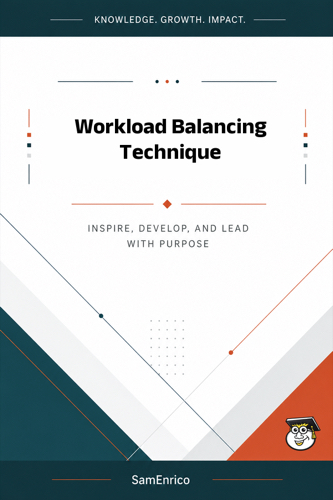
Non-FictionBusiness BriefWorkload Management
Workload Balancing Technique eBook
Evenly distribute tasks across team members.
Evenly distribute tasks across team members.
Formats
Free sample
Chapter 1: The Utilization Trap--–- It begins with a spreadsheet. Every Monday morning, managers across the world open a file that tells them how “busy” their people are. Green means good—someone is fully loaded with tasks. Yellow means warning—there might be idle time. Red means danger—someone has bandwidth to spare.
The goal, almost universally, is to turn every cell green. Keep everyone busy. Maximize utilization. This, we have been told, is the very definition of productivity.It is wrong. Not slightly inaccurate.
Not in need of minor adjustment. Fundamentally, catastrophically wrong.The single most destructive force in modern team management is the pursuit of 100% utilization. It is the silent killer of innovation, the breeding ground for burnout, and the primary reason most teams feel perpetually overwhelmed while accomplishing surprisingly little. This chapter will dismantle this sacred cow, introduce the concept of strategic slack, expose the hidden tax of “work about work,” and establish the first principle of the Dynamic Equilibrium model: that protecting unused capacity is not waste—it is the only path to sustainable throughput.The False God of Full Schedules Let us begin with a thought experiment. Imagine a highway designed to operate at 100% capacity.
Every lane is completely full. Cars are bumper-to-bumper, moving at exactly the speed limit with no gaps. In theory, this is maximally efficient. In reality, the moment any driver taps their brakes—a deer crosses the road, a merge goes awkwardly, a phone rings—the entire system collapses into a stop-and-go wave that takes hours to dissipate. A highway at 100% utilization has no room for error, no buffer for the unexpected, no slack to absorb variance.Your team is exactly the same.When every person is scheduled to 100% capacity, there is no one available to handle the unexpected client request, the urgent bug fix, the last-minute report.
There is no time for the creative insight that arrives during a quiet moment of reflection. There is no cognitive room for process improvement, for cross-training, for the kind of lateral thinking that solves problems before they emerge. The team becomes brittle. One small disruption triggers a cascade of delays, and suddenly everyone is working late, dropping tasks, and apologizing for missed commitments.The data bear this out. Research from the manufacturing sector, where utilization theory originated, has long shown that the optimal operating point for any system with variability is between 70% and 80% of theoretical maximum capacity.
Above that threshold, queue times grow exponentially. A team running at 85% utilization will have wait times roughly double those of a team at 80%. At 90%, wait times multiply by a factor of five. At 95%, the system becomes mathematically unstable—small delays propagate into large ones, and the concept of predictable delivery vanishes entirely.Yet most knowledge work teams operate at utilization levels that would bring a factory to its knees. The difference is that factories have visible queues—work piling up on the shop floor—while knowledge workers internalize the queue as stress, overtime, and the vague sense of always being behind.Efficiency Is Not Effectiveness The confusion begins with a linguistic trap.
We use the words “efficiency” and “effectiveness” as if they were interchangeable. They are not. Efficiency is doing things right—minimizing waste, maximizing output per unit of input, keeping everyone busy. Effectiveness is doing the right things—achieving goals, delivering value, finishing what matters. A team can be ruthlessly efficient at producing work that should never have been done in the first place.
A team can be 100% utilized on tasks that move the organization nowhere.Consider two teams. Team A has eight people, each operating at 95% utilization, producing ninety-five units of work per week. However, due to poor prioritization and lack of slack for reflection, only thirty of those units actually matter to the business. Team B has eight people, each operating at 70% utilization, producing seventy units of work per week. Because they have slack to think, to prioritize, to reject low-value requests, sixty of those units matter.
Which team is more productive? By traditional utilization metrics, Team A looks superior. By any sane measure of business impact, Team B dominates.The utilization trap tricks managers into optimizing the wrong variable. We measure what is easy to measure—hours logged, tasks completed, tickets closed—rather than what matters. And because we measure it, we manage to it.
The spreadsheet turns green, and we celebrate, even as the team drowns in work that does not matter.Introducing the Slack Principle Slack is the single most misunderstood resource in management. To most leaders, idle time is waste. To those who understand complex systems, idle time is the only thing that makes reliable performance possible.The Slack Principle is simple: every team requires a reservoir of unassigned capacity—time that is intentionally not scheduled—to absorb the inevitable variability of knowledge work. This reservoir serves four critical functions.First, slack absorbs unpredictability. When an urgent request arrives, a team with slack can respond without disrupting existing commitments.
The work flows into the empty space rather than cascading across the schedule. Teams without slack respond by asking everyone to work later, which leads to burnout, or by reprioritizing in a panic, which leads to context switching and lost time.Second, slack enables improvement. The teams that get better over time are not the busiest teams. They are the teams with enough breathing room to step back, reflect, and redesign their processes. Toyota, the company that perfected the concept of slack under the name “buffer capacity,” explicitly mandates that every line worker has time for continuous improvement.
They understand that a team running at full speed never has time to sharpen its tools.Third, slack preserves cognitive capacity for deep work. The human brain is not a machine that can run continuously at high intensity. It requires recovery periods. The moments between tasks, the quiet afternoon with no meetings, the walk around the block—these are not losses of productivity. They are the conditions that make high-quality output possible.
The best creative work, the most elegant solutions, the insights that save weeks of effort—these emerge from slack, not from back-to-back deadlines.Fourth, slack reduces the cost of context switching. When a team has no buffer, every interruption forces a reprioritization crisis. Work is stopped mid-stream, parked in working memory, and resumed later with a significant mental penalty. With slack, interruptions flow into the reserved capacity, leaving focused work uninterrupted. The difference in total throughput is often a factor of two or more.The Work About Work Epidemic If slack is the solution, we must first understand what is consuming all the time.
The answer is shocking: most knowledge workers spend the majority of their cognitive bandwidth on activities that are not the core work they were hired to perform.This is “work about work.” It includes checking and responding to email, updating status reports and project tracking tools, attending meetings about meetings, preparing progress updates, switching between applications, searching for information that should be findable, waiting for approvals, and the endless small administrative tasks that fill the interstices of the day. According to multiple time-use studies across technology, finance, healthcare, and professional services, work about work consumes between 55%…
This is the end of the free sample. Get the eBook to keep going. Buy now
About this book
Details
- Author
- Talley Charity
- Publisher
- SamEnrico
- Language
- English
- Genre
- Non-Fiction, Business Brief, Workload Management
- Released
- 2026-06-07
- Pages (approx.)
- 143
- Available as
- eBook, Audiobook

Read better in the ZLOADR app
Your eBooks on your phone or tablet. Sign in with your SamEnrico account and start reading.
More by Talley Charity
 Dubbing MyselfTalley Charity$11.99
 Snowfall Quiet GuideTalley Charity$11.99
 Medication Assisted Treatment GuideTalley Charity$11.99
 School Lunch Prep Time SaverTalley Charity$11.99
 Pedal to the Pulse: The Rhythmic Revolution of the Tour de France in AfricaTalley Charity$11.99
 Toyota Manufacturing SWOT GuideTalley Charity$12.99
 Scholarship Essay BlueprintTalley Charity$12.99
 Understanding Niemann–pick Disease, Type CTalley Charity$17.99
 Process ManagerTalley Charity$11.99
 How to Start a Cadmium Business (Beginners Guide)Talley Charity$11.99
You may also like
 Hong Kong Handover 1997Dunn Johnnie$11.99
 Zumba For Postnatal Recovery CourseNeal Christian$11.99
 Zumba for BeginnersLadner Nikia$11.99
 YouTube Comment Mining GuideHumes Pandora$12.99
 Worry Box MeditationCarlin Rudy$11.99
 Workplace Stress MeditationNguyen Lynn$11.99
 Workplace Stress and Sleep RepairHawley Ivory$11.99
 Workplace Perfectionism CureDelaney Jeffry$11.99
 Workplace Injustice Anger GuideWallen Isabelle$11.99
 Work Addiction and Burnout LinkGreenwood Ester$11.99
 Women in Yoga and WellnessBeattie Galina$11.99
 Women in Stand Up ComedyChun Evangeline$11.99