
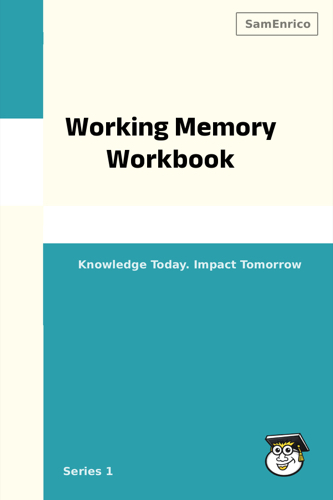
Free sample
Chapter 1: The Sticky Note Limit--You have just committed a small act of forgetting. Perhaps in the last hour, you walked into a room and couldn't remember why. Perhaps you met someone new and lost their name before they finished shaking your hand. Perhaps you opened your phone to check one thing—just one—and twenty minutes later found yourself watching a video about how to trim a bonsai tree, having completely forgotten the original task.This is not a sign of dementia. This is not laziness.
This is not a character flaw.This is your working memory hitting its natural limit.And here is the most important sentence you will read in this entire book: Your working memory is not broken. It is just full.Most people walk around believing they have a "bad memory" because they cannot hold a grocery list, follow three-step instructions, or remember a phone number long enough to dial it. They compare themselves to an impossible ideal—the fictional genius who remembers everything effortlessly—and find themselves wanting. But the problem is not the quality of your memory. The problem is that you are using a tool designed to hold four things at once as if it should hold twenty.This chapter will give you three things.
First, a clear, practical definition of working memory that you can actually use. Second, a metaphor that will change how you think about forgetting forever. Third, a baseline measurement of your current capacity—a number you will beat by the end of this book.Let us begin with the moment your brain fails.The Universal Crisis Think of the last time you forgot something embarrassing. Not a minor inconvenience—the kind of forgetting that made you stop and question your own mind.Perhaps you were introduced to someone at a party. They said, "Hi, I'm Sarah." You said, "Nice to meet you, Sarah." And then, three seconds later, as you opened your mouth to say something else, the name was gone.
You stood there smiling, hoping it would come back, knowing it wouldn't, already calculating how long you could avoid saying her name again.Or perhaps you were cooking dinner. You opened the refrigerator, pulled out the chicken, set it on the counter, and then stood there staring at it. You knew you needed something else—something obvious—but for the life of you, you could not remember what. You opened the refrigerator again. You opened the freezer.
You opened the refrigerator a third time, hoping the answer would appear like a vision. It did not. Ten minutes later, you found the broccoli still in the microwave, where you had put it when you first got home.Or perhaps you were in a meeting. Your boss asked a question. You had the answer—you knew you had the answer—but by the time three other people spoke, your thought had evaporated.
You sat there, nodding, hoping no one would call on you, feeling the slow burn of frustration at your own mind.These moments are not random. They are not a sign that you are losing your faculties. They are the predictable result of a cognitive system that has been asked to do more than it was designed to do.Working memory is the brain's real-time processing system. It is not where you store facts for years—that is long-term memory, and yours is probably fine. You can remember your childhood phone number.
You can remember the face of a friend you haven't seen in a decade. You can remember the lyrics to songs you haven't heard since high school. Long-term memory is vast, durable, and not your problem.Working memory is different. Working memory is the sticky note of the mind. It holds information for seconds, not years.
It manipulates that information while you do something else. And it has a strict, unforgiving limit.The Number You Need to Know For decades, cognitive psychologists believed that the average person could hold about seven items in working memory. This was George Miller's famous "Magic Number 7 ± 2," published in 1956, and it became one of the most cited findings in the history of psychology.There was just one problem. It was wrong.Not entirely wrong—Miller was a brilliant scientist, and his work laid the foundation for everything that followed. But Miller himself admitted that his "magic number" included strategies like chunking—grouping items together into meaningful units—rather than raw capacity.
When you dial a phone number as three chunks (area code, prefix, line number) rather than ten individual digits, you are using chunking. That is a skill, not a capacity limit.Modern research, using far more precise methods, has settled on a different number. Using the methods of Nelson Cowan and others, the best estimate for raw working memory capacity is approximately four items.Four.Not seven. Not ten. Four.For most people, the limit is between three and five items.
A small percentage of people can hold six. Almost no one can reliably hold seven raw, un-chunked items without significant training.Think about what that means. Every time you try to hold a shopping list, a set of directions, a conversation thread, a mental to-do list, and a worry about tomorrow's presentation all at once—you are asking a system designed for four things to hold ten. It will fail. It must fail.
And then you will stand in your kitchen, staring at a chicken, wondering what is wrong with you.Nothing is wrong with you. Your sticky note is just full.The Man Who Lost His Conductor To understand why working memory has this limit—and why it matters so much—we need to talk about a man who survived something no one should survive.In 1848, a railroad construction foreman named Phineas Gage was packing explosive powder into a rock with a tamping iron—a metal rod three feet long and one and a quarter inches thick. Something went wrong. The powder ignited. The rod shot upward like a missile, entered Gage's left cheek, passed behind his left eye, tore through the front of his brain, and exited through the top of his skull.The rod landed thirty yards away, covered in blood and tissue.Gage did not die.
In fact, according to contemporary reports, he was sitting upright in an oxcart within minutes, speaking coherently, aware of what had happened. He walked to a physician's office. He shook the doctor's hand. He described the accident in detail.But he was not the same.Before the accident, Gage was described as responsible, efficient, sharp-minded—one of the best foremen in the company. After the accident, he became impulsive, distractible, unable to follow through on plans, prone to outbursts.
He could still remember his past. He could still perform physical tasks. He could still carry on a conversation. But he could no longer hold a goal in mind while resisting distraction. He could no longer execute a sequence of steps without losing the thread.
He could no longer be trusted to manage himself.Gage's personality change was not mysterious. The rod had destroyed most of his left prefrontal cortex—the brain region that houses what cognitive psychologists now call the…
This is the end of the free sample. Get the eBook to keep going. Buy now
About this book
Details
- Author
- Rountree Jude
- Publisher
- SamEnrico
- Language
- English
- Genre
- Non-Fiction, Self-Help
- Released
- 2026-06-06
- Pages (approx.)
- 138
- Available as
- eBook, Audiobook

Read better in the ZLOADR app
Your eBooks on your phone or tablet. Sign in with your SamEnrico account and start reading.
More by Rountree Jude
 NVC Four Step FrameworkRountree Jude$11.99
 Valium Dependence Taper GuideRountree Jude$11.99
 Ayurvedic Stress GuideRountree Jude$11.99
 Road Rage and TailgatingRountree Jude$11.99
 CEO Sleep Optimization GuideRountree Jude$11.99
 The Stress Fatigue LinkRountree Jude$11.99
 Martin Luther KingRountree Jude$11.99
 Diaspora Network Business Building GuideRountree Jude$11.99
 Wings Over the World: The Arctic Tern’s 44,000-Mile OdysseyRountree Jude$11.99
 Sand and Shadow: The Lost Caravans of the Silk RoadRountree Jude$11.99
 The First Song: How the World Was Born in HarmonyRountree Jude$11.99
 How to Become a Appeals RefereeRountree Jude$11.99
You may also like
 Workplace Stress MeditationNguyen Lynn$11.99
 Volcano Monitoring ScientistCox Alexis$11.99
 The Tech Professional NetAguiar Nevada$11.99
 The Morning Metta RitualCanales Anya$11.99
 The Chunking Memory TechniqueClanton Hyacinth$11.99
 The Beginner Mistake FixAmmons Cassondra$11.99
 Surrendering to What IsGrimm Reatha$11.99
 Self Hypnosis for Fear of FireBillups Eli$11.99
 Road Rage for Professional DriversBrackett Janise$11.99
 Psychiatric Ward Nurse StressDunning Wyatt$11.99
 Observation vs Evaluation NVCTimmons Alda$11.99
 Networking for Nonprofit ProfessionalsPoole Jesse$11.99