
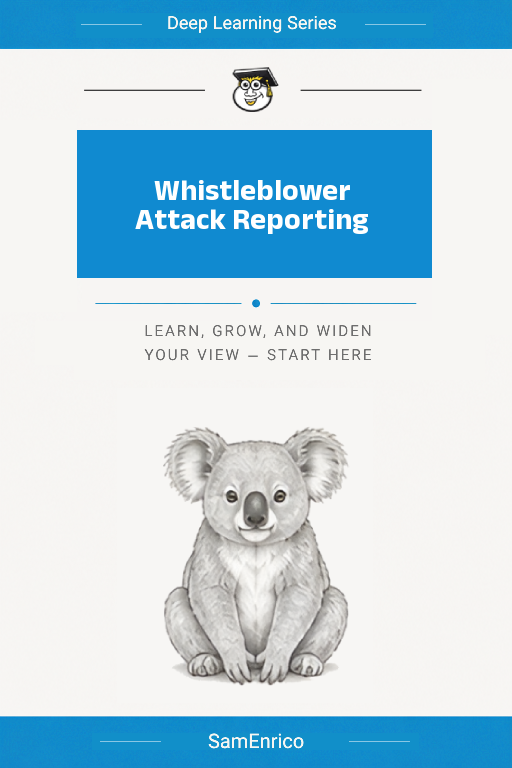
Non-FictionCrisis ManagementReporting
Whistleblower Attack Reporting eBook
Establish anonymous reporting channels for employe
by Rose Douglas
Establish anonymous reporting channels for employees to share threat concerns. Protect whistleblowers, investigate claims, and prevent terrorist attacks.
Formats
Free sample
Chapter 1: The Silenced Witness--–- The bomb was already inside the building. Security cameras had captured the man carrying a bag through the lobby, past the reception desk, and toward the elevator bank. Two guards reviewed the footage in real time from a dark room filled with monitors. They saw the bag. They saw the man’s nervous glances at the ceiling cameras.
They saw him refuse to make eye contact with the receptionist. One guard turned to the other and said, “Something’s wrong.” The other guard nodded. Neither picked up the phone. Neither radioed the floor. Neither did anything at all.The explosion came seventeen minutes later.
Seven people died. In the investigation that followed, both guards admitted they had suspected an attack was imminent. When asked why they had not acted, they gave nearly identical answers: they were afraid of being wrong. They had reported suspicious activity twice before in their careers, and both times their supervisors had ridiculed them for wasting time. One had received a formal warning for “excessive false alarms.” The other had been passed over for promotion.
They had learned, through painful experience, that speaking up carried higher immediate costs than staying silent. The dead paid for that calculus with their lives.This is not an isolated story. It is the quiet tragedy that repeats itself before nearly every preventable catastrophe, from the collapse of corporate giants to the deadliest terrorist attacks in modern history. The pattern is always the same. Someone sees the warning signs.
Someone knows something is wrong. Someone has the information that could stop the disaster. And that someone says nothing—not because they are indifferent, not because they are lazy, not because they are complicit, but because they have learned, through observation or experience, that reporting the truth will destroy them.The Information That Died in the Silos Before the September 11 attacks, more than a dozen federal employees held pieces of the puzzle that could have prevented the deaths of nearly three thousand people. An FBI agent in Phoenix, Arizona, wrote a detailed memo warning that suspicious individuals were training at American flight schools. He noted that the pattern matched intelligence about al-Qaeda’s interest in using airplanes as weapons.
He sent the memo to headquarters in Washington, where it was filed away and forgotten by supervisors who considered it too speculative to merit action.An agent in Minneapolis, Minnesota, watched as Zacarias Moussaoui, later identified as the twentieth hijacker, took flight lessons while exhibiting bizarre behavior and expressing radical views. The agent requested a warrant to search Moussaoui’s computer, where evidence of the September 11 plot was later discovered. The request was denied by headquarters, which considered the evidence insufficient. The agent was told to stop wasting resources on a case that would never go anywhere.CIA analysts had identified two of the hijackers, Khalid al-Mihdhar and Nawaf al-Hazmi, as al-Qaeda operatives attending a critical meeting in Malaysia. The analysts knew the men had entered the United States.
They knew their visa information. They knew their flight itineraries. They shared none of this information with the FBI until weeks before the attacks, after a lower-level CIA employee circumvented official channels to send a message directly to an FBI counterpart.The 9/11 Commission Report, after years of investigation and millions of documents reviewed, reached a devastating conclusion: the information needed to prevent the attacks was available across multiple agencies before September 11, but no one connected the dots. The Commission documented how “information silos” prevented intelligence from flowing to decision-makers. But the Commission missed a deeper pathology.
The problem was not just that information was trapped in silos. The problem was that the people who held the information had learned, through organizational conditioning, that sending information upward would hurt them more than withholding it.The FBI agent in Phoenix who wrote the memo about flight school training had previously flagged other potential threats. His reports had been ignored. His career had stagnated. His supervisors had labeled him a “troublemaker” who saw conspiracies where none existed.
When he wrote the Phoenix memo, he did so knowing it would likely be ignored. He was right. The agent in Minneapolis who requested the Moussaoui warrant had been told, in no uncertain terms, that his job depended on dropping the matter. He persisted anyway, and his career suffered for it. The CIA employee who finally shared the intelligence about al-Mihdhar and al-Hazmi with the FBI did so knowing she was violating protocol and risking termination.
She did it anyway, but by then it was too late.What if these employees had possessed an anonymous reporting channel that bypassed their hostile supervisors? What if the Phoenix agent could have submitted an encrypted tip that went directly to the FBI’s counter-terrorism division, the CIA’s analytic unit, and the Department of Homeland Security simultaneously, with no trace back to him? What if the Minneapolis agent could have flagged the Moussaoui warrant denial to an independent oversight body that had the authority to override his supervisors? What if the CIA employee could have shared her intelligence without fear of retaliation?These questions are not hypothetical. The technology to create such channels exists today.
The legal frameworks to protect anonymous reporters exist today. What does not exist, in most organizations, is the will to build them. This book exists to create that will.The Soldier Who Wasn't Stopped Eight years after September 11, the lessons had not been learned. On November 5, 2009, Major Nidal Hasan, an Army psychiatrist, opened fire at the Soldier Readiness Processing Center at Fort Hood, Texas. He killed thirteen people and wounded more than thirty others.
It was the deadliest mass shooting on an American military base in history.In the years before the attack, Hasan had displayed a constellation of behavioral warning signs that colleagues observed but did not report. He had communicated with Anwar al-Awlaki, a known al-Qaeda operative and radical cleric, exchanging emails that referenced jihad and martyrdom. The FBI’s Joint Terrorism Task Force had intercepted these emails and investigated Hasan in 2008. The investigation was closed after a few months, with no finding of terrorist activity.Hasan had given a presentation to fellow military doctors titled “The Koranic World View As It Relates to Muslims in the U.S. Military.” In the presentation, he argued that Muslims in the American military faced an impossible conflict of loyalty.
He quoted verses from the Quran that he claimed justified violence against enemies of Islam. He told his colleagues that the War on Terror was actually a war on Islam. Several audience members later described feeling deeply uncomfortable with the presentation, but none reported it through official channels.Hasan had told colleagues that he hoped American soldiers would be killed in Iraq and Afghanistan. He had expressed admiration for the 9/11 hijackers. He had visited a website that praised the attacks and discussed the religious justification for killing fellow soldiers.
He had attempted to contact al-Qaeda operatives through online forums. His internet history, later recovered by investigators, contained searches for fatwas authorizing violence against American troops.Yet no one reported these warning signs. Fellow soldiers who served with Hasan later told investigators that they had been…
This is the end of the free sample. Get the eBook to keep going. Buy now
About this book
Details
- Author
- Rose Douglas
- Publisher
- SamEnrico
- Language
- English
- Genre
- Non-Fiction, Crisis Management, Reporting
- Released
- 2026-05-29
- Pages (approx.)
- 144
- Available as
- eBook, Audiobook

Read better in the ZLOADR app
Your eBooks on your phone or tablet. Sign in with your SamEnrico account and start reading.
More by Rose Douglas
 The Suitcase Of PhotographsRose Douglas$11.99
 Hand Clasp InductionRose Douglas$11.99
 Surgeon Stress Management GuideRose Douglas$11.99
 Engineer Battalion MemoirsRose Douglas$11.99
 The Glazer Takeover: How American Billionaires Reshaped Manchester UnitedRose Douglas$11.99
 How to Start a Nightwear Knitting Mills BusinessRose Douglas$11.99
 Tire Track AnalysisRose Douglas$11.99
 How to Produce Bidet Faucets and SprayersRose Douglas$11.99
You may also like
 Hong Kong Handover 1997Dunn Johnnie$11.99
 Zumba For Postnatal Recovery CourseNeal Christian$11.99
 Zumba for BeginnersLadner Nikia$11.99
 YouTube Comment Mining GuideHumes Pandora$12.99
 Worry Box MeditationCarlin Rudy$11.99
 Workplace Stress MeditationNguyen Lynn$11.99
 Workplace Stress and Sleep RepairHawley Ivory$11.99
 Workplace Perfectionism CureDelaney Jeffry$11.99
 Workplace Injustice Anger GuideWallen Isabelle$11.99
 Work Addiction and Burnout LinkGreenwood Ester$11.99
 Women in Yoga and WellnessBeattie Galina$11.99
 Women in Stand Up ComedyChun Evangeline$11.99