
Non-FictionBusiness BriefPerformance Metrics
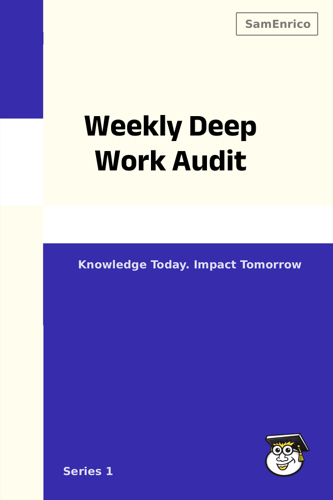
Weekly Deep Work Audit eBook
Teaches tracking and measuring hours of focused wo
Teaches tracking and measuring hours of focused work to increase capacity.
Formats
Free sample
Chapter 1: The Shallow Epidemic--–- The email arrives at 7:32 AM. You swipe it away before your feet touch the floor. By 8:00 AM, you have answered eleven messages, scanned three news headlines, and checked Slack twice. At 9:00 AM, you sit down to “really work.” By 9:07 AM, a calendar reminder pulls you into a meeting. At 10:30 AM, you emerge, confused about what you accomplished.
You open your email again. Forty-two new messages. You answer the urgent ones. At 11:00 AM, you try to focus on the report that was due yesterday. At 11:13 AM, a colleague taps your shoulder with a “quick question.” At 11:28 AM, you check your phone.
At 11:45 AM, you realize you have read the same paragraph three times. At noon, you give up and open your email again. This is not a bad day. This is a typical day. And this is the shallow epidemic.The feeling is familiar to nearly every knowledge worker.
You end a ten-hour day exhausted, yet when someone asks what you accomplished, you hesitate. You answered emails. You attended meetings. You “put out fires.” You felt busy—urgently, exhaustingly busy. But did you create anything?
Did you solve a hard problem? Did you learn something new? Did you move a meaningful project forward? The silence is the answer.We have mistaken movement for achievement. We have confused being busy with being productive.
And in doing so, we have surrendered our most valuable resource—our ability to focus deeply—to the shallow work that surrounds us like floodwater.This chapter draws a line in the sand. On one side: deep work, the kind of cognitively demanding, distraction-free concentration that produces your best output. On the other side: shallow work, the logistical, low-value tasks that feel productive but rarely produce results. Understanding the difference is not academic. It is the first and most important step toward increasing your capacity for focused work.
Because you cannot protect something you cannot identify. And right now, most people cannot identify their own shallow epidemic.The Seduction of Busyness Let us start with a provocation. Answering email feels productive. It should not. Checking a task off a list feels satisfying.
It should not. Responding to a Slack message within thirty seconds feels responsive and responsible. It should not. These feelings are not signals of real productivity. They are the psychological rewards of shallow work—cheap dopamine hits that keep you returning to the trough of trivial tasks while the important work goes undone.The problem is not that shallow work is evil.
Some shallow work is necessary. You cannot run a business without answering some emails, attending some meetings, and processing some logistics. The problem is that shallow work is seductive. It offers immediate feedback: you send an email, and sometimes you get an immediate reply. You complete a task, and you check a box.
You attend a meeting, and you feel like you did something. Deep work offers no such immediate rewards. You sit alone for ninety minutes, wrestling with a difficult problem, and at the end you may have nothing to show except a headache and a partial draft. The payoff is delayed. The struggle is invisible.
The reward comes days or weeks later, when the project is finished, the problem is solved, or the skill is mastered.This asymmetry explains why so many knowledge workers default to shallow work even when they know better. The shallow work calls to you. It buzzes, it pings, it glows. It promises quick wins and visible progress. The deep work sits quietly, waiting for you to choose it, offering no guarantees and no instant gratification.
In the battle between the ping and the quiet, the ping almost always wins.But there is a cost. Every hour spent on shallow work is an hour stolen from deep work. And deep work, as we will see throughout this book, is the only work that reliably produces exceptional results. The shallow epidemic is not just a personal productivity problem. It is a professional crisis.Defining Deep Work and Shallow Work Let us be precise.
Deep work is professional activity performed in a state of distraction-free concentration that pushes your cognitive capabilities to their limit. These efforts create new value, improve your skill, and are hard to replicate. Examples include writing a proposal from scratch, analyzing complex data to find a pattern, learning a new programming language, strategizing a market entry, or editing a manuscript for publication. Deep work requires your full attention. It cannot be done while checking email or half-listening to a podcast.
It demands that you show up with your whole brain.Shallow work is everything else. Shallow work is logistical, low-value, and often performed while distracted. It does not require your full cognitive capacity. Examples include answering routine emails, scheduling meetings, filling out expense reports, scrolling through Slack channels, moving tasks from one column to another in Asana, and attending status update meetings where nothing is decided. You can do shallow work while watching television.
You can do shallow work while half-asleep. You can do shallow work while carrying on a conversation. That is how you know it is shallow.A critical nuance: some tasks can be deep or shallow depending on how you do them. Writing a routine status update email is shallow. Writing a persuasive sales email that requires research and careful argumentation may be deep.
The difference is cognitive demand. Does the task require your full attention, or can you do it on autopilot? If the answer is autopilot, it is shallow.The author Cal Newport, who coined the term “deep work,” offers a useful rule of thumb. If a task could be done by a smart college intern after a brief explanation, it is shallow. If it requires your unique expertise, your full concentration, and your hardest thinking, it is deep.
Most knowledge workers spend 60-80% of their time on shallow work. They believe they are being productive. They are being busy. The two are not the same.The Cost of Context Switching To understand why shallow work is so damaging, you must understand context switching. The human brain is not a computer.
It cannot instantly switch between tasks without loss. When you toggle from email to a report and back, you do not lose a few seconds. Research from the University of California, Irvine, found that it takes an average of twenty-three minutes to fully refocus after an interruption. Twenty-three minutes. If you check email five times per day, that is nearly two hours of refocusing time—before you have done any actual work.This is the hidden cost of shallow work.
The shallow tasks themselves may take only a few minutes. But the damage they cause—the interruption of deep work flow, the cognitive residue left behind, the time required to re-engage—can be enormous. Imagine you are running a marathon. Every shallow interruption is like someone asking you to stop, tie your shoe, and then sprint to catch up. You can do it a few times.
Do it ten times, and you are not running a marathon anymore. You are doing wind sprints. And you are exhausted.The shallow epidemic thrives on context switching. Your email pings.…
This is the end of the free sample. Get the eBook to keep going. Buy now
About this book
Details
- Author
- Sutton Gertrude
- Publisher
- SamEnrico
- Language
- English
- Genre
- Non-Fiction, Business Brief, Performance Metrics
- Released
- 2026-06-06
- Pages (approx.)
- 129
- Available as
- eBook, Audiobook

Read better in the ZLOADR app
Your eBooks on your phone or tablet. Sign in with your SamEnrico account and start reading.
More by Sutton Gertrude
 TikTok Culture Impact GuideSutton Gertrude$11.99
 New Businesses Launched Past FiftySutton Gertrude$11.99
 Menopause And PCOS GuideSutton Gertrude$11.99
 The Personal Brand Audit GuideSutton Gertrude$11.99
 Tu Youyou Artemisinin PioneerSutton Gertrude$11.99
 Weekly Reading Review GuideSutton Gertrude$11.99
 Decision Confidence HypnosisSutton Gertrude$11.99
 The Last Empress and the Forbidden Love LettersSutton Gertrude$11.99
 The Hollow Hill: A Warrior’s Bargain with the SidheSutton Gertrude$11.99
 How to Produce Disposable CamerasSutton Gertrude$11.99
 Mastering Rav Akçesi: Ottoman Sheep Tax VariantSutton Gertrude$11.99
 Exploring Collage: Cut, Paste & LayerSutton Gertrude$11.99
You may also like
 Hong Kong Handover 1997Dunn Johnnie$11.99
 Zumba For Postnatal Recovery CourseNeal Christian$11.99
 Zumba for BeginnersLadner Nikia$11.99
 YouTube Comment Mining GuideHumes Pandora$12.99
 Worry Box MeditationCarlin Rudy$11.99
 Workplace Stress MeditationNguyen Lynn$11.99
 Workplace Stress and Sleep RepairHawley Ivory$11.99
 Workplace Perfectionism CureDelaney Jeffry$11.99
 Workplace Injustice Anger GuideWallen Isabelle$11.99
 Work Addiction and Burnout LinkGreenwood Ester$11.99
 Women in Yoga and WellnessBeattie Galina$11.99
 Women in Stand Up ComedyChun Evangeline$11.99