
Non-FictionStudent's ShortcutWeb Dev
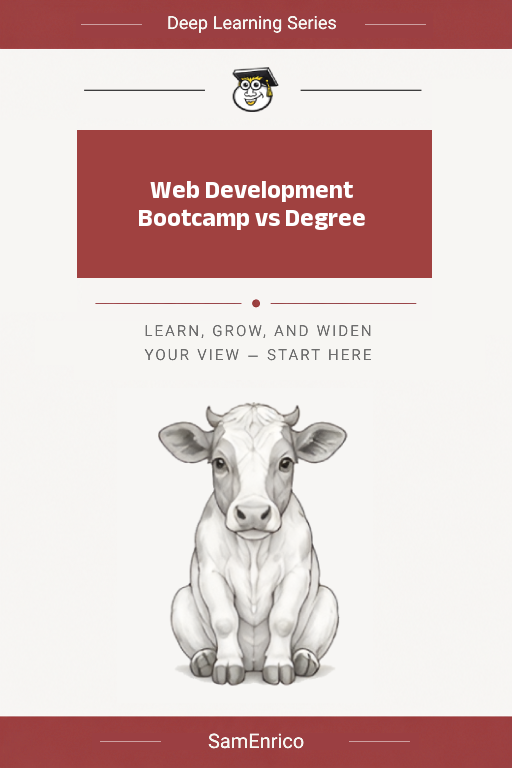
Web Development Bootcamp vs Degree eBook
Frontend and backend specialization outcomes from
by Dexter Chong
Frontend and backend specialization outcomes from bootcamps versus university programs.
Formats
Free sample
Chapter 1: The $163,000 Question--The email arrived on a Tuesday afternoon. Maria, twenty-two years old, had been applying to developer jobs for exactly three weeks. Her inbox had been quiet except for the automated rejections—the ones that said “we’ve decided to move forward with other candidates” in language so polite it felt almost cruel. But this email was different. The subject line read: “Offer Letter – Frontend Developer, Stellar Tech.”She opened it with trembling hands.
$71,000 base salary. Full benefits. A startup in Austin with a ping-pong table and unlimited coffee and the kind of culture that tech companies put in their job postings to seem hip. Maria had built her first React application thirteen months ago. She had never written a line of code before that.
She had no computer science degree, no prestigious internships, no family connections in tech. What she had was a fourteen-week coding bootcamp, a portfolio of three working applications, and the willingness to fail publicly on Git Hub until she figured things out.Across the country, James, twenty-six, was preparing for his afternoon stand-up meeting at a Fortune 500 company where he worked as a backend engineer. He had spent four years earning his computer science degree from a respected public university. He had graduated with 45,000instudentdebtandatranscriptfullof A’sincourseslike Operating Systems,Distributed Systems,and Advanced Algorithms.Hisstartingsalaryhadbeen45,000 in student debt and a transcript full of A’s in courses like Operating Systems, Distributed Systems, and Advanced Algorithms. His starting salary had been 45,000instudentdebtandatranscriptfullof A’sincourseslike Operating Systems,Distributed Systems,and Advanced Algorithms.Hisstartingsalaryhadbeen85,000—significantly above the national average for CS graduates, thanks to his company’s competitive compensation structure.
He was good at his job. He understood how databases scaled, how to optimize queries that processed millions of records, how to reason about system architecture in ways that his bootcamp-educated colleagues sometimes struggled with.Two developers. Two paths. Two different definitions of success.The question that haunts thousands of prospective developers every year is simple to state but agonizing to answer: Which path is right for you?This book exists because that question has no single correct answer. Every person who claims otherwise—every bootcamp evangelist who says degrees are obsolete, every CS professor who says bootcamps are diploma mills—is selling you something.
The truth is messier, more interesting, and entirely dependent on who you are, what you want to build, and how fast you need to get there.This chapter establishes the stakes. It explains why choosing between a bootcamp and a degree is not just an educational decision but a career-defining choice with financial, temporal, and psychological consequences that will echo through your next five to ten years. By the time you finish this chapter, you will understand what makes this decision so difficult, why the debate has become so heated, and how the rest of this book will help you navigate it.The Growth That Changes Everything Let us begin with a number: seventeen percent.According to the United States Bureau of Labor Statistics, employment for web developers and digital designers is projected to grow 17 percent from 2023 to 2033. That is more than three times the average growth rate for all occupations. The bureau estimates that over seventy thousand new developer positions will be created annually in the United States alone during this period.Those numbers explain a great deal about why you are reading this book.
The demand for developers has never been higher. Companies are desperate for people who can build things. This desperation has cracked open doors that were once firmly shut. It has forced employers to ask uncomfortable questions about whether the traditional four-year degree is truly necessary. It has created space for alternatives.But there is another number you need to hold in your mind: two hundred.Two hundred applications is not uncommon for a single junior developer position at a desirable company.
The explosion of bootcamps, online courses, and self-taught developers has flooded the entry-level market with candidates. The competition is fierce. A decade ago, a CS degree was a golden ticket. Today, it is one credential among many, and employers have become ruthless about filtering applicants based on what they can actually build, not what their diploma says.Here is the paradox of our moment: more jobs than ever, more applicants than ever, and more confusion than ever about how to position yourself for success.The growth is real. The competition is also real.
Understanding both is the first step toward making a wise decision.How Remote Work Changed the Rules Before 2020, geography was destiny for most aspiring developers. If you lived in rural Ohio, your job prospects were limited to whatever companies happened to exist within commuting distance. The best opportunities were concentrated in a handful of expensive cities: San Francisco, Seattle, New York, Austin. To compete for those jobs, you needed either a degree from an elite institution or the financial runway to relocate after a bootcamp.The pandemic shattered that reality.Remote work did not simply make it possible to work from home. It decoupled talent from location.
A bootcamp graduate in rural Ohio can now apply for the same San Francisco job as a Stanford CS graduate. The playing field is not perfectly level—networks and pedigrees still matter—but it is far more level than it was a decade ago.Hiring practices have changed in tandem. Technical interviews, once conducted in person with whiteboards and nervous handshakes, have shifted fully remote. This standardization has reduced the advantage that elite degree holders once enjoyed. When every candidate takes the same Leet Code assessment from their own laptop, the signal that matters is problem-solving ability, not the name on your diploma.Companies have also realized something important: they do not need every engineer to understand compiler design or operating systems.
They need people who can ship features, fix bugs, and collaborate effectively. For many roles, a bootcamp graduate who has built and deployed multiple applications is more valuable than a degree holder who has only written academic code.This is not to say that degrees have become worthless. They have not. But the structural advantages that once made a degree non-negotiable have eroded. You now have a genuine choice.The Skills-Over-Credentials Movement In 2018, IBM announced that it would no longer require four-year degrees for many of its technology roles.
Google followed. Apple followed. Other companies quietly updated their job descriptions. The message was unmistakable: the industry was moving away from credentialism and toward skills-based hiring.Data from multiple employer surveys tells a consistent story. Eighty percent of hiring managers say they prioritize portfolios and technical interviews over degrees.
Ninety-four percent cite portfolio quality as the single most important factor in hiring decisions. Among employers who have hired bootcamp graduates, 99.8 percent say they would do so again.These numbers are striking. They suggest that the gatekeepers of the industry have largely abandoned the idea that a CS degree is the only legitimate path into development.But there is nuance here. The skills-over-credentials movement is strongest in tech-first companies—startups, mid-sized Saa S companies, and the more progressive arms of big tech. It is weakest in traditional industries like banking, healthcare, and government, where compliance requirements and…
This is the end of the free sample. Get the eBook to keep going. Buy now
About this book
Details
- Author
- Dexter Chong
- Publisher
- SamEnrico
- Language
- English
- Genre
- Non-Fiction, Student's Shortcut, Web Dev
- Released
- 2026-06-01
- Pages (approx.)
- 136
- Available as
- eBook, Audiobook

Read better in the ZLOADR app
Your eBooks on your phone or tablet. Sign in with your SamEnrico account and start reading.
More by Dexter Chong
 Networking for Podcasters GuideDexter Chong$11.99
 Public Speaking Confidence BoostDexter Chong$11.99
 Pregnancy Chiropractic CareDexter Chong$11.99
 Stress Gut Microbiome GuideDexter Chong$11.99
 Higher Power Explained SimplyDexter Chong$11.99
 The EQ for Introverts GuideDexter Chong$11.99
 Silence and Solitude RitualDexter Chong$11.99
 Self Hypnosis For SalesDexter Chong$11.99
 Presidents Master GuideDexter Chong$11.99
 The Antarctic Mirage: The Secret Survival of the Lost ExpeditionDexter Chong$11.99
 Hippocrates: The Birth of Medical ScienceDexter Chong$11.99
 Echoes of the Last Wild: The Great American Bison ComebackDexter Chong$11.99
You may also like
 Hong Kong Handover 1997Dunn Johnnie$11.99
 Zumba For Postnatal Recovery CourseNeal Christian$11.99
 Zumba for BeginnersLadner Nikia$11.99
 YouTube Comment Mining GuideHumes Pandora$12.99
 Worry Box MeditationCarlin Rudy$11.99
 Workplace Stress MeditationNguyen Lynn$11.99
 Workplace Stress and Sleep RepairHawley Ivory$11.99
 Workplace Perfectionism CureDelaney Jeffry$11.99
 Workplace Injustice Anger GuideWallen Isabelle$11.99
 Work Addiction and Burnout LinkGreenwood Ester$11.99
 Women in Yoga and WellnessBeattie Galina$11.99
 Women in Stand Up ComedyChun Evangeline$11.99