
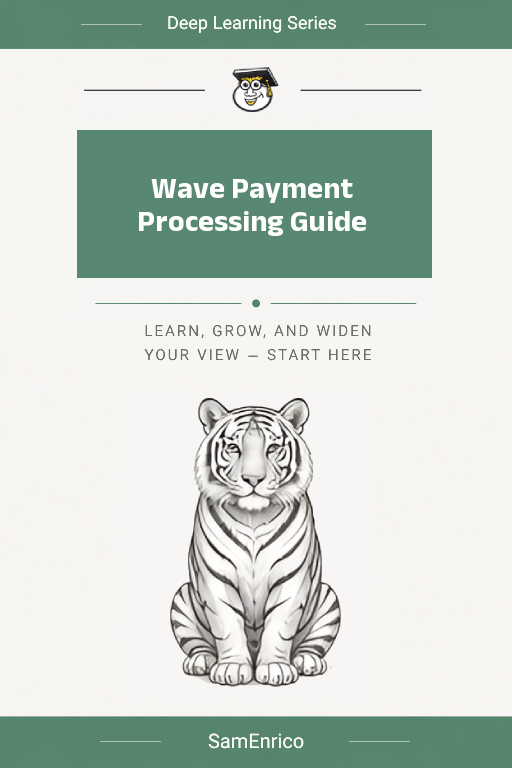
Non-FictionFirst 30 DaysBookkeeping
Wave Payment Processing Guide eBook
Accept credit card and bank payments through Wave.
Accept credit card and bank payments through Wave. Set up payment gateway and reconcile transaction fees.
Formats
Free sample
Chapter 1: The Three Bridges–- I lost $2,147 in my first year on Wave. Not to fraud. Not to bad customers. To something far more insidious: invisible fees that I never categorized, batch payouts that I never reconciled, and a beautiful automation system that I trusted completely – until I realized it was lying to me.My name is not important. What matters is that I run a small design agency.
Twelve clients. Monthly invoices averaging 1,200each.In2023,Iprocessedroughly1,200 each. In 2023, I processed roughly 1,200each.In2023,Iprocessedroughly86,000 through Wave. And when my accountant asked for my reconciled books in January 2024, I confidently exported my profit and loss statement. Net income: $82,300.
I was proud of that number.Then my accountant asked a simple question: "Where are your processing fees?"I blinked. "They're... deducted? The deposit is less than the invoice. Wave handles that automatically."She nodded slowly – the kind of nod that says I've seen this before and you're about to be very unhappy.
"Wave creates an expense transaction for the fee. But if you never categorized it as an expense – if you just accepted the net deposit as income – you just paid taxes on 86,000ofrevenueinsteadofon86,000 of revenue instead of on 86,000ofrevenueinsteadofon82,300 of revenue after $3,700 in fees."I had done exactly that. For twelve months. Every credit card fee, every bank payment fee, every instant payout charge – I had treated them as invisible discounts rather than deductible expenses. The difference in taxes: roughly 1,100overpaidtothe IRS.Plusthe1,100 overpaid to the IRS.
Plus the 1,100overpaidtothe IRS.Plusthe1,047 in fees I had never tracked at all because I didn't know where to look.$2,147. Gone. Not lost to fraud. Lost to a misunderstanding of how Wave's automation actually works.This chapter exists so that doesn't happen to you.The All-in-One Promise vs. The Patching Nightmare Before Wave, most small business owners patch together three separate tools: Quick Books or Xero for accounting, Stripe or Pay Pal for payments, and a spreadsheet for reconciliation.
Every sale requires manual data entry: record the invoice in the accounting system, record the payment in the payment processor, record the deposit in the bank, match them together. This takes the average freelancer 5-10 hours per month. At 50perhourofyourtime,that′s50 per hour of your time, that's 50perhourofyourtime,that′s250-500 monthly – or $3,000-6,000 annually – just to move numbers from one column to another.Wave's promise is seductive because it eliminates this manual labor. When you send an invoice through Wave, and your customer pays that invoice online using Wave Payments, Wave automatically creates every accounting entry. The invoice, the payment, the deposit, the fee – all of it appears in your books without you lifting a finger.But here is the truth that Wave's marketing doesn't emphasize: automation is not the same as accuracy.Wave automates the creation of transactions, but it does not automate their classification.
A fee expense that exists in your Chart of Accounts but is never categorized to the correct account might as well not exist. A deposit that Wave auto-categorizes as "Income" when it should be a "Transfer from Wave Payments" will double-count your revenue. A batch payout that Wave splits incorrectly will leave your clearing account perpetually unbalanced.The result? You trust the system. The system looks right.
Your bank account balance matches your Wave balance. But your profit and loss statement is wrong. Your tax liability is wrong. And you don't know it until your accountant – or worse, the IRS – tells you.This book is the antidote to that blind trust. Every chapter builds toward one goal: a reconciliation system so simple and so consistent that you can complete it in 30 minutes per week, catch every error before it compounds, and sleep soundly knowing your books are right.The Three-Bridge Framework: How Money Actually Moves Before we touch a single setting in Wave, you need a mental model for how payment processing works under the hood.
I call this the Three-Bridge Framework, and it will save you more time than any other concept in this book.Imagine that money moves across three bridges between your customer and your bank account.Bridge One: The Customer-to-Clearing Bridge.When a customer pays an invoice, the money leaves their credit card or bank account. It does not go directly to your bank account. It first goes to a holding account – a clearing account – that sits between the customer and your bank. This clearing account is managed by Wave's payment processor (a company called Stripe, actually, which powers Wave Payments under a white-label agreement).From an accounting perspective, when money crosses Bridge One, you have recorded income. The customer has paid.
You have earned the revenue. But the money is not yet in your possession. It is in transit.Bridge Two: The Clearing-to-Bank Bridge.Once Wave accumulates enough payments to make a transfer worthwhile (or when a certain time threshold is reached), they initiate a payout. Money leaves the clearing account and enters your business bank account. This typically takes 1-2 business days for credit cards, 2-7 business days for bank payments.From an accounting perspective, when money crosses Bridge Two, you have received a transfer.
This is not new income. This is the same money from Bridge One, just moved to a new location. If you record this transfer as income, you have doubled your revenue – a mistake that costs thousands in overpaid taxes.Bridge Three: The Fee Bridge.Somewhere between Bridge One and Bridge Two, Wave deducts its processing fees. The fee is calculated on the gross transaction amount, subtracted before the money reaches your bank. The fee then crosses its own bridge: from your potential revenue to Wave's revenue.From an accounting perspective, when money crosses Bridge Three, you have incurred an expense.
That fee is deductible. Every penny of it. But you can only deduct it if you track it.Here is the critical insight that 90% of Wave users miss: Wave automatically creates transactions for all three bridges, but it does not automatically classify them correctly.Wave creates the income transaction when the customer pays (Bridge One). It creates the deposit transaction when the payout arrives (Bridge Two). It creates the fee expense transaction when the fee is deducted (Bridge Three).
But the deposit transaction may be auto-categorized as "Income" instead of "Transfer from Wave Payments." The fee transaction may be sitting in an account called "Uncategorized Expense" instead of "Payment Processing Fees." The clearing account may show a balance that never zeroes out because the transfer was never properly recorded.Your job – and the job of this book – is to ensure that these three bridges are properly mapped in your Chart of Accounts. The rest of this chapter establishes the foundational rules that make that mapping possible.The One Rule That Solves 90% of Problems If you remember nothing else from this book, remember this: never delete original transactions.I will state this rule in every chapter where it applies. I will shout it from the margins. I will print it on a bookmark and encourage you to tape it to your monitor. Because the single most common cause of unrecoverable reconciliation errors is deletion.Here is what happens.
A Wave user sees a transaction that looks wrong. Maybe a deposit is categorized as "Income" when it should be…
This is the end of the free sample. Get the eBook to keep going. Buy now
About this book
Details
- Author
- Grayson Arica
- Publisher
- SamEnrico
- Language
- English
- Genre
- Non-Fiction, First 30 Days, Bookkeeping
- Released
- 2026-05-30
- Pages (approx.)
- 146
- Available as
- eBook, Audiobook

Read better in the ZLOADR app
Your eBooks on your phone or tablet. Sign in with your SamEnrico account and start reading.
More by Grayson Arica
 History Essay AI PromptsGrayson Arica$11.99
 One Color MasterpieceGrayson Arica$11.99
 Nesting Divorce RecoveryGrayson Arica$11.99
 Digital Distraction Blocking HandbookGrayson Arica$11.99
 The Blue Light Memory DisruptionGrayson Arica$11.99
 The Digital Detectives: How AI Solved Australia's Coldest CaseGrayson Arica$11.99
 Understanding Placenta DisorderGrayson Arica$17.99
 How to Start a Optical Magnifying Instruments Business (Beginners Guide)Grayson Arica$11.99
 Association of Publishing AgenciesGrayson Arica$11.99
 Insurance Consolidation GuideGrayson Arica$12.99
You may also like
 Hong Kong Handover 1997Dunn Johnnie$11.99
 Zumba For Postnatal Recovery CourseNeal Christian$11.99
 Zumba for BeginnersLadner Nikia$11.99
 YouTube Comment Mining GuideHumes Pandora$12.99
 Worry Box MeditationCarlin Rudy$11.99
 Workplace Stress MeditationNguyen Lynn$11.99
 Workplace Stress and Sleep RepairHawley Ivory$11.99
 Workplace Perfectionism CureDelaney Jeffry$11.99
 Workplace Injustice Anger GuideWallen Isabelle$11.99
 Work Addiction and Burnout LinkGreenwood Ester$11.99
 Women in Yoga and WellnessBeattie Galina$11.99
 Women in Stand Up ComedyChun Evangeline$11.99