
Non-FictionSelf-HelpOrganizational Psychology
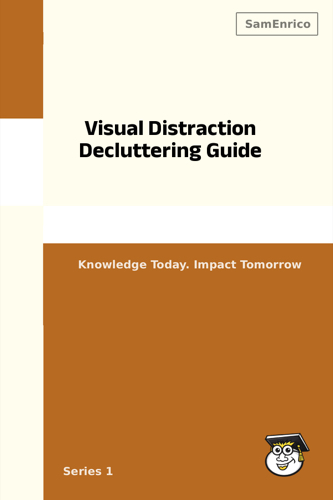
Visual Distraction Decluttering Guide eBook
Focuses on reducing visual interruptions such as m
Focuses on reducing visual interruptions such as multiple tabs, sticky notes, and desk clutter that compete for attention.
Formats
Free sample
Chapter 1: The Attention Surplus--We have been told a lie for the past twenty years. The lie whispers itself into your ear every time you abandon a task halfway, every time you stare at a blinking cursor for ten minutes without typing a word, every time you close a browser window only to immediately open a new one. The lie sounds like this: You have an attention deficit.Pharmaceutical companies have built billion-dollar fortunes on this lie. Productivity gurus have built careers on it. Schools have built accommodation policies around it.
But the lie remains a lie, and today we are going to dismantle it completely.You do not have an attention deficit. You have an attention surplus. And that surplus is being systematically stolen from you by your own environment.Let that sink in for a moment. The problem is not that your brain is broken. The problem is not that you lack willpower or discipline or grit.
The problem is that you are attempting to focus inside a space that has been inadvertently designed to make focus impossible. Your workspace—whether it is a home office, a cubicle, a kitchen table, or a coffee shop corner—is leaking your attention through a thousand tiny holes you cannot see.This chapter will show you those holes. It will name the enemy. And it will introduce the foundational concept upon which every subsequent chapter of this book is built: Visual Load Theory.The 60,000x Problem Here is a number that should terrify you: sixty thousand. That is how many times faster the human brain processes visual information compared to textual information.
When you read a sentence, your brain is decoding symbols, assembling grammar, constructing meaning—a slow, deliberate process that takes real time. But when you see something, the recognition is nearly instantaneous. You do not "read" a coffee mug. You see it, and in a fraction of a second, your brain has identified it, categorized it, judged its relevance, and filed it away.This speed is a biological marvel. It kept our ancestors alive by allowing them to spot a predator in the periphery before it struck.
But in a modern workspace, that same marvel becomes a curse.Every visible object in your field of vision triggers what cognitive psychologists call a micro-recognition event. This is a split-second neural firing that says, "I see something. What is it? Is it relevant? Do I need to act?" You are not consciously aware of these events.
They happen in the dark basement of your brain, below the level of awareness. But they happen. And they happen constantly.Let us do a quick inventory of a typical workspace right now. Look up from your screen. What do you see?
Perhaps a stack of papers to your left. A coffee mug to your right. A phone face-up on the desk. A sticky note on the edge of your monitor. A pen that does not belong to the pen cup.
A book you were meaning to read. A charging cable snaking across the surface. A family photo in a frame. A pair of reading glasses. A box of paperclips.
A stapler. A half-empty water bottle.Each of those objects triggers a micro-recognition event. Multiply that by the number of objects. Then multiply that by the number of times your eyes drift across your workspace in a given hour. Then multiply that by the number of hours in a workday.The math is devastating.In 2005, researchers at Princeton University published a landmark study on visual clutter and cognitive performance.
They found that the mere presence of task-irrelevant objects in a visual field reduced reaction times by an average of 18 percent and increased error rates by 11 percent. The participants in the study were not aware that the clutter was affecting them. When asked, they reported feeling "fine" and "unbothered." But the data told a different story. Their brains were working harder, slower, and less accurately—and they had no idea.This is the insidious nature of visual distraction. You do not feel it.
You just feel tired. You do not see it. You just see a day that slipped away.Introducing Visual Load Theory The central framework of this book is something I call Visual Load Theory, or VLT. It is a simple idea with profound implications.Your working memory—the part of your brain that holds and manipulates information in real time—has a finite capacity. Cognitive psychologists have known this for decades.
The classic study by George Miller in 1956 suggested that working memory can hold approximately seven items, plus or minus two. More recent research has refined that number downward, suggesting that for most people, the functional limit is four to seven discrete chunks of information.Here is what most productivity advice gets wrong: they assume that these four to seven slots are filled only by intentional thoughts. You know, the task you are working on, the conversation you are having, the problem you are solving. But that is not how working memory works. Working memory is not a polite guest who waits to be invited.
Working memory is a vacuum. It will fill itself with whatever is available.And what is always available? Whatever you can see.Visual Load Theory states that physical objects and digital elements compete equally with your intentional thoughts for the limited slots in working memory. When your desk has twenty visible items and your computer desktop has fifteen icons, your brain is not "ignoring" those things. It is processing them, categorizing them, and using up precious working memory capacity to do so.
That capacity is then not available for the task you actually want to be doing.Think of your working memory as a small desk. On that desk, you can place four to seven pieces of paper at a time. That is all the space you have. Now, imagine that someone else keeps walking by and placing random objects on that desk—a coffee cup, a stapler, a sticky note, a phone. Pretty soon, your desk is full.
But instead of your actual work being on the desk, the desk is covered with things you did not ask for and do not need. You have to push them aside, shuffle them around, constantly clear space just to find room for your own papers.That is what visual clutter does to your brain. It occupies real estate. And it never pays rent.The Attention Surplus (Yes, Surplus)Now we return to the lie. Why do we call this an "attention deficit" when the problem is that our attention is being stolen?The medicalization of attention problems has done enormous good for people with genuine neurological conditions like ADHD.
Let me be absolutely clear: there are real, diagnosable conditions that affect attention, and they require professional medical treatment. This book is not a substitute for that. If you suspect you have a clinical attention disorder, please see a doctor.But for the vast majority of people who say "I can't focus anymore," the problem is not a deficit. The problem is a hostile environment.Here is the evidence. In 2011, researchers at the University of California, Irvine, studied the work habits of…
This is the end of the free sample. Get the eBook to keep going. Buy now
About this book
Details
- Author
- Higgins Shelley
- Publisher
- SamEnrico
- Language
- English
- Genre
- Non-Fiction, Self-Help, Organizational Psychology
- Released
- 2026-06-09
- Pages (approx.)
- 132
- Available as
- eBook, Audiobook

Read better in the ZLOADR app
Your eBooks on your phone or tablet. Sign in with your SamEnrico account and start reading.
More by Higgins Shelley
 Senior Video Chat Self EsteemHiggins Shelley$11.99
 Self Hypnosis for EnduranceHiggins Shelley$11.99
 Bumble Compliment SeekingHiggins Shelley$11.99
 The Fractal Fire: How Black Mathematicians Decoded Nature's ChaosHiggins Shelley$11.99
 Sales RepresentativeHiggins Shelley$11.99
 How to Produce Advertising and Marketing ServicesHiggins Shelley$11.99
 Remote Employee Engagement Survey HandbookHiggins Shelley$12.99
 How to Start a Hobby in Art collectingHiggins Shelley$11.99
You may also like
 Hong Kong Handover 1997Dunn Johnnie$11.99
 Zumba For Postnatal Recovery CourseNeal Christian$11.99
 Zumba for BeginnersLadner Nikia$11.99
 YouTube Comment Mining GuideHumes Pandora$12.99
 Worry Box MeditationCarlin Rudy$11.99
 Workplace Stress MeditationNguyen Lynn$11.99
 Workplace Stress and Sleep RepairHawley Ivory$11.99
 Workplace Perfectionism CureDelaney Jeffry$11.99
 Workplace Injustice Anger GuideWallen Isabelle$11.99
 Work Addiction and Burnout LinkGreenwood Ester$11.99
 Women in Yoga and WellnessBeattie Galina$11.99
 Women in Stand Up ComedyChun Evangeline$11.99