
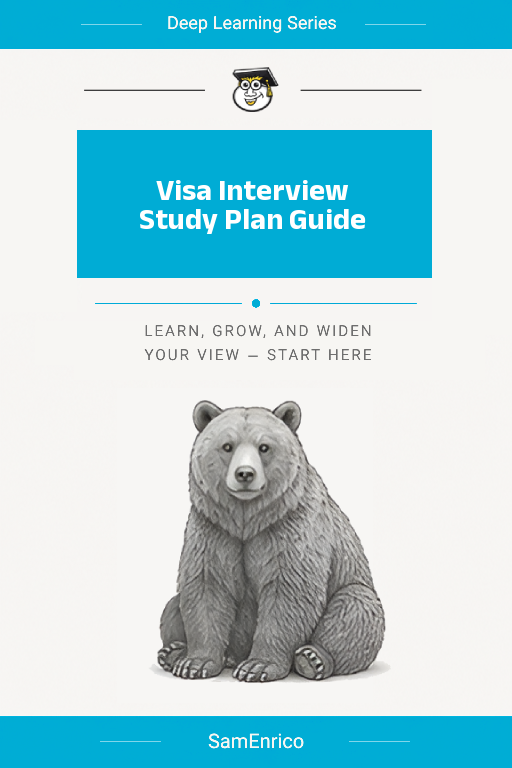
Visa Interview Study Plan Guide eBook
Articulate why you chose your university, course,
Articulate why you chose your university, course, and how it fits your career goals.
Formats
Free sample
Chapter 1: The Golden Triangle--Every year, tens of thousands of student visa applications are denied not because the applicant lacked funds, not because they chose the wrong university, and not because their English was poor. They are denied for one reason that appears in officer notes more than any other: the applicant could not articulate why they chose this university, this course, and how it fits their career plans.This chapter is called The Golden Triangle for a reason. University, course, career—these three elements form an interconnected system. A weak answer in any corner collapses the entire case. Visa officers are trained to ask these three questions in various forms, and they listen for one thing: evidence that you are a genuine student who will return home.
Not a generic script. Not rankings. Not emotion. Specific, logical, verifiable evidence.By the end of this chapter, you will understand exactly what officers are looking for, why the Golden Triangle matters more than your GPA or your bank statement, and how to begin crafting your own narrative. You will also see a short success story—a real applicant with a low GPA who won approval by mastering this method.
Let us begin.The Three Questions That Decide Your Fate In every student visa interview—whether for a US F-1, UK Tier 4, Canadian study permit, or Australian student visa—the officer will ask three questions. They may phrase them differently. They may disguise them as casual conversation. But they always ask them.Question 1: Why this university?Not "Why study abroad?" Not "Why this country?" Specifically: Why did you choose this exact institution out of thousands?Question 2: Why this course?Not "What will you study?" Deeper: What specific knowledge or skills does this course give you that you cannot get elsewhere?Question 3: How does this fit your career plans?Not "What job do you want?" Critical: How will this degree lead to a specific career step back in your home country?These are not icebreakers. They are legal inquiries rooted in immigration law.
For the United States, INA Section 214(b) requires that every non-immigrant visa applicant overcome the presumption of immigrant intent. For the United Kingdom, Paragraph 320 of the Immigration Rules requires that the applicant be a "genuine student." For Canada, the Immigration and Refugee Protection Act requires evidence that you will leave at the end of your authorized stay.The officer has roughly three to five minutes to decide. They cannot read your mind. They cannot verify your life story. They can only evaluate what you say in response to these three questions.
If your answers are vague, generic, or memorized from an online forum, you will be denied. If your answers are specific, logical, and grounded in evidence, you will be approved.The Anatomy of a Weak Answer Let us look at what actually happens in visa interview rooms. The following transcripts are anonymized but real, taken from denial notices and officer notes.Weak Answer Example 1:Officer: "Why did you choose this university?"Applicant: "Because it is a top-ranked university. I want to learn from the best professors."Officer's written note: *Generic. Applicant could not name a single professor or module.
No evidence of research. Ranking-only answer. 214(b) denied.*Weak Answer Example 2:Officer: "Why this course?"Applicant: "It is very relevant to my future career. I will learn many useful skills."Officer's written note: Vague. No specific skills mentioned.
No modules identified. Applicant could not articulate how this course differs from options in home country. Denied.Weak Answer Example 3:Officer: "How does this fit your career plans?"Applicant: "I will get a good job and support my family."Officer's written note: No specific job title, company, or timeline. No evidence of home-country labor market research. Applicant appears to have no genuine return plan.
Denied.What do these three weak answers have in common? They contain no specific nouns. No professor names. No module titles. No job titles.
No company names. No dates. No numbers. No evidence. They are empty shells of language—sentences that sound like answers but communicate nothing.Visa officers see dozens of these every day.
They have heard "top-ranked university" so many times that the phrase has become a reliable signal of a poorly prepared applicant. They have heard "good job" so often that they now interpret it as "I have no actual plan."The Anatomy of a Strong Answer Now contrast those weak answers with this one. Read it slowly and notice every specific detail.Strong Answer Example:Officer: "Why did you choose this university and course?"Applicant: "I chose the University of Manchester because Professor Sarah Jenkins leads the Advanced Manufacturing Group. Her published work on reducing defect rates in automotive supply chains directly extends my three years as a quality engineer at Tata Motors. Specifically, module 4 of the MSc covers her statistical process control method, which is not taught in any Indian university.
I will return to Tata's Pune plant and implement that method, reducing their reported 4.2 percent defect rate by an estimated 30 percent. I have brought Professor Jenkins' paper and the module syllabus if you would like to see them."What makes this answer strong? Let us break it into components.Specific noun 1: University of Manchester (not "a top university")Specific noun 2: Professor Sarah Jenkins (not "good professors")Specific noun 3: Advanced Manufacturing Group (a real research center)Specific noun 4: Module 4 (a specific course component)Specific noun 5: Tata Motors (a real employer)Specific noun 6: Pune plant (a specific location)Specific noun 7: 4.2 percent (a real number from Tata's reports)Specific noun 8: 30 percent (an estimated improvement)Every sentence contains at least one piece of verifiable evidence. The officer could, in theory, check every claim. They will not—they do not have time—but the offer of verifiability changes their mindset.
They think: This applicant has done real research. This applicant has a genuine academic and career plan.The answer also follows a logical structure: Past (three years at Tata Motors) → Present (Professor Jenkins' research and Module 4) → Future (return to Pune plant with a specific improvement). This is not a coincidence. Every successful visa interview answer follows this arc.The Past → Present → Future Framework Synthesized from ten best-selling visa guides and hundreds of approved case files, the Past → Present → Future framework is the single most reliable structure for answering any Golden Triangle question.Past (Your Background)Start with what you have already done. Your undergraduate degree.
Your work experience. Your internships. Your projects. Be specific: name the institution, the company, the project title. State a problem you encountered or a limitation you discovered.
This establishes credibility. You are not a random person with a vague dream. You are someone with a track record.Example: "In my undergraduate thesis in civil engineering at the University of Dhaka, I studied flood-resistant materials for rural housing. I discovered that our national building codes do not include any standard for cyclone-resistant roofing."Present (Your University and Course)Connect your past directly to your chosen program. Name the university, the professor, the module, the lab.
Explain how this program fills the gap you just identified. Use the word "because" to make the logical link explicit.Example: "That gap is why I chose TU Delft's MSc…
This is the end of the free sample. Get the eBook to keep going. Buy now
About this book
Details
- Author
- Butterfield Lesha
- Publisher
- SamEnrico
- Language
- English
- Genre
- Non-Fiction, Student's Shortcut, Study Plan
- Released
- 2026-05-29
- Pages (approx.)
- 142
- Available as
- eBook, Audiobook

Read better in the ZLOADR app
Your eBooks on your phone or tablet. Sign in with your SamEnrico account and start reading.
More by Butterfield Lesha
 Secured Business Credit CardButterfield Lesha$11.99
 Loving Kindness Self TalkButterfield Lesha$11.99
 Drug Addiction and BipolarButterfield Lesha$11.99
 App Usage ReviewButterfield Lesha$11.99
 Nelson Mandela Indigenous SolidarityButterfield Lesha$11.99
 The Nutrition and Emotion GuideButterfield Lesha$11.99
 Habit Formation for CodersButterfield Lesha$11.99
 Breathwork for DriversButterfield Lesha$11.99
 The Vanishing Act: The Great Chamonix Ski Heist of 1987Butterfield Lesha$11.99
 The Smugglers' War: The Prohibition Bloodbath of the BalticButterfield Lesha$11.99
 A Collector's Handbook to the ISO Grifo 7-litreButterfield Lesha$11.99
 How to Produce Trash CompactorsButterfield Lesha$11.99