
Non-FictionStudent's ShortcutOnline
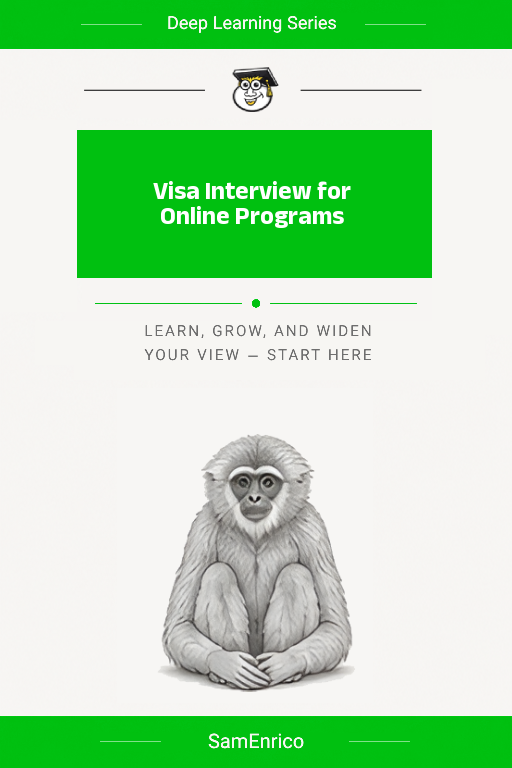
Visa Interview for Online Programs eBook
Navigate interviews for blended or hybrid programs
Navigate interviews for blended or hybrid programs with significant online components.
Formats
Free sample
Chapter 1: The Invisible Applicant--The young woman sat across from the consular officer, her hands folded neatly on the counter. She had been accepted into a reputable executive MBA program at a well-known university. Her grades were excellent. Her funding was solid. She had no criminal record, no overstay history, and no relatives working the visa system.
By every objective measure, she was exactly the kind of student the United States wants to attract.The officer looked at her I-20, then at her program description, then back at her. "Your program is listed as hybrid," he said. "How many of your courses are online?""Approximately seventy percent," she replied honestly.The officer nodded, stamped her application, and handed her a denial letter. The reason checked was simple: 221(g) – Incomplete documentation. But the real reason, the one that would never appear on any official form, was something else entirely.
The officer did not believe she was a genuine student. He looked at her hybrid program and saw not a modern educational design but a loophole. He saw someone who wanted a visa to work, not to study. He saw, in short, an invisible applicant—someone whose legitimate academic path did not fit the outdated template in his head.This chapter is about why that happened and why it keeps happening to thousands of hybrid and online program applicants every year. It is also about why you are not the problem.
The system is not broken because you chose a flexible degree. The system is simply slow to adapt. And adaptation—understanding the mismatch, anticipating the officer's suspicions, and rebuilding your application narrative from the ground up—is exactly what this book will teach you.The Great Mismatch: Why Hybrid Students Confuse the System For most of the history of international student exchange, the F-1 visa was straightforward. A student applied to a university, received an I-20, proved they had enough money to live and study, and convinced a consular officer they would return home after graduation. The unspoken assumption baked into every part of this process was that the student would be physically present on a US campus for the vast majority of their academic hours.
They would live in a dorm or an off-campus apartment. They would attend classes in person, five days a week. They would eat in dining halls, use library study carrels, and participate in student organizations. Their life would be, in every meaningful sense, located in the United States.The consular officer's mental checklist was built around this assumption. When a traditional student walked up to the window, the officer could quickly tick boxes: acceptance letter, check.
I-20, check. Financial documents, check. The officer did not need to ask complicated questions about how the student would study because the answer was obvious. The student would study the same way everyone always had.Then came the pandemic. Universities closed their campuses and moved everything online almost overnight.
When they reopened, something unexpected happened. Many students and faculty discovered they preferred certain aspects of online learning. Lectures could be recorded and watched at any time. Discussion forums allowed deeper reflection than hand-raising in a crowded room. Students who had jobs or family obligations could participate without relocating.
Universities, seeing an opportunity to expand enrollment, began designing programs specifically for this new reality.Today, top universities including Columbia, Northeastern, the University of Southern California, Arizona State, and many others offer hybrid and low-residency degrees in fields ranging from computer science to public health to business administration. These programs are not emergency pandemic measures. They are deliberate, accredited, academically rigorous offerings designed for working professionals and students with specific career timelines.But the consular officer's mental checklist did not update alongside the curriculum. The officer still expects to see a student who will be in the United States for the duration of their degree. When a hybrid applicant appears—someone who will study mostly from home, travel to campus only for short residencies, and maintain significant ties to their home country—the officer's framework breaks.
The officer sees a person who does not fit the template and therefore, in the officer's mind, might not be a legitimate student at all.This is the great mismatch. It is not your fault. It is not even entirely the officer's fault. It is a structural gap between how education is now delivered and how immigration law still evaluates it. And the only way to bridge that gap is to understand it so thoroughly that you can explain it to the officer before they even ask.The Regulatory Backbone: What SEVP Actually Says About Online Study Before we go any further, we need to establish the actual rules.
Not what students whisper about on internet forums. Not what visa consultants guess based on anecdotal evidence. The actual, written, enforceable regulations that govern F-1 status for students in hybrid programs.The Student and Exchange Visitor Program, or SEVP, is the arm of the US government that manages the Student and Exchange Visitor Information System (SEVIS). Every school that enrolls international students must be SEVP-certified. Every student receives a SEVIS record.
And SEVP has very specific rules about online study.The rule that matters most for hybrid applicants comes from 8 CFR 214.2(f)(6)(i)(G). For decades, this regulation limited F-1 students to taking no more than one online class per semester, or three credits worth. The rest had to be in person. The logic was simple: the F-1 visa exists for physical presence. If you can complete your degree without setting foot on campus, you do not need an F-1 visa.Then, in 2020, the pandemic forced a temporary relaxation of these rules.
When the emergency ended, some of those relaxations became permanent. In 2022, SEVP issued updated guidance clarifying that students enrolled in programs that are designated as hybrid by their schools could count online coursework toward their full-time enrollment requirement, provided the program had a structural in-person component.Here is the key distinction that most applicants miss, and that many consular officers themselves misunderstand. There is a world of difference between a student who chooses to take online courses for convenience and a student enrolled in a program that is structurally hybrid. The convenience student is taking an in-person degree but registering for online electives to avoid commuting or to fit around a part-time job. That student raises red flags because they appear to be minimizing their US presence without a legitimate academic reason.
The structural hybrid student is enrolled in a program that was designed from the start to mix online theory with in-person application. The online components are not shortcuts. They are the curriculum.SEVP approves structural hybrid programs on a case-by-case basis. The school must demonstrate that the online components are academically rigorous and that the in-person components are essential and irreplaceable. When you receive an I-20 for such a program, that I-20 carries the full weight of SEVP approval.
But here is the problem. The consular officer at the embassy does not always know, or does not always remember, that your specific I-20 belongs to the structural category rather than the convenience category. The officer sees the word "online" and defaults to suspicion.Your…
This is the end of the free sample. Get the eBook to keep going. Buy now
About this book
Details
- Author
- Benavides Hertha
- Publisher
- SamEnrico
- Language
- English
- Genre
- Non-Fiction, Student's Shortcut, Online
- Released
- 2026-06-01
- Pages (approx.)
- 133
- Available as
- eBook, Audiobook

Read better in the ZLOADR app
Your eBooks on your phone or tablet. Sign in with your SamEnrico account and start reading.
More by Benavides Hertha
 The Comet Hale Bopp DeceptionBenavides Hertha$11.99
 Forgiveness After Financial RuinBenavides Hertha$11.99
 Ignite Talk PreparationBenavides Hertha$11.99
 Shy Adult Social SkillsBenavides Hertha$11.99
 Self Esteem for First RespondersBenavides Hertha$11.99
 Business Credit for Auto RepairBenavides Hertha$11.99
 Road Rage Prevention PlanBenavides Hertha$11.99
 Growth Mindset for TeachersBenavides Hertha$11.99
 The Lens That Captured a Nation: How Helen Geer and Bob Willoughby Revolutionized Fashion PhotographyBenavides Hertha$11.99
 Riders of the Forgotten Trail: The Ballad of Nat Love and the Outlaw QueenBenavides Hertha$11.99
 How to Produce a TritucapBenavides Hertha$11.99
 How to Produce Iron RestsBenavides Hertha$11.99
You may also like
 Hong Kong Handover 1997Dunn Johnnie$11.99
 Zumba For Postnatal Recovery CourseNeal Christian$11.99
 Zumba for BeginnersLadner Nikia$11.99
 YouTube Comment Mining GuideHumes Pandora$12.99
 Worry Box MeditationCarlin Rudy$11.99
 Workplace Stress MeditationNguyen Lynn$11.99
 Workplace Stress and Sleep RepairHawley Ivory$11.99
 Workplace Perfectionism CureDelaney Jeffry$11.99
 Workplace Injustice Anger GuideWallen Isabelle$11.99
 Work Addiction and Burnout LinkGreenwood Ester$11.99
 Women in Yoga and WellnessBeattie Galina$11.99
 Women in Stand Up ComedyChun Evangeline$11.99