
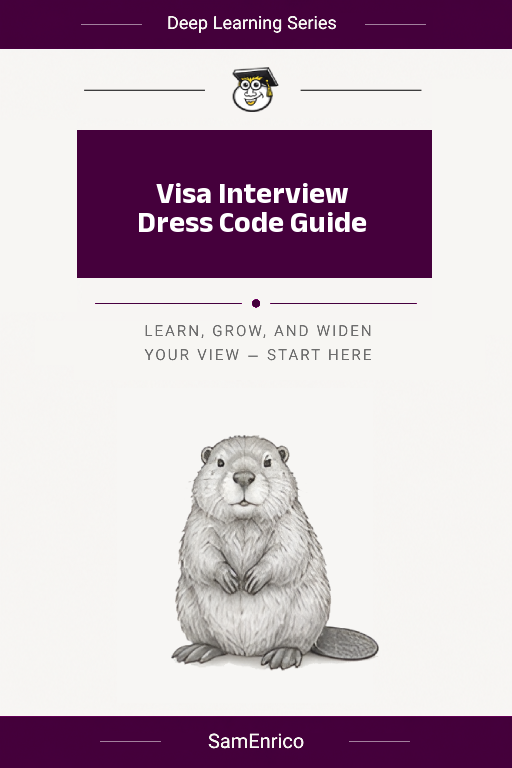
Visa Interview Dress Code Guide eBook
Dress professionally for your visa interview to ma
Dress professionally for your visa interview to make a positive first impression.
Formats
Free sample
Chapter 1: The Seven-Second Judgment--–- The heavy glass door of the U.S. Embassy in London swings shut behind a thirty-four-year-old software engineer from Bangalore. His name is Vikram, and he has spent the last six years building a career that now requires him to attend a technical conference in San Francisco. His visa interview is scheduled for 9:15 AM. He has prepared for three months.
He has memorized his project timelines, his company’s financial statements, and his exact itinerary down to the hotel confirmation number. He is wearing a brand-new charcoal suit that cost him the equivalent of two weeks’ rent, a crisp white shirt, and a silk tie his wife picked out. He polished his shoes at 5:00 AM. He has not slept well.Behind the glass, a consular officer who has already conducted forty-seven interviews that morning glances up as Vikram approaches the window. The officer will not remember Vikram’s name thirty seconds from now.
But in the time it takes to inhale once, the officer has already formed a hypothesis. Not about Vikram’s job. Not about his ties to India. About something far more basic: whether Vikram is telling the truth.This is not fiction. This is the daily reality of every visa interview conducted at every U.S.
embassy and consulate around the world. And the single most powerful variable in those first few seconds—the variable that applicants almost universally underestimate—is not the thickness of their bank statements or the eloquence of their answers. It is the clothes on their back.Welcome to the psychology of the window. Before you speak a single word, your outfit has already begun to tell a story. The question is whether that story helps you or hurts you.The Anatomy of a First Impression In 1992, Princeton psychologists Janine Willis and Alexander Todorov published a study that would change how we understand human judgment.
They showed participants hundreds of faces for exposure times as short as one-tenth of a second. After each flash, participants were asked to rate the faces on trustworthiness, competence, likeability, and aggressiveness. The results were astonishing: judgments made after one-tenth of a second correlated almost perfectly with judgments made with unlimited time. In other words, the human brain makes up its mind about a stranger faster than you can blink.Visa officers are not immune to this wiring. If anything, the high-stakes, high-volume nature of consular work amplifies it.
A former officer who served at the U.S. Embassy in New Delhi for three years described the reality behind the glass in a 2019 interview with the American Immigration Lawyers Association: "By the time an applicant reaches my window, I have already processed thirty to forty people. My brain is looking for shortcuts. The first shortcut is visual. Does this person look like someone who takes the process seriously?
That judgment happens before they open their mouth."This is what we call the Seven-Second Judgment. It is not a formal policy. No consular manual instructs officers to judge applicants by their appearance. But human beings are pattern-recognition machines, and the pattern begins with what the eyes see first. In seven seconds, a visa officer has typically registered:Your posture (slouched or upright)Your eye contact (direct or evasive)Your grooming (neat or unkempt)Your clothing (appropriate or questionable)Only after these visual cues are processed does the officer begin to listen to your words.The implication is both terrifying and liberating.
Terrifying because it means you are being judged before you prove yourself. Liberating because it means you can control that judgment by controlling what the officer sees first.The Micro-Impression Theory Let us refine the Seven-Second Judgment into something more precise. Most applicants assume that major wardrobe disasters—a t-shirt with profanity, a bikini top, a costume tuxedo—are the only things that matter. This is a dangerous misconception. In reality, it is the small things that kill.
We call this the Micro-Impression Theory.A micro-impression is a tiny, seemingly insignificant detail in your appearance that consumes an outsized portion of the officer’s limited cognitive bandwidth. Here is how it works. The human brain has a finite amount of attention. When that attention is diverted by something unexpected or incongruent—a scuff on a shoe, a loose thread on a cuff, a collar that does not lie flat—the brain must allocate resources to process that anomaly. Those resources are then unavailable for listening to your answers.Consider two hypothetical applicants, both with identical credentials and perfectly rehearsed answers.Applicant A wears a clean, well-fitted blue button-down shirt, pressed khakis, and leather loafers with no visible wear.
His hair is neat. His nails are clean. His belt matches his shoes. When he approaches the window, the officer sees nothing that demands attention. The officer’s brain is free to focus entirely on the answers.Applicant B wears the same shirt, but it is wrinkled from being left in a suitcase.
His khakis are clean but slightly too long, bunching at the ankles. His loafers are scuffed on the toes. One of his shirt buttons is missing, revealing an undershirt. When he approaches the window, the officer’s brain registers the wrinkles, the bunching, the scuffs, the missing button. Each detail consumes a sliver of attention.
By the time Applicant B begins to speak, the officer has already formed a pattern: this person does not pay attention to details. That pattern then colors how the officer hears every subsequent answer.The tragedy is that Applicant B may have stronger credentials than Applicant A. But the micro-impressions have already tilted the playing field.Former consular officers report that the most common micro-impressions that lead to negative judgments include:Scuffed or dirty shoes (interpreted as general sloppiness)Wrinkled collars (interpreted as poor planning)Unkempt facial hair (interpreted as lack of self-respect)Chipped nail polish or dirty fingernails (interpreted as neglect)Visible undergarments through sheer fabrics (interpreted as poor judgment)Bulging pockets (interpreted as unprepared or hiding something)None of these items alone will cause a visa denial. But together, they create an atmosphere of low credibility. And in a process where the officer has absolute discretion, atmosphere matters enormously.Respect Versus Rigidity: The Goldilocks Principle If the Seven-Second Judgment is real, and micro-impressions matter, then the natural reaction for many applicants is to overcorrect.
If casual clothes are bad, then extremely formal clothes must be good. This logic is seductive and wrong.The visa interview is not a wedding, not a prom, not a black-tail gala, and not a funeral. It is a government proceeding. The goal is not to impress the officer with your fashion sense. The goal is to make the officer forget that they are looking at your clothes at all.
This requires a balance we call Respect Versus Rigidity.Respect looks like this: clean, pressed, well-fitted clothing in neutral colors. Modest coverage. Polished shoes. Neat grooming. This communicates: "I understand this is a serious proceeding, and I have honored it with my preparation."Rigidity looks like this: a full three-piece suit with a pocket watch and cufflinks.
A floor-length sequined gown at 9:00 AM. A tuxedo. A military-style uniform when you are not active military. This communicates…
This is the end of the free sample. Get the eBook to keep going. Buy now
About this book
Details
- Author
- Esparza Millicent
- Publisher
- SamEnrico
- Language
- English
- Genre
- Non-Fiction, Student's Shortcut, Attire
- Released
- 2026-06-01
- Pages (approx.)
- 144
- Available as
- eBook, Audiobook

Read better in the ZLOADR app
Your eBooks on your phone or tablet. Sign in with your SamEnrico account and start reading.
More by Esparza Millicent
 Affirmation Wallpaper GuideEsparza Millicent$11.99
 The Social Support and EmotionEsparza Millicent$11.99
 Cloud Storage CleanupEsparza Millicent$11.99
 Stutter And Public SpeakingEsparza Millicent$11.99
 Miriam Makeba Anti ApartheidEsparza Millicent$11.99
 Business Credit Score SecretsEsparza Millicent$11.99
 Habit Formation for SleepEsparza Millicent$11.99
 Driving Empathy GuideEsparza Millicent$11.99
 The Arsenic Inheritance: How Victorian Heiresses Died for a FortuneEsparza Millicent$11.99
 The Visionaries of the Grid: How Western Planners Shaped the Modern CityEsparza Millicent$11.99
 A Collector's Handbook to the Isotta Fraschini 8aEsparza Millicent$11.99
 Freemium Download SchedulingEsparza Millicent$12.99