
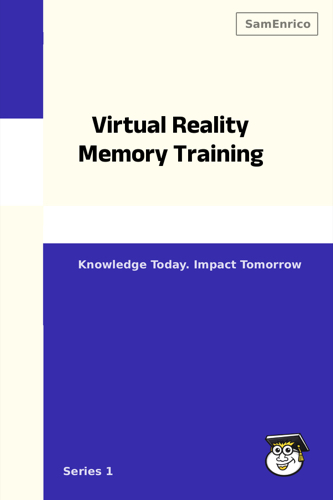
Non-FictionSelf-HelpVR Therapy
Virtual Reality Memory Training eBook
Use VR cognitive exercises that engage spatial mem
Use VR cognitive exercises that engage spatial memory more effectively than screens.
Formats
Free sample
Chapter 1: Beyond the Flatland--–- The email arrived at 7:42 AM. You read it, nodded, and closed it. By 8:15 AM, you could not remember the sender’s name. By noon, you had forgotten the action item entirely. By bedtime, you did not even remember receiving an email.
This is not a failure of character. It is a failure of medium.The modern knowledge worker lives inside a rectangle. A glowing, flickering rectangle of text, icons, tabs, and notifications. Inside this rectangle, we attempt to do the work of our ancestors who hunted across savannahs, navigated by stars, and remembered the location of every water source within fifty miles. The rectangle asks your brain to perform a trick it was never designed to execute: treating abstract symbols as if they were real things.This chapter will show you why your brain loves space, hates symbols, and why virtual reality—when used correctly—unlocks a memory capacity you did not know you possessed.
We will travel from the discovery of place cells (the neurons that map your environment) to the Virtual Supermarket Experiment (where a grocery list became unforgettable). By the end, you will understand why “I have a bad memory” is almost always a lie. What you have is a bad interface.The Paradox of the Knowledge Worker Consider the average office worker in 2026. They have a smartphone, a laptop, an external monitor, and possibly a tablet. They have calendar apps that beep at them, note-taking apps that sync across devices, and search engines that can retrieve any fact in under two seconds.
By every objective measure, they have more memory support than any human in history.And yet, surveys consistently show that knowledge workers report feeling more forgetful than their parents’ generation. They forget birthdays. They forget passwords. They walk into a room and forget why. They meet someone at a conference and forget their name before the handshake ends.This is not because their brains are decaying.
It is because their brains are doing exactly what evolution designed them to do: discard information that appears to be stored elsewhere. Psychologists call this the Google Effect. In a landmark 2011 study, researchers Sparrow, Liu, and Wegner found that when people believe information will be saved on a computer, their memory for that information drops significantly. The brain outsources the job. Why bother remembering something that lives in your pocket?The Google Effect is not a bug.
It is a feature. Your brain is ruthlessly efficient. It will not waste neural resources on data that seems retrievable without effort. The problem is that screens make everything seem retrievable. The calendar is always there.
The note is always there. Google is always there. So your hippocampus—the seahorse-shaped memory center deep in your temporal lobe—simply stops trying.But here is the twist: the Google Effect applies almost exclusively to symbolic information. Text. Icons.
Lists. The kind of information that lives on screens. It does not apply to spatial information. You do not forget where you parked your car (usually). You do not forget the layout of your childhood home.
You do not forget the route to your favorite coffee shop. Because your brain never outsources spatial memory. It cannot. Space is too important for survival.This book is built on a single, radical proposition: what if you could treat every piece of information—every email, every password, every meeting agenda, every chapter of every textbook—as if it were a location in space? What if you could walk through your to-do list as if it were a city?
What if you could remember a phone number because you placed it on a specific shelf in a specific room of a specific virtual building?That is what virtual reality offers. Not a better screen. A fundamentally different relationship between your mind and your data.The Discovery of the Brain’s GPSTo understand why this works, we need to travel back to 1971. A British neuroscientist named John O’Keefe was recording electrical signals from the brains of rats as they ran around a small enclosure. He expected to find neurons that responded to specific stimuli—a light turning on, a sound playing, a piece of food appearing.
Instead, he found something entirely unexpected.Certain neurons fired only when the rat was in a specific location. Not when it saw something. Not when it heard something. Just when it was there. One neuron fired when the rat was in the northeast corner.
Another fired when the rat was near the water bottle. Another fired when the rat approached the door. O’Keefe called these “place cells.”Place cells are the fundamental unit of spatial memory. Every time you enter a room, a unique combination of place cells fires to create a neural map of that space. You do not have to think about it.
You do not have to try. It happens automatically, effortlessly, and permanently. You can walk into a house you have not visited in twenty years, and your place cells will still remember the layout.For this discovery, O’Keefe won the Nobel Prize in 2014. He shared it with May-Britt and Edvard Moser, who discovered an even more fundamental system: “grid cells.” Grid cells are neurons in the entorhinal cortex (the brain’s navigation hub) that fire in a hexagonal pattern, creating a coordinate system for space. Imagine a sheet of graph paper laid over every environment you have ever visited.
Grid cells are the ink.Together, place cells and grid cells form the brain’s internal GPS. This system is so ancient, so fundamental, that it exists in essentially all mammals. It evolved hundreds of millions of years ago to solve a single problem: how to remember where things are. Food. Water.
Predators. Mates. Shelter.Here is what matters for this book: the brain’s GPS does not distinguish between “real” space and “virtual” space. When you navigate a well-designed VR environment, your place cells fire just as they would in the physical world. Your grid cells create coordinate maps just as they would in a real city.
Your hippocampus treats the virtual room as a room.This is the scientific foundation of virtual reality memory training. You are not tricking your brain. You are giving it what it evolved to use.Why Screens Are Memory Poison Let us be precise about what screens do wrong. It is not that screens are evil. It is that screens ask your brain to work against its own architecture.First, screens are flat.
Human vision evolved in a three-dimensional world where objects have depth, distance, and relative position. When you look at a screen, your brain must perform a constant translation: these flat symbols represent real things, but they are not real things. This translation consumes cognitive resources. Resources that could have been used for memory.Second, screens are bounded. Your field of view in the physical world is roughly 200 degrees horizontally and 135 degrees vertically.
A typical monitor occupies about 30 degrees. Your peripheral vision—which is exquisitely sensitive to movement and spatial relationships—is essentially useless when you look at a screen. You are navigating with blinders on.Third, screens are symbolic. Text is not a thing.…
This is the end of the free sample. Get the eBook to keep going. Buy now
About this book
Details
- Author
- Briones Avery
- Publisher
- SamEnrico
- Language
- English
- Genre
- Non-Fiction, Self-Help, VR Therapy
- Released
- 2026-06-07
- Pages (approx.)
- 134
- Available as
- eBook, Audiobook

Read better in the ZLOADR app
Your eBooks on your phone or tablet. Sign in with your SamEnrico account and start reading.
More by Briones Avery
 The Letting Go ChallengeBriones Avery$11.99
 The Sepoy Mutiny Rebellion GuideBriones Avery$11.99
 Walking Meditation For Addiction Recovery CourseBriones Avery$11.99
 Reframing Anger Thoughts HandbookBriones Avery$11.99
 Blood and Laurels: Caesar and Pompey’s Deadly RivalryBriones Avery$11.99
 Understanding OCDBriones Avery$17.99
 How to Become a LawyerBriones Avery$11.99
 Sequencing for Changeover ReductionBriones Avery$12.99
 German Student Residence Permit GuideBriones Avery$12.99
 Temporary AssociateBriones Avery$11.99
You may also like
 Hong Kong Handover 1997Dunn Johnnie$11.99
 Zumba For Postnatal Recovery CourseNeal Christian$11.99
 Zumba for BeginnersLadner Nikia$11.99
 YouTube Comment Mining GuideHumes Pandora$12.99
 Worry Box MeditationCarlin Rudy$11.99
 Workplace Stress MeditationNguyen Lynn$11.99
 Workplace Stress and Sleep RepairHawley Ivory$11.99
 Workplace Perfectionism CureDelaney Jeffry$11.99
 Workplace Injustice Anger GuideWallen Isabelle$11.99
 Work Addiction and Burnout LinkGreenwood Ester$11.99
 Women in Yoga and WellnessBeattie Galina$11.99
 Women in Stand Up ComedyChun Evangeline$11.99