
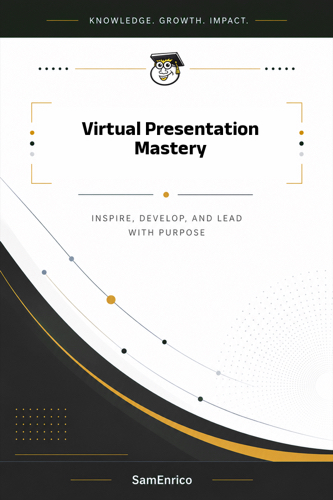
Virtual Presentation Mastery eBook
Engage remote audiences on Zoom and Teams using th
Engage remote audiences on Zoom and Teams using this practical guide.
Formats
Free sample
Chapter 1: Beyond Zoom Fatigue--–- The screen glows. Your thumbnail stares back at you. Twelve faces—some attentive, some frozen mid-blink, some replaced by gray rectangles with initials. You’re thirty seconds into your presentation, and already two people are typing responses to emails. One person’s camera is on, but their eyes drift sideways every few seconds—probably a second monitor.
Another participant hasn’t moved in forty-five seconds; you’re not sure if they’re thinking deeply or have walked away entirely. This is the modern virtual meeting. And if you feel a familiar knot in your stomach reading this description, you are not alone.The term “Zoom fatigue” entered our vocabulary shortly after the world went remote in 2020, but it has always described the wrong problem. The fatigue isn’t caused by the software. It isn’t caused by the number of meetings on your calendar.
The fatigue is caused by something much more fundamental: the mismatch between how humans evolved to communicate and the two-dimensional rectangle we now use to do it.For tens of thousands of years, human beings read each other through full-body language, peripheral vision, ambient sound, and the subtle physics of shared physical space. You knew someone was about to speak because their chest expanded slightly. You felt a room’s energy shift before anyone said a word. You could lean toward a colleague and whisper a clarifying question without interrupting the flow of a meeting. In the physical world, communication was a multidimensional, embodied experience that your brain processed effortlessly because it was wired specifically for that environment.Then, almost overnight, that environment disappeared.
In its place came a flat rectangle, a tiny camera lens positioned an inch above your eyeline, and a microphone that picks up your neighbor’s dog barking but somehow misses the warmth in your voice. Your brain, suddenly forced to do more work with less information, started exhausting itself trying to fill in the gaps.That exhaustion is not your fault. But it is your problem to solve.This book will teach you how to solve it. Not by buying expensive equipment—though we will cover affordable upgrades that deliver massive returns. Not by becoming a charismatic extrovert—though introverts often make the best virtual presenters once they learn the rules.
And not by memorizing a set of rigid scripts—though you will leave every chapter with templates you can use tomorrow morning.The solution is simpler and harder at the same time: you must stop delivering in-person presentations over video and start designing virtual presentations from scratch. The medium is not the message. The medium is the constraint, and constraints, when understood properly, become creative advantages.Let me prove it to you with a story.The CEO Who Lost Her Room Two years ago, I watched a CEO deliver a quarterly earnings preview to two hundred employees. She was brilliant—a dynamic speaker who had commanded thousand-person auditoriums with ease. She had prepared slides.
She had data. She had a clear agenda. She did everything right by the standards of physical presentation.Within four minutes, her virtual audience was gone.Not literally gone—most of them stayed on the call out of obligation. But they were gone in every way that mattered. Three people had their cameras off and never contributed a word.
The chat was silent except for one person asking if the recording would be available later. When she asked, “Does anyone have questions?” the void answered back with a silence so complete it felt like rejection.After the call, she collapsed into her chair and said something I will never forget: “I’ve spoken to thousands of people in person. I’ve never felt so invisible.”That feeling—invisibility—is the true cost of virtual incompetence. It is not merely frustration or technical annoyance. It is the slow erosion of your professional identity.
When you speak and no one listens, when you ask and no one answers, when you present and no one remembers, you stop feeling like a leader, a teacher, or a contributor. You become a background process running on someone else’s attention.The good news is that invisibility is reversible. The CEO I just described spent three months retooling her approach using the methods in this book. Six months later, she ran a virtual all-hands with four hundred participants. The chat exploded with comments.
Fifty people volunteered for a new initiative. Her post-meeting survey scored 9.2 out of 10 on “clarity of message” and 8.7 on “feeling connected to leadership.” She had not changed her personality. She had changed her medium literacy.This chapter will give you the foundation for that transformation. We will cover three essential shifts: understanding why virtual is fundamentally different from in-person communication, recognizing the hidden costs of “emergency remote” habits that most presenters never unlearn, and embracing a new identity as a proactive presenter who designs for engagement rather than broadcasting information. By the end of this chapter, you will never look at a Zoom call the same way again.The Cognitive Tax of Two Dimensions Let us begin with the neuroscience, because understanding why you are exhausted is the first step to exhausting your audience less.When you communicate with someone in person, your brain processes what scientists call “rich social information.” You see their full body—posture, gesture, weight shifts.
You hear their voice in three dimensions, allowing you to localize sound and filter background noise automatically. You sense the temperature of the room, the distance between bodies, the subtle pheromonal signals that influence trust and attraction. Most importantly, your peripheral vision tracks the movements of everyone in the room simultaneously, giving you what amounts to a social radar system.This system evolved over millions of years. It is fast, efficient, and largely unconscious. You do not “try” to read body language; you just do it.
You do not “decide” to notice that someone is about to interrupt; your brain registers the micro-muscle movements in their chest and shoulders and prepares you to respond. In a physical room, your brain spends very little energy on the mechanics of communication because the environment is the environment it evolved for.Now contrast that with a virtual meeting.Your screen shows you a grid of faces—or, increasingly, initials on gray backgrounds. Each face is cropped at the chest or neck, eliminating all information from the torso, hands, and posture. The faces do not move in relation to each other; they are frozen in place, regardless of who is actually closer to whom in physical space. Eye contact is a lie—the person you think is looking at you is actually looking at the camera, and the person looking at the camera appears to be looking slightly above your head.
Your peripheral vision is useless because everything outside the rectangle is your actual physical room, not the meeting.To compensate for this impoverished information, your brain starts working overtime. It attempts to reconstruct missing social cues from fragments. It tries to interpret a frozen face as an emotional signal. It strains to hear vocal nuances through compressed audio that strips out overtones and spatial information. Meanwhile, the cognitive…
This is the end of the free sample. Get the eBook to keep going. Buy now
About this book
Details
- Author
- Gallant Tonie
- Publisher
- SamEnrico
- Language
- English
- Genre
- Non-Fiction, Self-Help, Virtual Speaking
- Released
- 2026-06-08
- Pages (approx.)
- 155
- Available as
- eBook, Audiobook

Read better in the ZLOADR app
Your eBooks on your phone or tablet. Sign in with your SamEnrico account and start reading.
More by Gallant Tonie
 Boomer Home OwnershipGallant Tonie$11.99
 British Voice In HollywoodGallant Tonie$11.99
 Creative Habits for ChefsGallant Tonie$11.99
 PIK Interest CapitalizationGallant Tonie$11.99
 Vitamin K2 And Calcium SynergyGallant Tonie$11.99
 Senior Technology ConfidenceGallant Tonie$11.99
 Pelvic Ultrasound ImagingGallant Tonie$11.99
 The Silk and the Boot: How Football Legends Redefined Middle Eastern FashionGallant Tonie$11.99
 The Salon of Madame Geoffrin: Where Enlightenment Ideas Were BornGallant Tonie$11.99
 How to Produce Paper Clips and ClampsGallant Tonie$11.99
 How to Produce a Cotton Module BuilderGallant Tonie$11.99
 Geese: Waterfowl Behavior, Migration & Backyard CareGallant Tonie$11.99