
Operational PlanStartup GuideApplication
Venture Debt Application Process eBook
Submit financials, cash flow projections, and due
by Jean Kylie
Submit financials, cash flow projections, and due diligence materials for venture debt approval.
Formats
Free sample
Chapter 1: The Runway Trap--–- Sarah had eighteen months of cash in the bank, a term sheet from a top-tier venture capital firm, and a board that told her she was invincible. Eight months later, she had three weeks of runway, zero term sheets, and a banking relationship that had turned glacial. The problem wasn't her product, her team, or her market. The problem was that she had never learned the difference between a marriage and a car loan.This chapter is not about venture debt. Not yet.
First, it is about the single most common mistake founders make when they start exploring debt: treating it like slow equity. Venture capital and venture debt look similar from a distance. Both provide cash. Both require diligence. Both involve lawyers and signatures.
But the underwriting philosophy, the relationship dynamic, and the consequences of failure are so different that confusing the two is like confusing a marriage certificate with a car lease. One is forever. The other is a transaction.If you pick up only one concept from this entire book, let it be this: Lenders are not betting on your home run. They are betting on your ability to stay in the game long enough to hit a single.That single insight changes everything about how you prepare, how you negotiate, and how you know whether you are ready to apply at all.The Dilution Monster Every founder understands equity dilution. You raise 5millionata5 million at a 5millionata20 million pre-money valuation, and you give away 20 percent of your company.
If the company eventually sells for 100million,that20percentisworth100 million, that 20 percent is worth 100million,that20percentisworth20 million that you will never see. Founders hate this math, but they accept it because equity is the only fuel they know.What most founders do not understand is that the true enemy is not dilution itself. The enemy is unnecessary dilution. Venture debt exists because a small group of financial engineers realized that a healthy, growing startup with a predictable business model could borrow money at a fraction of the cost of equity. Instead of giving away 20 percent of your company for 5million,youmightgiveaway2percentinwarrantsandpay10percentinterest.Ifthecompanysellsfor5 million, you might give away 2 percent in warrants and pay 10 percent interest.
If the company sells for 5million,youmightgiveaway2percentinwarrantsandpay10percentinterest.Ifthecompanysellsfor100 million, that 2 percent costs you 2millioninsteadof2 million instead of 2millioninsteadof20 million.That is a $18 million difference. For a single financing round.But here is the trap that catches even experienced founders: venture debt only works if you are healthy when you apply. The lenders have a finely tuned radar for desperation, and they will punish it mercilessly. Apply when you have six months of runway, and you are a respected partner. Apply when you have three months of runway, and you are a distressed asset.
The terms change. The covenants tighten. The warrants expand. And in the worst cases, the lender simply says no and walks away, leaving you with no time to find an alternative.The difference between six months and three months is just ninety days. Yet those ninety days can mean the difference between a 7 percent warrant and a 15 percent warrant—or between a loan and a liquidation.The 3 to 9 Month Rule Explained Venture debt is a timing tool.
Nothing more, nothing less.The standard heuristic in the industry—drawn from decades of data across thousands of deals—is that debt should buy you between three and nine months of additional runway. Three months is the minimum useful increment. Less than that, and the transaction costs (legal fees, diligence time, management distraction) outweigh the benefit. Nine months is the maximum safe increment. More than that, and you are probably borrowing more than you can repay given the typical growth trajectory of a venture-backed startup.But here is the crucial insight that most resources omit: The application process itself consumes eight to twelve weeks.Read that sentence again.
Eight to twelve weeks. That is two to three months. If you have six months of runway when you start the application, you will have roughly three months remaining when the cash hits your account. If you have four months of runway when you start, you will be nearly out of cash by the time the loan closes. If you have three months or less, you are almost certainly too late.This is the Runway Trap.
Founders consistently underestimate how long the venture debt process takes, and they consistently overestimate their ability to accelerate it. They believe that because they are desperate, the lender will move faster. The opposite is true. Desperation makes lenders move slower, because they want to verify every number three times before committing.Consider two companies.Company A has nine months of runway. Its founders read this chapter, realize they have time, and begin the application process methodically.
They spend two weeks on internal preparation (see Chapter 3). They apply to four lenders (following the 3 to 5 Lender Rule from Chapter 2). They receive a term sheet in week four. Negotiations take four weeks. Legal takes six weeks.
The loan closes in week fourteen. They have five months of runway remaining—plenty of buffer.Company B has four months of runway. Its founders panic. They apply to twelve lenders simultaneously, hoping for speed. The lenders notice the broad shopping and assume desperation (Chapter 2).
The term sheet takes six weeks. Negotiations are tense because the founders have no leverage. Legal drags because the lender demands extra protections. The loan closes in week sixteen. The founders have zero months of runway remaining.
They draw the full loan immediately just to make payroll. They have no cushion, no negotiating power for a second draw, and a lender who knows they are trapped.Company A and Company B started just five months apart in runway. Company A ended up with a healthy relationship and optionality. Company B ended up with a lender who effectively controls their destiny.The lesson is brutal but essential: Venture debt is not a lifeline for the drowning. It is a turbocharger for the healthy.Case Study: The Airbnb Model vs.
The Distressed Bridge To understand how to position your narrative, let us examine two archetypal use cases for venture debt. One is celebrated. The other is a cautionary tale.Archetype A: Growth Capital (The Airbnb/Twitch Model)Airbnb famously used venture debt to finance international expansion before its Series C. The company had strong unit economics, a clear path to profitability, and a valuation that was rising rapidly. The founders did not need the debt to survive.
They needed it to accelerate.In this scenario, the pitch to lenders is simple and powerful: "We have a term sheet for equity at a Xvaluation.Wewouldprefertodelaythatraisebyninemonths,duringwhichwewillgrow ARRby Ypercent.Lendus X valuation. We would prefer to delay that raise by nine months, during which we will grow ARR by Y percent. Lend us Xvaluation.Wewouldprefertodelaythatraisebyninemonths,duringwhichwewillgrow ARRby Ypercent.Lendus Z, and we will repay you from the proceeds of a larger equity round at a higher valuation."The lender hears: predictable growth, low risk, and a clear exit from the loan via equity. This is the ideal venture debt application. The company has leverage.
The lender is competing for the deal.Archetype B: Distressed Bridge (The Last-Minute Lifeline)Now consider a different scenario. A company misses…
This is the end of the free sample. Get the eBook to keep going. Buy now
About this book
Details
- Author
- Jean Kylie
- Publisher
- SamEnrico
- Language
- English
- Genre
- Operational Plan, Startup Guide, Application
- Released
- 2026-05-30
- Pages (approx.)
- 151
- Available as
- eBook, Audiobook

Read better in the ZLOADR app
Your eBooks on your phone or tablet. Sign in with your SamEnrico account and start reading.
More by Jean Kylie
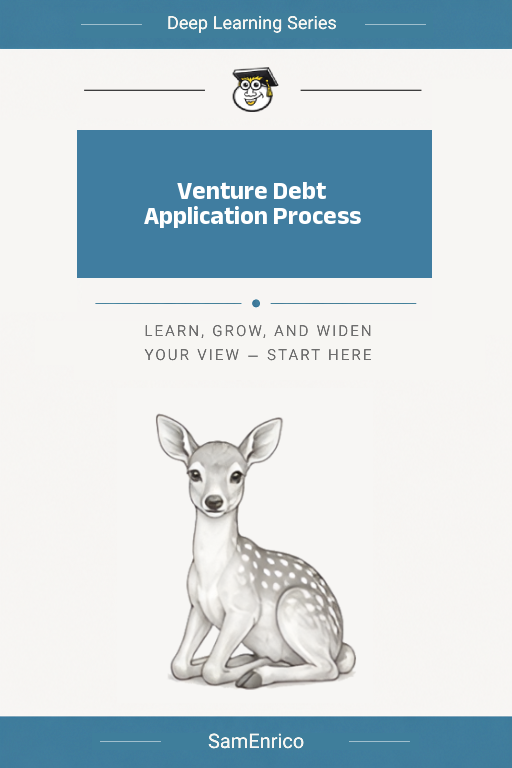 Venture Debt Application ProcessJean Kylie$12.99
 Letting Go of School ShameJean Kylie$11.99
 Self Esteem for Micromanaged RolesJean Kylie$11.99
 Meaningful Connection GuideJean Kylie$11.99
 The Bus Driver MentorJean Kylie$11.99
 LinkedIn Professional BalanceJean Kylie$11.99
 Free Cash Flow Analysis GuideJean Kylie$11.99
 Growth Mindset for ScientistsJean Kylie$11.99
 Forensic Autopsy Reports ReviewedJean Kylie$11.99
 The Digital Phoenix: How the Internet Archive Saved the World's LibrariesJean Kylie$11.99
 The Blood of the Fujiwara: The Battle of Uji That Shattered the HeikeJean Kylie$11.99
 Service Providers Guide to Clock RepairJean Kylie$11.99