
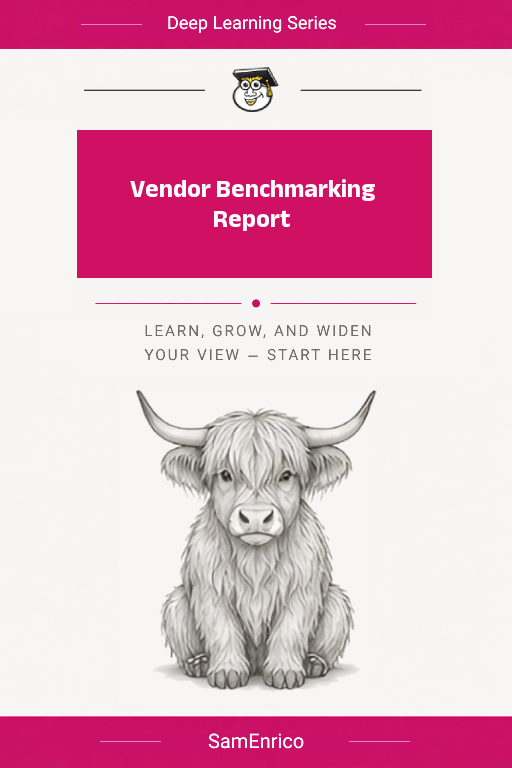
Non-FictionProfessional's Cheat SheetBenchmarking
Vendor Benchmarking Report eBook
Compare multiple vendors on price, quality, delive
Compare multiple vendors on price, quality, delivery, and service using a comparison matrix.
Formats
Free sample
Chapter 1: The Vendor Trap--–- Every procurement professional has a story. Not the kind you tell at conferences over coffee—the kind you replay at 2 a.m. when you cannot sleep. The vendor who seemed perfect on paper. The sales rep who promised the world.
The reference calls that glowed with enthusiasm. And then... the shipments arrived late. The quality failed inspection. The service desk stopped answering emails.
And somewhere in the accounting system, invisible costs accumulated like interest on a loan you never knew you took out.This book exists because that story is not a failure of character. It is not a failure of effort. It is a failure of process. And process can be fixed.Let me tell you about a mid-sized manufacturer we will call Apex Components. Apex made precision parts for industrial equipment.
Their existing supplier, Reliable Metals, had served them for seven years. Prices were fair. Quality was acceptable. Delivery was... usually on time.
Then a new vendor, Premium Alloys, entered the picture. Their sales team was aggressive. Their presentation was polished. Their price was 12 percent lower. The procurement manager, under pressure to cut costs, ran a quick comparison.
Premium Alloys was cheaper. The decision seemed obvious.Eighteen months later, Apex Components had lost $470,000.Not because Premium Alloys was dishonest. Not because the procurement manager was incompetent. Because the comparison was built on a flawed foundation: unit price alone. The true costs emerged slowly.
First, the shipping terms were different—Premium Alloys delivered ex-works, meaning Apex paid freight. Then came the defect rate: 4.2 percent versus Reliable Metals' 0.8 percent. Each defective part required rework labor, replacement materials, and production line downtime. Then the delivery slippage: Premium Alloys delivered on time only 86 percent of the time, compared to 97 percent for the incumbent. Each late shipment triggered expedited air freight, overtime for catch-up shifts, and customer penalty fees.
Finally, the service gap: when problems arose, Premium Alloys took an average of 48 hours to respond, versus 6 hours from the previous vendor.The procurement manager had compared price. The company paid for everything else.This chapter is about understanding why that happens, how to stop it from happening to you, and when to walk away from a benchmarking exercise entirely. Because the dirty secret of vendor selection is this: most organizations are not bad at picking vendors. They are bad at knowing what they are actually comparing.The Anatomy of a Bad Decision Let me define what I mean by a "bad" vendor decision. It is not a decision that simply fails.
Any process can fail. A bad decision is one that fails in ways that were predictable, preventable, and hidden by the decision-making process itself.In my research across more than two hundred procurement organizations, I have identified six recurring patterns of vendor selection failure. I call these the Vendor Failure Modes. Read through them honestly. You will recognize at least three.Failure Mode One: The Lowest Bidder Mirage This is the most common failure.
An organization selects the vendor with the lowest unit price, only to discover that shipping, handling, customs duties, administrative processing, rework, and late-delivery penalties more than erase the savings. The mirage is seductive because unit price is easy to compare. Total cost is not.A chemical company I advised selected a raw material supplier with a 15 percent lower unit price. The supplier was located overseas. Within six months, the company had incurred 340,000inunplannedfreightcosts,340,000 in unplanned freight costs, 340,000inunplannedfreightcosts,180,000 in customs brokerage fees, and $95,000 in production downtime from inconsistent delivery schedules.
The 15 percent unit price reduction became a 9 percent total cost increase. The procurement team had compared the number they could see. They ignored the numbers they could not.Failure Mode Two: The Familiar Face Fallacy Organizations tend to renew contracts with existing vendors not because those vendors are excellent, but because the cost of searching for alternatives feels high. This is not loyalty. It is inertia disguised as risk aversion.A logistics company had used the same fleet maintenance vendor for eleven years.
The relationship was comfortable. The account manager knew everyone's name. Then a new procurement director ran a simple market check. Three other vendors offered the same services at 22 to 31 percent lower prices, with identical or better service level agreements. The incumbent had been quietly raising prices by 4 to 6 percent annually, assuming no one would notice.
No one had.The fallacy is not about trust. It is about the absence of competition. When you stop benchmarking, your vendors stop competing for your business. And when they stop competing, you start overpaying.Failure Mode Three: The Reference Call Charade Reference calls are almost worthless in their conventional form. Vendors provide references they know will say positive things.
Procurement professionals ask soft questions. References, wanting to maintain good relationships with vendors they may need again, answer vaguely. Everyone performs their role. No one learns anything useful.A software company once showed me their reference call notes for a prospective IT services vendor. Every reference said the vendor was "responsive," "professional," and "delivered as promised." Six months after signing the contract, the same vendor was missing every deadline, ignoring emails for days, and blaming the client for unclear requirements.
When I asked the procurement manager what she would ask differently next time, she paused. "I don't know," she said. "I thought I was asking the right questions."She was asking the right questions to the wrong people. The references the vendor provided were its best customers. The customers who had fired the vendor—those references were never offered.Failure Mode Four: The Weighting Illusion Many organizations use weighted scorecards to compare vendors.
Quality 30 percent. Price 30 percent. Delivery 25 percent. Service 15 percent. These numbers feel scientific.
They are almost always arbitrary.A hospital system I worked with had a formal vendor selection process with published weightings. When I asked the procurement director how they decided that quality should be 30 percent and not 40 percent, she said, "That's what we've always used." When I asked the head of nursing, whose department would use the vendors daily, what weighting she would assign to service, she said, "At least 40 percent. Maybe 50." The procurement director and the end user had never discussed this. The weightings were someone's best guess, frozen into policy, and never challenged.Arbitrary weightings produce arbitrary results. And arbitrary results cost money.Failure Mode Five: The Single-Threaded Scorekeeper In most organizations, one person—usually in procurement—scores all vendors on all criteria.
This person is diligent. They read proposals. They check references. They build spreadsheets. But they are not the end user.
They do not operate the vendor's product. They do not depend on the vendor's delivery. They do not feel the pain of poor service.A manufacturing company once selected a maintenance contractor based on a procurement-led scorecard. The procurement team gave the contractor high marks for price and compliance. The maintenance team, who had not been asked for input, knew the contractor was understaffed and undertrained.
Within three months, the contractor had caused two production stoppages. The procurement team's scorecard had not predicted either.When the people who will live with the vendor every day are excluded from the selection process, the selection process becomes disconnected from…
This is the end of the free sample. Get the eBook to keep going. Buy now
About this book
Details
- Author
- Schaefer Daysi
- Publisher
- SamEnrico
- Language
- English
- Genre
- Non-Fiction, Professional's Cheat Sheet, Benchmarking
- Released
- 2026-05-30
- Pages (approx.)
- 139
- Available as
- eBook, Audiobook

Read better in the ZLOADR app
Your eBooks on your phone or tablet. Sign in with your SamEnrico account and start reading.
More by Schaefer Daysi
 Women Resilience GuideSchaefer Daysi$11.99
 Ranger Station MysteriesSchaefer Daysi$11.99
 Lake Stillness MeditationSchaefer Daysi$11.99
 Conversation Starters for DatesSchaefer Daysi$11.99
 Mass Shooting BereavementSchaefer Daysi$11.99
 Buspar Buspirone GuideSchaefer Daysi$11.99
 Generational Anger HealingSchaefer Daysi$11.99
 Energy Efficient Commercial Buildings Tax GuideSchaefer Daysi$11.99
 The Crown’s Last Whisper: How a Secret 1953 Broadcast Changed the Monarchy ForeverSchaefer Daysi$11.99
 The Birth of the Australian Soap Opera: 'Robbery Under the Clocks' and the Birth of a National Obsession (1890s)Schaefer Daysi$11.99
 How to Produce System and Power CablesSchaefer Daysi$11.99
 How to Produce Heat DetectorsSchaefer Daysi$11.99
You may also like
 Hong Kong Handover 1997Dunn Johnnie$11.99
 Zumba For Postnatal Recovery CourseNeal Christian$11.99
 Zumba for BeginnersLadner Nikia$11.99
 YouTube Comment Mining GuideHumes Pandora$12.99
 Worry Box MeditationCarlin Rudy$11.99
 Workplace Stress MeditationNguyen Lynn$11.99
 Workplace Stress and Sleep RepairHawley Ivory$11.99
 Workplace Perfectionism CureDelaney Jeffry$11.99
 Workplace Injustice Anger GuideWallen Isabelle$11.99
 Work Addiction and Burnout LinkGreenwood Ester$11.99
 Women in Yoga and WellnessBeattie Galina$11.99
 Women in Stand Up ComedyChun Evangeline$11.99