
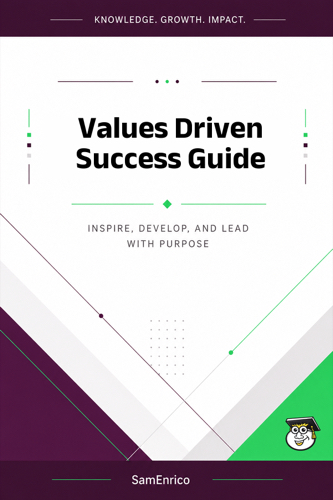
Values Driven Success Guide eBook
Make career decisions aligned with your core value
by Piper Arla
Make career decisions aligned with your core values to prevent existential burnout.
Formats
Free sample
Chapter 1: The Empty Promotion--–- Rachel had waited three years for this moment. The senior vice president shook her hand in front of the entire department, announced her promotion to Director of Strategic Initiatives, and presented her with a bonus that exceeded her annual salary from five years ago. She smiled. She said all the right things. She thanked her team, her mentors, and the company for believing in her.
And then she walked to her car, sat in the driver's seat, and cried for twenty minutes before she could drive home.Not tears of joy. Not the overwhelmed relief of someone who had finally arrived. Something else entirely. A hollow, confusing, almost embarrassing emptiness that she could not name and did not want to admit to anyone, least of all herself. She had everything she had been told to want.
So why did she feel like she had just lost something?This is not a story about Rachel. This is a story about you. Or someone you know. Or the version of yourself that you hide from your colleagues and your family and your Linked In network. Because Rachel's experience is not unusual.
It is not a personal failing. It is not depression, though it can look like it. It is a specific, increasingly common condition that this book will name, explain, and give you the tools to escape.It is called existential burnout.The Success Hangover Let us distinguish right now between two things that feel similar but are fundamentally different. Ordinary exhaustion is when you work too hard, sleep too little, and recover over a long weekend. Existential burnout is when you work hard on things you do not ultimately care about, achieve exactly what you were supposed to achieve, and feel nothing—or worse, feel less than nothing.
You can sleep eight hours, exercise daily, eat organic food, take vacations, and still feel depleted. Because the problem is not the quantity of your effort. The problem is the relationship between your effort and your sense of self.I call this the Success Hangover. It is the 24/7 low-grade nausea of achieving what you were supposed to want, only to realize it does not feel like anything. You are not depressed in the clinical sense, though you may be heading there.
You are not lazy—you work harder than almost everyone you know. You are hungover on a version of success that was never yours, built from borrowed blueprints, chased because everyone around you seemed to be chasing the same thing.The data on this phenomenon is stark and growing. A 2022 study from the American Psychological Association found that among high-achieving professionals—defined as those in the top quartile of income and educational attainment—rates of emotional exhaustion increased 47 percent between 2019 and 2022, even as reported work hours remained stable. Something shifted. And what shifted was not the amount of work.
What shifted was the meaning of the work.High achievers are not burning out because they work too hard. They are burning out because they have become expert climbers of ladders that are leaning against the wrong walls.The Values-Success Gap Let me introduce a framework that will run through every chapter of this book. I call it the Values-Success Gap. It is the distance between what society rewards (salary, title, prestige, approval, external validation) and what your nervous system actually needs (autonomy, belonging, mastery, purpose, congruence with your core beliefs).When that gap is small, you feel energized. When it is large, you feel depleted.
When it becomes chronic, you experience existential burnout.Here is what makes this gap so dangerous for high achievers. You have spent years, probably decades, getting very good at closing the distance between your efforts and external rewards. You know how to get the promotion. You know how to impress the right people. You know how to build a resume that opens doors.
But no one ever taught you how to ask the more important question: Am I climbing the right mountain in the first place?In fact, the very skills that make you successful in your career—goal orientation, persistence, the ability to delay gratification, the capacity to tolerate discomfort for future gain—can become the engines of your burnout. You are so good at pursuing what you are told to want that you have never stopped to ask whether you actually want it.Consider a simple experiment I have run with hundreds of coaching clients. I ask them to write down their three biggest career achievements from the past five years. Then I ask them to rate, on a scale of one to ten, how much personal meaning each achievement held for them at the moment they achieved it. The average rating is usually between six and seven.
Then I ask them to rate how much meaning they thought they would feel before they achieved it. The average there is between nine and ten.The gap between expected meaning and experienced meaning is the Success Hangover in numerical form.Default Success Versus Values-Driven Success To understand how to escape this trap, we need two definitions that will serve as the north star for everything that follows.Default Success is achievement at the cost of the self. It looks like the corner office, the six-figure bonus, the impressive title, the envy of your peers. It feels like running a race you never chose, on a track you never built, toward a finish line someone else drew. You cross that line and look around, expecting fireworks, and instead you find only the quiet hum of the next race already beginning.Default Success is not evil.
It is not even wrong, necessarily. It is simply borrowed. You adopted it from parents, from school, from media, from the unconscious consensus of your industry. And because you did not choose it, it cannot fulfill you.Values-Driven Success is feeling genuinely fulfilled while achieving. Not after.
Not someday when you finally arrive. During. The process itself aligns with your core beliefs. The daily work feels like an expression of who you are, not a transaction that erodes who you are.Notice the emphasis on the present tense. Values-Driven Success is not a destination.
It is a way of moving through the world. It is the difference between climbing a mountain because you love the feeling of your muscles working and the views unfolding versus climbing because someone told you the top is the only place that matters.In Values-Driven Success, the promotion is nice. The bonus is helpful. The title opens doors. But none of those things are the point.
The point is that Monday morning does not fill you with dread. The point is that you do not need a vacation from your entire life. The point is that you can be proud of how you work, not just what you achieve.The Four Layers of Burnout Before we go further, I need to clarify something important. Burnout is not one thing. Throughout this book, we will identify multiple causes of existential burnout.
They are not competing theories. They are layers of the same problem, each requiring a different solution.Layer 1: Values Misalignment. This is…
This is the end of the free sample. Get the eBook to keep going. Buy now
About this book
Details
- Author
- Piper Arla
- Publisher
- SamEnrico
- Language
- English
- Genre
- Non-Fiction, Self-Help, Values Alignment
- Released
- 2026-06-08
- Pages (approx.)
- 130
- Available as
- eBook, Audiobook

Read better in the ZLOADR app
Your eBooks on your phone or tablet. Sign in with your SamEnrico account and start reading.
More by Piper Arla
 Career Transition Affirmation GuidePiper Arla$11.99
 Study Group Collaboration GuidePiper Arla$11.99
 DoorDash Cash Order HandlingPiper Arla$11.99
 Depression Biopsychosocial ModelPiper Arla$11.99
 Spitfire Pilot MemoirPiper Arla$11.99
 Citation Rules Reference Management SoftwarePiper Arla$11.99
 Panzer Tactics Against Soviet ArmorPiper Arla$11.99
 Resentment And InjusticePiper Arla$11.99
 The Verdict of the SphinxPiper Arla$11.99
 The Last Flight of the Icebreaker: A Race Against Time in AntarcticaPiper Arla$11.99
 The Healing Hands of Ankh: Egypt's Forgotten Medical PioneersPiper Arla$11.99
 Understanding Aplasia Cutis MyopiaPiper Arla$17.99