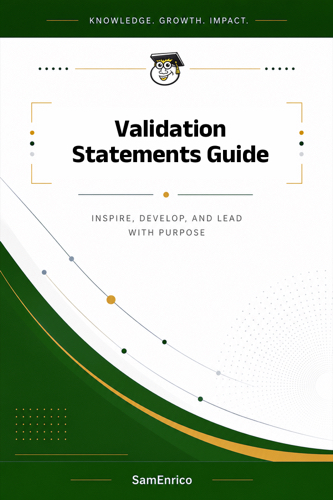
Validation Statements Guide eBook
Provides ready-to-use phrases to acknowledge other
by Parish Tad
Provides ready-to-use phrases to acknowledge others' emotions.
Formats
Free sample
Chapter 1: The 12-Second Rule--–- Imagine you are in an argument. Not a loud one, necessarily—maybe just the kind where the air gets thick and the words come out sharper than you intended. Your partner, your child, your colleague, or your friend has just said something that makes your chest tighten. You have two choices. You can prepare your defense, gather your evidence, rehearse your counterpoint, and wait for the first crack in their sentence to jump in.
Or you can do something else entirely. Something that feels, at first, like doing nothing. You can stop. You can breathe. You can listen.
And then, instead of fixing, instead of explaining, instead of defending, you can say six words: “It makes sense that you feel that way.”That moment of pause, that small shift from reacting to receiving, is the most powerful move in any conversation. And it takes about twelve seconds.This chapter is called “The 12-Second Rule” because that is the approximate amount of time required to shift a conversation from conflict to connection. Twelve seconds of focused, non-reactive, present listening—followed by a single sentence of validation—can lower the other person’s stress hormones, calm your own nervous system, and open a door that was just about to slam shut. Twelve seconds. That is less time than it takes to wait for a traffic light to change, less time than it takes to microwave a cup of coffee, less time than it takes to scroll past three videos on your phone.
And yet, in the economy of human connection, twelve seconds is a fortune.But here is the problem. Most of us have been trained, by culture and by habit, to do the exact opposite. When someone is upset, we try to fix them. When someone is angry, we try to calm them down. When someone is scared, we try to reassure them that everything will be okay.
When someone is grieving, we try to find the silver lining. These are not malicious responses. They are almost always offered with love, with concern, with genuine care. But they are almost always wrong. Not morally wrong—strategically wrong.
They fail because they skip the one step that cannot be skipped: acknowledgment.Validation is not agreement. Validation is not problem-solving. Validation is not cheerleading. Validation is the act of showing someone that their emotional experience is understandable. That is all.
And that is everything.The Neuroscience of Being Heard To understand why validation works, you have to understand what happens inside the human brain when a person feels dismissed versus when they feel heard. This is not abstract psychology. This is biology.When a person experiences invalidation—when they share something vulnerable and receive in return a dismissal, a solution, a silver lining, or a subject change—their brain activates a network associated with physical pain. The anterior cingulate cortex and the insula, two regions that light up when you stub your toe or burn your hand, also light up when you feel unheard. Social rejection and physical pain share neurological real estate.
This is why being dismissed feels like being punched.At the same time, the brain releases cortisol, the primary stress hormone. Cortisol narrows attention, heightens threat detection, and prepares the body for fight, flight, or freeze. In a state of high cortisol, a person cannot think creatively, cannot problem-solve effectively, and cannot hear nuanced arguments. They can only react. This is why arguments escalate.
It is not because people are stubborn or irrational. It is because their biology has been hijacked.Now consider what happens during validation. When a person receives a genuine acknowledgment of their emotional experience—when someone says, “It makes sense that you feel that way” or “I can see why you’re hurting”—their brain releases oxytocin. Oxytocin is often called the “bonding hormone,” but it is more accurately described as the “safety hormone.” It lowers cortisol, reduces activity in the amygdala (the brain’s fear center), and activates the parasympathetic nervous system—the “rest and digest” state that allows for calm, clear, connected thinking.This is not subtle. This is a biological shift that happens in seconds.
And it happens reliably. Research consistently shows that even brief moments of validation—as short as twelve seconds—can measurably reduce physiological markers of stress. The person who felt attacked begins to feel seen. The person who was preparing to fight begins to breathe. The conversation that was about to become a war becomes, instead, a conversation.The 12-Second Rule is not a gimmick.
It is a neurological fact. You have the power to change someone’s brain chemistry with a handful of words and a few seconds of presence.Emotions as Data, Not Emergencies Before you can validate someone else’s emotions, you have to understand what emotions actually are. And most of us have been taught a fundamentally unhelpful model.The dominant cultural model of emotion goes something like this: Emotions are reactions to events. Some emotions are good (happiness, excitement, pride). Some emotions are bad (anger, sadness, fear, grief).
When you feel a bad emotion, you should try to replace it with a good emotion. If you cannot, there is something wrong with you. And if someone else is feeling a bad emotion, your job is to help them replace it with a good one.This model is wrong. It is not just slightly inaccurate—it is backwards.Emotions are not reactions. They are information.
They are data points that tell you something about your relationship to your environment, your needs, your values, and your boundaries. Fear tells you that you perceive a threat. Anger tells you that a boundary has been crossed. Sadness tells you that you have lost something you value. Grief tells you that you loved something or someone deeply.
These are not problems to be solved. They are signals to be understood.The APA research on emotions as information makes this clear: emotions are like mail. You do not throw mail away without opening it. You do not respond to a letter without reading it first. You certainly do not try to replace a bill with a birthday card and pretend the bill never arrived.
You open the envelope, you read the contents, and then you decide what to do. Emotions work the same way. You cannot skip the opening-and-reading step. That is validation. Validation is opening the envelope.This reframe is crucial because it changes what validation asks of you.
You are not being asked to agree with someone’s interpretation of events. You are not being asked to endorse their behavior. You are not being asked to feel what they feel. You are being asked to acknowledge that the data they are receiving—their emotion—is real and worth opening.When someone says, “I am so angry at my boss,” you do not need to agree that the boss is terrible. You do not need to help them craft a resignation letter.
You do not need to tell them to calm down. You just need to open the envelope: “It makes sense that you feel angry. Tell me more.”That is it. That is validation.The…
This is the end of the free sample. Get the eBook to keep going. Buy now
About this book
Details
- Author
- Parish Tad
- Publisher
- SamEnrico
- Language
- English
- Genre
- Non-Fiction, Self-Help / Scripts
- Released
- 2026-06-07
- Pages (approx.)
- 152
- Available as
- eBook, Audiobook

Read better in the ZLOADR app
Your eBooks on your phone or tablet. Sign in with your SamEnrico account and start reading.
More by Parish Tad
 Patient Rights During DetoxParish Tad$11.99
 ABCDE Method WorkbookParish Tad$11.99
 Blue Zone Nuts And Seeds GuideParish Tad$11.99
 Parent Social Life SaverParish Tad$11.99
 Remote Team Collaboration ToolsParish Tad$11.99
 Anger Restructuring For FamiliesParish Tad$11.99
 Virtual Team Time ManagementParish Tad$11.99
 The Carbonari Conspiracy: The Assassination That Shaped a NationParish Tad$11.99
 Silent Code: The Enigma of the Zodiac Killer's Corporate Cover-UpParish Tad$11.99
 How to Produce I/o Cards and AdaptersParish Tad$11.99
 A Collector's Handbook to the Healey 2.4-litre Tickford SaloonParish Tad$11.99
 US Company Registration GuideParish Tad$12.99