
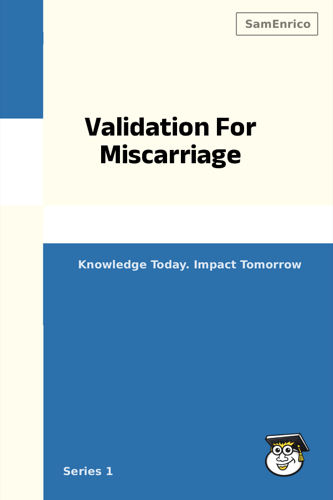
Validation For Miscarriage eBook
Acknowledge pregnancy loss grief without minimizin
by Cade Jenise
Acknowledge pregnancy loss grief without minimizing or platitudes.
Formats
Free sample
Chapter 1: What They Took From You--The first thing they take from you is not the baby. The baby is already gone, though you may not know it yet. The first thing they take is the language. They strip away the words that would make your loss real and replace them with clinical euphemisms, polite evasions, and empty phrases designed to do one thing: make everyone else more comfortable. They say "miscarriage" as if you simply carried wrong.
They say "products of conception" as if your baby was industrial waste. They say "spontaneous abortion" as if your body made a choice. They say "there's no fetal cardiac activity" as if those seven syllables could possibly contain the truth that your child has died. They say everything except the four words you need to hear: your baby died. And in that refusal, they take something almost as precious as the life you lost.
They take your right to grieve.This chapter is about that theft. It is about the war on language that happens in every miscarriage, the systematic erasure of your baby's existence by a culture that does not know how to hold grief. It is about the difference between what happened and what people will allow you to say happened. And it is about how to take back the words that were stolen from you, one syllable at a time, even if you are the only one who ever hears them.Let us begin with the word you have probably already heard a hundred times since your loss. Miscarriage.
The prefix "mis" means wrong, bad, or ill. To miscarry is to carry badly. The word itself implies fault. It whispers that if you had done something differently—rested more, eaten better, been less stressed, known earlier, tried harder—the pregnancy would have continued. This is not an accident of etymology.
Language carries ideology the way a river carries silt. Every time someone says "miscarriage," they are depositing a thin layer of blame onto your already wounded heart. They do not mean to. They are using the only word they have. But the word is a wound, and every repetition deepens it.The alternative words are no better.
"Pregnancy loss" is clinical and cold, the kind of phrase an insurance adjuster might use to deny a claim. "Spontaneous abortion" is a medical term that sounds like a choice, or a crime, or both—and it shares its root with a word that has been weaponized against women's bodies for generations. "Stillbirth" is reserved for losses after twenty weeks, as if grief has a cutoff date, as if a baby who dies at nineteen weeks and six days is somehow less real than a baby who dies one day later. And "miscarriage"—the word everyone uses—has been worn smooth by overuse, rendered meaningless by frequency. One in four pregnancies end in miscarriage, the statistics say, as if common grief is less painful than rare grief.
As if knowing that millions of other people have also lost their babies should somehow make your loss smaller.But you know the truth. What happened to you was not common. It was unique. It was your baby. Your pregnancy.
Your body. Your future. The fact that you share this experience with millions of other people does not divide your grief into manageable pieces. It only means that millions of other people are also walking around with a hole in their chest where their child used to be. That is not comfort.
That is indictment. It means the culture has failed on a massive scale.The Silence That Says Everything If everyday language minimizes miscarriage, the silence that follows it annihilates. After the words "I'm sorry" and the awkward pat on the arm and the hurried change of subject, there is nothing. Friends stop calling. Family members stop mentioning the baby.
The pregnancy is erased from the family narrative as if it never happened. No one asks how you are doing, because they are afraid of the answer. No one says your baby's name, because they do not know it, because you were not far enough along to have picked one, because you picked one but no one asked, because you picked one but now it feels like a secret you are not allowed to tell.This silence is not neutral. It is an active force. It communicates, in no uncertain terms, that your loss is not to be discussed.
That your grief is an inconvenience. That your baby was not real enough to mourn in public. That the appropriate response is to move on, to try again, to produce a living child who will make everyone feel better about the one who died. The silence says: we will only acknowledge your motherhood if it results in a baby we can hold. Otherwise, you are not a mother.
You are just a woman who had a medical event.One woman, quoted in the book I Never Held You, described being told "there was never a baby 'seen'" as one of the most wounding things she heard. The word "seen" is the knife. It suggests that if the baby was not visible on an ultrasound—if the pregnancy was too early, if the equipment was not sensitive enough, if the technician did not look carefully—then the baby did not exist. It suggests that your experience of pregnancy, your symptoms, your hopes, your dreams, your love for a child you had not yet met—none of it counts unless it can be captured on a grainy black-and-white image. This is not medicine.
This is erasure. And it happens every day, in every hospital, to every person who miscarries before their first ultrasound appointment.The Clinical Language That Cuts Deeper Than Any Scalpel In hospitals and clinics, the erasure becomes systematic. Your baby becomes "products of conception" or "POC" for short. Your uterus becomes "the gestational sac" or "the intrauterine contents." What you experience becomes "a missed abortion" if the pregnancy ended but your body hasn't realized it yet, or "an incomplete abortion" if some tissue remains. These are the terms that appear on your charts, on your bills, on your discharge papers.
These are the words that follow you home.Doctors are not monsters. They use these terms for reasons that make sense within their world. They are trained to be objective. They are taught to distance themselves from the emotional weight of their work, to use clinical terminology that allows them to function without being destroyed by the accumulation of grief. A doctor who wept at every miscarriage would not be able to practice medicine for very long.
The emotional toll would be unbearable, and the next patient would suffer for it.But understanding why doctors use these words does not make them hurt less when they are used on you. When a physician says "products of conception," what you hear is "your baby was not a baby." When a nurse says "spontaneous abortion," what you hear is "you failed at pregnancy." When a technician says "there's no fetal cardiac activity," what you hear is "your child is dead, and I can't even say that word." The…
This is the end of the free sample. Get the eBook to keep going. Buy now
About this book
Details
- Author
- Cade Jenise
- Publisher
- SamEnrico
- Language
- English
- Genre
- Non-Fiction, Self-Help, Miscarriage
- Released
- 2026-06-12
- Pages (approx.)
- 128
- Available as
- eBook, Audiobook

Read better in the ZLOADR app
Your eBooks on your phone or tablet. Sign in with your SamEnrico account and start reading.
More by Cade Jenise
 The Parent Anger Therapy GuideCade Jenise$11.99
 ED Research ReviewCade Jenise$11.99
 Ten Homes Before GraduationCade Jenise$11.99
 The Unchanging Signature GuideCade Jenise$11.99
 The Breeder's Guide to Orpington DucksCade Jenise$11.99
 PR for Green StartupsCade Jenise$12.99
 Minority Firm Federal ProcurementCade Jenise$12.99
 Millwright ApprenticeCade Jenise$11.99
 10 Ways to Use Fortified Wine (Recipe Book)Cade Jenise$11.99
You may also like
 Parenting After MiscarriageBond Thanh$11.99
 Parent Miscarriage Self Care GuideGriffiths France$11.99
 Miscarriage Prolonged GriefSaylor Patrick$11.99
 Miscarriage Grief Recovery GuideGillis Augusta$11.99
 Miscarriage Complicated GriefRosado Leonardo$11.99
 Breath Awareness For Pregnancy LossMclaurin Elvera$11.99
 Child Miscarriage Grief GuideRosario Dollie$11.99
 Miscarriage Dream WorkBronson Ethan$11.99
 DBT For Pregnancy LossSchulze Lang$11.99
 Anger After Partner's MiscarriageLindgren Manie$11.99
 Pregnancy Loss ResentmentCherry Jacquelynn$11.99
 Miscarriage Recurrent LossBurdick Sherrie$11.99