
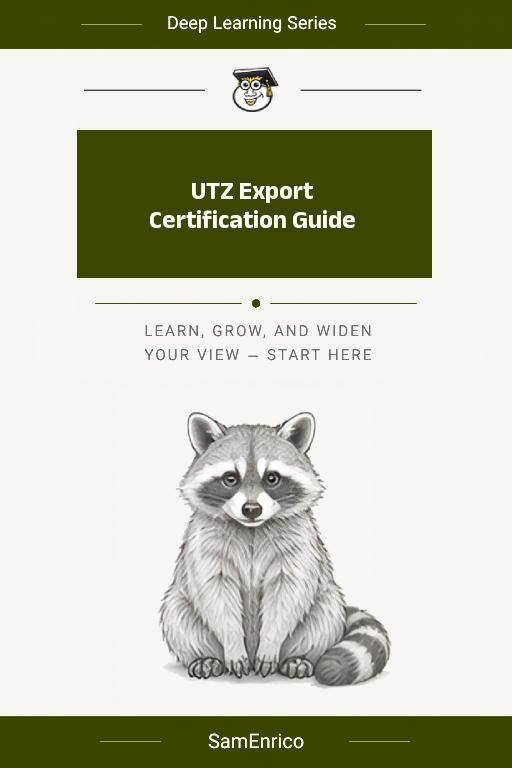
UTZ Export Certification Guide eBook
UTZ certification for coffee, cocoa, and tea susta
UTZ certification for coffee, cocoa, and tea sustainable exports (now part of Rainforest Alliance).
Formats
Free sample
Chapter 1: The $48,000 Mistake--–- The phone rang at 3:47 AM on a Tuesday. Ahmed, the export manager for a mid-sized Kenyan coffee cooperative, answered to the voice of his Dutch buyer. "The container is rejected," the buyer said. "Your UTZ certificate expired yesterday. We cannot accept the shipment as certified."The container was already at sea, steaming toward Rotterdam.
Inside were 20 metric tons of premium Arabica—beans that had been hand-sorted, sun-dried on raised beds, and packed with the care of farmers who had invested three years in UTZ certification. The cooperative had done everything right. They had passed their farm audit. They had maintained their Code of Conduct. They had kept detailed records of every bag.But Ahmed had missed one detail: the Chain of Custody certificate for the cooperative's export entity had expired at midnight.
Not the farm certificate—that was still valid. The export certificate. The one that allowed them to call themselves certified when they sold to international buyers.The buyer offered a choice: sell the coffee as conventional at a 40% discount, or let it sit in Rotterdam while Ahmed scrambled to renew the certificate. Renewal, even if rushed, would take ten days. Port storage would eat $200 per day.
By the time the certificate arrived, the coffee would have cost more to store than it was worth.Ahmed took the 40% loss. The cooperative lost $48,000 on a single shipment. Three farmers who had been counting on their premium payments could not afford school fees for their children that term. One farmer sold his dairy cow.This is not a story about fraud, corruption, or malice. It is a story about a single administrative failure—a missed renewal date—in a certification system that has no margin for error.
And it is the reason this book exists.The Lie You Have Been Told About Certification The global market for certified sustainable coffee, cocoa, and tea is worth approximately $50 billion annually. Major roasters like Nestlé, JDE Peet's, and Starbucks have committed to 100% sustainable sourcing. Consumers pay premiums of 10-30% for products bearing certification labels. Governments, including the European Union, are writing certification requirements into trade law.And yet, most exporters fail their first audit. Most lose money on certification for the first two years.
Most do not understand the difference between the certificate their farmer holds and the certificate they need to hold themselves.The certification industry has done a masterful job of marketing its benefits to consumers. It has done a terrible job of educating the supply chain. The result is a system where millions of dollars in premiums never reach the farmers who earned them, where certified product is sold as conventional because of paperwork errors, and where small and medium exporters are slowly squeezed out by multinationals with dedicated compliance departments.This book is not a defense of the UTZ certification system, nor is it an attack. It is a map of a minefield. UTZ, now folded into the Rainforest Alliance, created the template for modern sustainable supply chains.
Its Chain of Custody standards—the rules for tracking certified product from farm to buyer—are still the operating system beneath most ethical trade today. If you understand how UTZ worked, you understand how Rainforest Alliance works, how Fairtrade works, and increasingly, how EU trade regulations work.But understanding is not enough. You need to survive.Who This Book Is For (And Who It Is Not For)This book is written for three distinct types of operators. Identifying your type is not optional—it is the difference between reading 200 pages that apply to you and reading 400 pages of confusion.Type A: The Pure Trader. You buy certified product from farms, cooperatives, or other traders.
You do not own farms. You do not own processing facilities. You rent warehouse space, hire truckers, and subcontract everything except the contract itself. Your risk is administrative: keeping certificates current, matching paperwork to shipments, and avoiding over-claims. You should read Chapters 2, 4-6, 9, 10, 11, and 12.
Chapters 7 and 8 are optional context unless you verify mill or farm records.Type B: The Vertically Integrated Mill Owner. You own or operate wet mills, dry mills, hulling facilities, or processing equipment. You may also trade. Your risk is physical: contamination, mixing, inadequate cleaning between lots, and facility audits. You should read every chapter, with special attention to Chapter 7 (coffee processing), Chapter 8 (cocoa/tea nuances), and Chapter 4's cleaning standards.Type C: The Producer Cooperative or Smallholder Group.
You represent farmers. You may also export. Your risk is dual: you must maintain both farm-level Code of Conduct and export-level Chain of Custody. You should read every chapter, with special attention to the smallholder group section in Chapter 8. You need to know why IMO is often your best choice for a Certification Body (Chapter 10).If you are not sure which type you are, stop now.
Go back to the Preface. Reread the descriptions. The distinction between these three types is the single most important concept in this book. The UTZ system treats them differently. Auditors treat them differently.
Your competitors treat them differently. Do not proceed until you know your type.Why UTZ? Why Now? (A Critical Note on Status)The UTZ program merged with the Rainforest Alliance in 2018. As of 2026, new UTZ certificates are no longer issued.
If you are seeking certification for the first time, you should apply directly to Rainforest Alliance 2020, not UTZ.However, Chapters 2-11 of this book remain valuable because the Rainforest Alliance's Chain of Custody standards are direct descendants of UTZ. Approximately 80% of the requirements are identical. The remaining 20% are stricter, particularly on deforestation and farmer premiums. Understanding UTZ gives you a running start on Rainforest Alliance.But if you are currently holding a UTZ certificate issued before 2021, or if you are in the middle of a transitional audit, you need the legacy UTZ knowledge in this book. Your buyers may still require UTZ-specific documentation.
Your Certification Body may still audit you against UTZ protocols. And the online traceability platform—the Good Inside Platform, or GIP—may still be the system you use to record transactions.The table below tells you, in plain terms, whether you should read Chapters 2-11 or skip to Chapter 12.If you are...Your status Action Holding an active UTZ certificate (issued before 2021)Valid until expiration date Read Chapters 2-11 for compliance; Chapter 12 for transition planning In a transitional audit (UTZ to RA)In process Read Chapters 2-11 for UTZ obligations; Chapter 12 for RA requirements Seeking new certification in 2026 or later No UTZ certificate Read Chapter 12 now, then return to Chapters 2-11 for background Buying from UTZ-certified suppliers but not certified No certificate required Read Chapters 2, 3, 9, and 10 to verify supplier compliance If you fall into the first or second row, read this chapter carefully. If you fall into the third row, skip to Chapter 12 and then use the cross-reference table in the Appendix to find relevant UTZ concepts. If you fall into the fourth row, you do not need certification yourself, but you need to know what to demand from your suppliers. You are in a position of power: you can require them to show you their certificates before you pay.
Do not skip Chapter 9.The Architecture of Sustainable Certification Before we dive into the mechanics of UTZ, you need to…
This is the end of the free sample. Get the eBook to keep going. Buy now
About this book
Details
- Author
- Barrows Marshall
- Publisher
- SamEnrico
- Language
- English
- Genre
- Non-Fiction, Business Brief, UTZ
- Released
- 2026-05-27
- Pages (approx.)
- 139
- Available as
- eBook, Audiobook

Read better in the ZLOADR app
Your eBooks on your phone or tablet. Sign in with your SamEnrico account and start reading.
More by Barrows Marshall
 Stress and Memory ImpairmentBarrows Marshall$11.99
 Persuasion for PilotsBarrows Marshall$11.99
 Postpartum Abdominal BindingBarrows Marshall$11.99
 Forgiveness Night MeditationBarrows Marshall$11.99
 Senior Self Esteem GuideBarrows Marshall$11.99
 First Job Loss RecoveryBarrows Marshall$11.99
 The Growth Mindset for CoachesBarrows Marshall$11.99
 Team Creativity for ChefsBarrows Marshall$11.99
 The 19th Amendment: A Century of Suffrage StrugglesBarrows Marshall$11.99
 Elephant Seals: Facts, Size, Breeding Battles & DivingBarrows Marshall$11.99
 How to Produce Paintball GunsBarrows Marshall$11.99
 How to Become a Barley SteeperBarrows Marshall$11.99
You may also like
 Hong Kong Handover 1997Dunn Johnnie$11.99
 Zumba For Postnatal Recovery CourseNeal Christian$11.99
 Zumba for BeginnersLadner Nikia$11.99
 YouTube Comment Mining GuideHumes Pandora$12.99
 Worry Box MeditationCarlin Rudy$11.99
 Workplace Stress MeditationNguyen Lynn$11.99
 Workplace Stress and Sleep RepairHawley Ivory$11.99
 Workplace Perfectionism CureDelaney Jeffry$11.99
 Workplace Injustice Anger GuideWallen Isabelle$11.99
 Work Addiction and Burnout LinkGreenwood Ester$11.99
 Women in Yoga and WellnessBeattie Galina$11.99
 Women in Stand Up ComedyChun Evangeline$11.99