
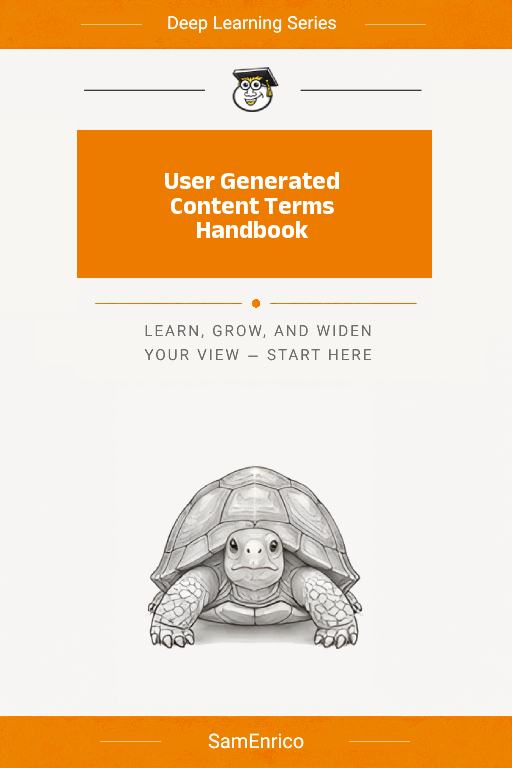
Non-FictionFirst 30 DaysContent Platforms
User Generated Content Terms Handbook eBook
Create Terms for platforms where users post conten
Create Terms for platforms where users post content. Cover ownership, moderation rights, and copyright infringement.
Formats
Free sample
Chapter 1: The Permission Revolution...–- The internet once operated like a broadcast television station: a small number of people created content, and the vast majority consumed it. That world ended sometime between the launch of You Tube in 2005 and the rise of Tik Tok in the 2020s. Today, the user is not merely a consumer but the primary engine of value, controversy, and legal risk. Every minute, users upload over 500 hours of video to You Tube, millions of images to Instagram, and countless posts on forums and platforms of every size. This shift from portals to platforms—from publishing to hosting—represents the single most important legal transformation in the history of digital media.Yet most platforms operate under terms of service that are either copied from competitors without understanding, drafted by lawyers who have never built a product, or written in such dense legalese that no user actually reads them.
The result is a ticking time bomb. A platform that fails to define "user content" properly may find itself liable for material it never knew existed. A platform that claims ownership of user content will lose its creators to competitors within weeks. A platform that ignores the Digital Millennium Copyright Act's safe harbor requirements can be sued into bankruptcy by a single determined copyright holder.This book exists because the rules of the user-generated content economy are not optional. They are the difference between a thriving community and a legal disaster.
And they begin with a single, seemingly simple question: what exactly is user-generated content?The Definition That Determines Everything Before any court can decide who owns what, who is liable for what, or who must remove what, the terms of service must establish what counts as "Content" and who counts as a "User." These definitions are not mere formalities. They are the foundation upon which every other clause rests. If the definition of Content is too narrow, the platform may inadvertently exclude material that later creates liability. If it is too broad, users may feel the platform is overreaching, claiming ownership of things they never intended to share.The most effective definitions of Content are both exhaustive and illustrative. They list specific categories while explicitly stating that the list is not exclusive.
A well-drafted definition includes "text, images, video, audio, code, metadata, comments, likes, shares, and any other material, information, or data that a User submits, posts, uploads, displays, or otherwise makes available through the Service." This formulation captures both obvious content (a photograph) and less obvious elements (the comment on that photograph, the metadata embedded in it, and the like that signifies engagement).But Content alone is insufficient. The definition must also address the temporal dimension: does Content include material that has been deleted? What about material that was never fully uploaded? The best practice is to define Content as including "submitted material, whether or not published, and material that has been removed or deleted, to the extent permitted by applicable law and subject to any data deletion requests under privacy regulations." This provision, which will become critical when we discuss privacy laws in Chapter 13, ensures that the platform retains the right to maintain backups and comply with legal process even after a user believes the material is gone.The User Distinction That Changes Liability Just as important as the definition of Content is the definition of "User." Most platforms assume a user is anyone who visits the website. That assumption is dangerously incomplete.
The terms must distinguish between registered users (who have created an account and affirmatively agreed to the terms via clickwrap, as discussed in Chapter 15) and unregistered visitors (who may only be bound by browsewrap, which is significantly less enforceable). This distinction affects everything from the ability to terminate accounts to the scope of the license granted to the platform.The draftsperson must also consider whether the definition of User includes automated systems. Bots, scrapers, and crawlers are not human users, but they may consume content, copy it, and repurpose it in ways that violate the platform's commercial interests. The terms should explicitly state that "User refers to natural persons only, and automated systems, bots, crawlers, scrapers, and other non-human actors are not permitted to access the Service except as expressly authorized in writing." However, as we will explore in Chapter 12's discussion of hi Q Labs v. Linked In, such contractual prohibitions are most effective when combined with technical controls like CAPTCHA, rate limiting, and login requirements.
A term without technical enforcement is merely a wish.Age is another critical dimension of the User definition. Platforms that knowingly collect information from children under 13 without parental consent violate the Children's Online Privacy Protection Act (COPPA) in the United States and similar laws abroad. The terms should therefore define "User" as "persons who are at least 13 years of age, or if between 13 and the age of majority in their jurisdiction, who have obtained parental consent to use the Service." For platforms operating in the European Union, the age threshold rises to 16 under the General Data Protection Regulation, unless individual member states have lowered it. Chapter 13 will address these privacy complexities in detail.Professionals Versus Amateurs: A Distinction Without a Difference?One of the most subtle but important distinctions in user-generated content law is the difference between professional creators and casual amateurs. On its face, the law draws no distinction: a user who posts a photograph taken with an expensive camera and a user who posts a blurry snapshot from a flip phone both own the copyright in their respective works.
In practice, however, the two categories of users behave differently, have different expectations, and create different levels of risk.Professional creators—artists, musicians, writers, and influencers who derive income from their content—are far more likely to read the terms of service, to assert their rights, and to litigate if they believe those rights have been violated. They are also more likely to post content that is valuable enough to attract infringement by others. A platform that accidentally claims ownership of a casual user's vacation photo may face a confused email. A platform that claims ownership of a professional photographer's portfolio may face a federal lawsuit.The terms of service should therefore acknowledge the existence of professional creators without creating separate, contradictory legal regimes. The preferred approach is to draft terms that are fair to all users but to include specific representations and warranties that are more burdensome for professional creators.
For example, the terms might require any user who posts content for commercial purposes to warrant that they have obtained model releases for any recognizable individuals depicted, a requirement that would be unreasonable to impose on a user posting a family photo.Conversely, the terms should recognize that casual amateurs generate the bulk of liability not because their content is more infringing, but because there is so much more of it. A platform with one million professional creators and one hundred million casual users will receive the vast majority of DMCA takedown notices from the casual users, who are more likely to repost memes, share copyrighted songs, and upload clips from movies without understanding the legal consequences. The terms must therefore provide the platform with…
This is the end of the free sample. Get the eBook to keep going. Buy now
About this book
Details
- Author
- Fisher Javier
- Publisher
- SamEnrico
- Language
- English
- Genre
- Non-Fiction, First 30 Days, Content Platforms
- Released
- 2026-05-28
- Pages (approx.)
- 155
- Available as
- eBook, Audiobook

Read better in the ZLOADR app
Your eBooks on your phone or tablet. Sign in with your SamEnrico account and start reading.
More by Fisher Javier
 The Tsung Dao Lee Parity ViolationFisher Javier$11.99
 PCOS Anti Inflammatory DietFisher Javier$11.99
 Fireplace Visualization Warmth GuideFisher Javier$11.99
 School Zone Patience GuideFisher Javier$11.99
 Low Motivation Work Stress FixFisher Javier$11.99
 The Golden Quill: Timbuktu's Scholarly Feast of KnowledgeFisher Javier$11.99
 Understanding Osteoglophonic DwarfismFisher Javier$17.99
 Support AssociateFisher Javier$11.99Support AssociateFisher Javier$11.99
 Business English for Chinese ProfessionalsFisher Javier$12.99
 How to Start a Choreographers - Independent BusinessFisher Javier$11.99
You may also like
 Hong Kong Handover 1997Dunn Johnnie$11.99
 Zumba For Postnatal Recovery CourseNeal Christian$11.99
 Zumba for BeginnersLadner Nikia$11.99
 YouTube Comment Mining GuideHumes Pandora$12.99
 Worry Box MeditationCarlin Rudy$11.99
 Workplace Stress MeditationNguyen Lynn$11.99
 Workplace Stress and Sleep RepairHawley Ivory$11.99
 Workplace Perfectionism CureDelaney Jeffry$11.99
 Workplace Injustice Anger GuideWallen Isabelle$11.99
 Work Addiction and Burnout LinkGreenwood Ester$11.99
 Women in Yoga and WellnessBeattie Galina$11.99
 Women in Stand Up ComedyChun Evangeline$11.99